
Listen to this podcast in the app for free: Download for free in the App Store
radio.net
Sleep timer
Save favourites
100 episodes
Bronze Age Reset: De- and Re-Mythologizing the Manosphere
10/08/2026 | 2h 5 mins.In a time of fracture, in which people are searching for meaning and belonging, it is no wonder that men are re-exploring what manhood means. Yet the sense-making project around manhood has veered from the mythic journey it rightly could and should be into decidedly different territory. The last several years have seen the rise of the alt-right manosphere, whose narratives journey into outright misogyny, eugenics racism, and advocated violence. To weave these stories, the manosphere reaches for everything from fascist philosophers to Nordic animism to Bronze Age mythology, spinning tales of heroes who shone in individualist glory in order to reinforce a vision of the true man as one who dominates and triumphs and to reclaim an ancient vitality that they say is sapped by everything from immigration to feminism. But the vitalist manosphere ultimately misunderstands its own mythologies. Those Bronze Age stories, more often than not, are not celebrations of heroism but stern warnings about overstep, invitations into humility, and reminders of relationality. So the manosphere misses the mythic point, which is that, in tradition after tradition, there is an understanding that vital energy must be tempered, and rogue men who seek only domination must be brought back into the relational web. Cultures across the world have understood that warrior energy is a real thing, and that it needs initiation and initiatory systems to temper it and transform it from an adolescent vision of domination to a mature vision of kinship and service. To transform this vital energy — this predilection towards intensity — requires more than just discourse that dismisses it entirely. Rather, it requires recognizing the longing that lives at the heart of it, just as it requires a commitment to community, to accountability, to eldership, to initiation, and to accompaniment — every burning step of the way. Featuring interviews with authors Tyson Yunkaporta, Jamie Wheal, and mythopoetic guide Ian McKenzie, and original music from Travis Puntarelli, Rainer Baumorr, and Victor Sakshin, this episode takes us on a journey through the blazing depths of the sour-belly-power in its darkest and most glorious expressions. Play it for your nephews and brothers and sons. And for those bros with enough attention span to make it to the last 30 minutes, there may just be a gift waiting.
Support the showSpace Hex! (The Curse of Restlessness, Revisited)
13/06/2026 | 1h“We don’t go to other planets because our planet is dying. Our planet dies, specifically because we perpetually want to go somewhere else.” Fresh off of the Initial Public Offering of Space X, the largest IPO in human history, it's worth revisiting the deeper implications of humanity's incessant drive... beyond. Today on the podcast, we look at humanity’s increasing obsession with transcending planet Earth, in the context of the mythologies of human restlessness. How human beings, whether through certain religious visions of transcendence or through the increasing transhuman and supernatural focus of modern science, are ultimately looking to be anywhere but right here, with ourselves, in nature. This misplaced spiritual drive, in which we perpetually seek wholeness out there when wholeness ultimately lives right here, has been the subject of some of our most central stories about ourselves. Many in fact, have seen it as… a primordial curse.
Support the showSeven
08/06/2026 | 43 mins.Seven years ago last Tuesday, The Emerald podcast was born. This episode reflects on the journey of the podcast so far and gives hints of what's to come, all through the prism of the number 7, which is — to say the least — a mythically important number. The myths often iterate in cycles and families of seven—seven swans, seven dwarves, seven ravens, and seven gates of the underworld. In many traditions, seven represents the completion of a cycle and the beginning of a new one. In Ayurveda, in order for something to be fully embodied, it must pass through seven dhatus, or tissue layers. In many traditions, initiates pass through a journey of seven stages. This recurring 'journey through seven' is not just arbitrary, it is a reflection of nature itself, which often repeats in cycles of seven. The ancients saw seven at play in the architecture of the cosmos, in the musical scales and the spectrum of light and in a world that they saw as expressing through seven cosmic layers. The vision of seven as a number of threshold, passage, and reconnection can be understood through the numerical and geometric attributes of seven itself, which displays strange characteristics not found in any other number. Featuring Nivedita Gunturi singing the seven-note scale progressions of Hindustani and Carnatic music, and excerpts of beloved stories of seven, this episode is a celebration of seven years of The Emerald, and a preparation for what's to come.
Support the showEnter the Dragon, Part 2: On Order and Chaos
01/05/2026 | 2h 12 mins.The dragon, or serpent, in myth and story, is the coiling, spiraling power of nature itself. And so, how cultures have treated the dragon depends a lot on how they view nature and how they view the world. Some have celebrated and honored the serpent power, some have sought to harness or direct it, others to contain or tame it, while some have labeled it as chaos and sought to subdue and slay it. The history of the Western world's relationship with dragons and serpents is fraught, and Western mythic tradition is rife with monstrous serpent beings that are vilified as 'evil'. How does this primal undulant power come to be seen as 'evil'? As author Veronica Strang explains, it has to do with how human beings interact with forces we cannot control. With the rise of large scale societies, forces outside the civilizational order — floods, unpredictable weather, and movements of the water cycle — became labeled as 'chaos.' Whereas once 'chaos' signified primal oceanic generativity, chaos became seen as wanton disorder, and in Western tradition, a polarity forms between that which is stable and eternal and good that which is shifting and changing and undulant and evil. This dichotomy — this fundamental misunderstanding of the nature of stability and movement, of boundary and flow — informs the entire history of the Western world and is still playing itself out across the sociocultural, political, and spiritual spectrum today. In traditional systems, this power is not dichotomized but is met with deep protocol, in which it is understood that the dragon-serpent power is not to be vilified, nor is it to be invoked without caution. For in relational polytheistic systems, there may be serpent powers that are helpful and those that aren't, and there may be powers that require deep preparation before they are met. So the dragon-serpent asks us — what does it mean to be in real relationship with that which is awesome, powerful, and potentially dangerous? How do we treat... the dragon? Featuring interviews with author Veronica Strang, Nyoongar Elder Noel Nannup, Shipibo professor Eli Sanchez Pakan Meni, and Mythosomatic practitioner Eve Bradford and featuring music from Victor Sakshin, Travis Puntarelli, Jeunae Elita, and Marya Stark, enjoy this spiraling journey that concludes our exploration of THE DRAGON.
Support the showEnter The Dragon, Terrifying and Beautiful (Part 1)
17/02/2026 | 1h 59 mins.Dragon lore is everywhere in global mythology — no matter what continent you live on, the land you inhabit holds dragon story, and quite possibly was shaped by dragons, or has sleeping dragons in it. Such dragons have captured human imagination across hundreds of cultures and thousands of years. But the dragon is much more than a category of fantastical beast. In many traditions the world-dragon, or world-serpent, is creator, land-shaper, present in the water cycle and in weather systems and in the vast temporal cycles of the cosmos itself. More deeply, the dragon is related to kinetic power — to all that moves in spirals. So the coils of the dragon draw us in to a deep discussion of the fundamental energetic power of a cosmos whose basic movements are serpentine — coiling and releasing, gathering and dispersing, shedding and regenerating — one sinuous energy that is also multifaceted. This power is paradoxical — it creates and destroys, it births and it devours. Like the world itself, it is beautiful and it is terrifying. So this power is met in vastly different ways — with awe and reverence, and with fear and suspicion. How a culture views dragons says a lot about how they view... the world. For the dragon is the primal power of creation, and to explore dragon story is to explore how human beings have interacted with the world and its powers, its cycles and convolutions, across cultures and generations. Discussions on the world-dragon have deep relevance at a time when socio-historical power patterns are repeating, and forgotten monsters waking, and old power structures crumbling and new ones rising. At stake are questions of how we as human beings treat vast, monstrous, beautiful, paradoxical, primal powers. Featuring interviews with Nyoongar Elder Noel Nannup and Shipibo Professor Eli Sanchez Pakan Meni and original music from Victor Sakshin, Jeunae Elita, Travis Puntarelli, Charlotte Malin Collins and Marya Stark, this episode asks us to stare deep into the eyes of the flashing, feathered, scaled, fractal power at the heart of creation itself. Enter.... THE DRAGON.
Support the show
More Arts podcasts








Trending Arts podcasts






















About The Emerald
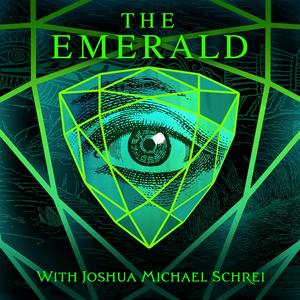
The Emerald explores the human experience through a vibrant lens of myth, story, and imagination. Brought to life through the wise, wild, and humorous vision of Joshua Michael Schrei — a teacher and lifelong student of the cosmologies and mythologies of the world — the podcast draws from a deep well of poetry, lore, and mythos to challenge conventional narratives on politics and public discourse, meditation and mindfulness, art, science, literature, and more. At the heart of the podcast is the premise that the imaginative, poetic, animate heart of human experience — elucidated by so many cultures over so many thousands of years — is missing in modern discourse and is urgently needed at a time when humanity is facing unprecedented problems. The Emerald advocates for an imaginative vision of human life and human discourse as it questions deep underlying assumptions about societal progress.
Podcast websiteListen to The Emerald, Stories of Art and many other podcasts from around the world with the radio.net app
Get the free radio.net app
- Stations and podcasts to bookmark
- Stream via Wi-Fi or Bluetooth
- Supports Carplay & Android Auto
- Many other app features
Get the free radio.net app
- Stations and podcasts to bookmark
- Stream via Wi-Fi or Bluetooth
- Supports Carplay & Android Auto
- Many other app features

The Emerald
Scan code,
download the app,
start listening.
download the app,
start listening.
 UK
UK