

Listen to this podcast in the app for free: Download for free in the App Store
radio.net
Sleep timer
Save favourites
38 episodes
Tyler Williams | FrameRate, Motion Array, and Building a Creator-First Video Platform
27/02/2026 | 47 mins.Today I'm speaking with Tyler Williams, the founder of Frame Rate, a new creator-first video platform built for motion designers, filmmakers, animators, and editors.
Tyler previously co-founded Motion Array, the template and asset library that grew into a huge part of the creator ecosystem and was later acquired by Artlist.
In this conversation, we talk about why Frame Rate exists in the first place, what Tyler thinks broke in the video hosting world as Vimeo shifted away from the community that built it, and what it means to design a platform that puts the work first.
We also get into the early decisions behind the product, curation versus algorithms, creator trust in the AI era, and where Tyler hopes Frame Rate can go over the next few years.
Topics Discussed
The Vimeo shift and why it felt cultural, not just product-level.
Motion Array, the exit, identity loss, and why other projects did not stick.
Building FrameRate from scratch and what "creator-first" really means in practice.
Curation versus algorithms, and resisting distraction mechanics.
The two-sided ambition: helping artists get hired, not just host work.
AI anxiety, protection limits, and the reality of robots.txt.
Early traction: first 1,000 users, Discord loop, embeds, and product iteration.
Lessons from Motion Array scaling, and what he wants to do differently this time.Jonny Burger | Remotion, Programmatic Video, and Agentic AI
15/02/2026 | 1h 22 mins.Today I'm speaking with Jonny Burger, the creator and founder of Remotion, a framework for making videos programmatically with React. In other words, making videos with code.
I reached out to Jonny a few weeks ago to book this interview. Two days later, Remotion went viral in the Claude ecosystem when they released agent skills. Almost overnight, Remotion had thousands of non-coders prompting videos into existence. They went from a fairly niche developer framework to suddenly having three-quarters of their users be non-technical people one-shotting videos with AI. For someone deeply interested in agentic video, it's one of the clearest real-world examples of early agentic video becoming practical.
We go back to the beginning: Jonny's original intention with Remotion, the first use cases, and how it's evolved over five years. We cover the stack (React, headless Chromium, FFmpeg), source-available vs open source licensing, and why Remotion focuses on being composable with other tools rather than building a full After Effects replacement. We also dig into the Claude skills wave, what's needed for AI to understand motion better, the Lottie and Rive integrations, and where Jonny sees Remotion in five years.Ben Fryc | 3D Artist and Designer at Framer and Creator of Knob Keyboard
14/02/2026 | 55 mins.Today I'm speaking with Ben Fryc, a 3D artist, motion designer, and creative who's worked with Google, Figma, Loom, Wealthsimple, and now, for the last year, at Framer.I've followed Ben's work for years and really admired it. It's been exciting to watch his 3D and motion craft bring even more polish and energy to Framer's already stellar brand over the past year.In our conversation, we dove into his first year at Framer, the tight-knit marketing/video team, how he collaborates with folks like Andy Orsow, and the creative process behind their in-house work. We also covered his tool stack (Cinema 4D, Redshift, After Effects, Plasticity, and where each shines), the shift from freelance to full-time, his fantastical Knob series (and the role of Joseph Sims' sound design in elevating it), the wild journey turning those renders into real hardware with Work Louder, and where AI fits (mostly conceptual, not production).We also spoke about his personal work building the Knob keyboard, from "how hard could it be?" to shipping Batch 1: the compromises, community momentum, and what he'd tackle next with limitless resources (like a dream mouse or desk takeover). I really enjoyed this interview. Ben's a great guy. So I hope you do too.
--
Chapters
00:00 Introduction to Ben Fryc and His Work
01:43 Joining Framer: A Year in Review
04:24 The Creative Team at Framer
07:31 The Role of 3D in Framer's Brand
10:30 Creative Process and Collaboration at Framer
13:32 Experimentation and Learning in Design
16:24 Tools of the Trade: 3D Design Software
19:13 Challenges in 3D Design and Production
22:16 The Intersection of Speed and Craft in Design
30:12 Navigating Project Timelines and Client Work
31:13 The Challenges of Scoping Projects
32:31 Pre-Production: Aligning Teams and Feedback
33:46 Rendering Techniques and Tools
34:11 Exploring Plasticity and the Knob Series
35:29 The Role of Sound Design in Visual Projects
38:16 From Concept to Creation: Designing a Keyboard
43:09 The Power of Willing Ideas into Existence
49:11 AI's Role in Motion Design and 3D Work
54:58 Looking Ahead: Future Projects at FramerJustin Taylor | Hyper Brew, Bolt, Open Source and Adobe Plugin Development
28/01/2026 | 1h 18 mins.Today I'm speaking with Justin Taylor, editor, motion designer, and founder of [Hyper Brew](https://hyperbrew.co), a company that builds plugins and automation tools for creative teams.
If you listened to my conversation with Adam Plouff, you'll know that Adam builds many of his tools on top of something Justin created called the [Bolt frameworks](https://github.com/hyperbrew). Adam makes the tools. Justin makes the tools the tool makers use.
This episode goes deeper into the development side than most. We talk about what "pipeline" actually means at studios like Buck, how the Adobe plugin landscape evolved from expressions to CEP to UXP, and how Justin turned open source into a business model. If that's not your world, the conversation opens with his journey from churning out product videos to automating the boring parts, and closes with where video tooling is headed (AI, Figma acquiring Weavy, and whether we'll all be writing our own tools soon).
## Topics Discussed
- From shooting product videos to automating the edits in Premiere Pro
- Working at Verasity CoLab and sharing tools with a mid-size video team
- Getting ProIO on aescripts and meeting Lloyd Alvarez
- Meeting Zack Lovatt at SIGGRAPH and the Adobe dev community
- Working at Buck as a creative technologist on pipeline development
- What "pipeline" actually means at studios like Buck
- Building tools for Cinema 4D, Figma, Nuke, Maya, and Houdini
- The early days of Adobe plugin development before proper documentation existed
- Going full-time with Hyper Brew
- The tagline evolution from "software solutions for video" to "we automate the boring"
- Working with Eric Moore from Brand Autopsy on messaging
- Adobe Video Partner Program and testing beta builds
- The Adobe plugin landscape: expressions, ExtendScript, CEP, and UXP
- Why Adobe moved from CEP to UXP
- How Bolt CEP became Bolt UXP, Bolt Figma, and Bolt Express
- Getting funding from aescripts, Figma's Creators Fund, and Adobe
- Custom tools for clients: image recognition, OCR, custom captions for a sports league
- Languages used: JavaScript, C++, Rust, Python, Lua
- Why extensible tools (Premiere, After Effects, Figma) win over closed ones like Affinity
- Klutz GPT and why Hyper Brew doesn't use AI for client code
- Custom vs off-the-shelf tools: 50% vs 100%
- Remotion and agents for video
- Figma acquiring Weavy
Chapters
00:00 Introduction to Justin Taylor and Hyperbrew
01:44 The Journey to Tool Development
06:42 The Evolution of ProIO and Its Impact
12:26 Building a Community and Networking
15:15 Understanding Pipeline Management in Large Agencies
23:37 The Role of Technical Directors
24:54 Transitioning to Full-Time with Hyperbrew
26:49 The Evolution of Business Taglines
29:27 Understanding Adobe Partnerships
33:03 Custom Tool Projects and Automation
37:18 Navigating API Limitations in Video Tools
41:28 The Importance of Extensibility in Software
43:54 The Adobe Plugin Landscape Explained
48:59 The Development of Bolt and Open Source Contributions
55:35 The Evolution of Open Source Projects
58:51 The Benefits of Open Source Development
01:01:12 Custom vs. Off-the-Shelf Tools
01:01:13 AI in Custom Tool Development
01:04:32 The Future of Video Tools and AI
01:15:37 HyperBrew's Vision and Future ProjectsDanny Perry | Plugin Play, AI Development, Agentic Motion & a New Motion Marketplace
02/09/2025 | 1h 39 mins.Learn more about Danny at https://www.dannyperry.me
Learn more about the podcast at https://jackvaughan.com
Today I’m speaking with Danny Perry — Founder of Plugin Play — historically a plugin development company and just recently expanding to be a new marketplace for motion and video pros.
We spoke about
- How AI development has evolved in his organization — particularly agentic-accelerating dev and org speed.
- Comparing dev & motion - and the need for similar support/agentic power
- What it would take to get motion to this point-agentic editing & motion
- AI in products
- Future of Plugin Play and bringing a new marketplace of tools to the community
By the time this podcast goes out, Danny will have launched the new chapter for Plugin Play, and I'm really excited to see where it leads.
Summary (AI generated)
In this conversation, Jack Vaughan speaks with Danny Perry, founder of Plugin Play, about the evolution of the company and its integration of AI in motion design and development. They discuss the impact of AI on productivity, the importance of customer feedback in feature development, and the future of motion design tools. Danny emphasizes the need for project files in generative AI and the challenges posed by the lack of training data. They also explore the development landscape for motion graphics and the significance of UI design in creating effective tools. In this conversation, Jack Vaughan and Danny discuss the intricacies of building web tools, particularly in the context of motion graphics and UI design. They explore the challenges of creating user-friendly interfaces, the interdisciplinary nature of motion and code, and the future of software development with AI integration. Danny shares insights on the upcoming projects for Plugin Play, emphasizing the need for a cohesive platform for motion tools and the importance of user feedback in shaping their offerings. The discussion also touches on the evolving landscape of software development and the role of AI in enhancing creative workflows.
Chapters (AI generated)
00:00 The Evolution of AI in Development
07:29 Transforming Daily Operations with AI
13:24 Agentic Editing and the Need for Project Files
19:17 Integrating AI with Editing Software
25:24 The Journey of a Motion Graphics Entrepreneur
38:49 Building Proprietary Platforms and Tools
43:57 Transforming Long-Form Content into Short-Form
49:10 Transitioning to UXP: A New Development Framework
55:56 UI Design and User Experience in Motion Graphics
01:09:46 The Power of Real-Time Feedback in Motion Design
01:16:06 AI and Automation in Video Editing
01:23:39 The Role of Plugin Play in a Crowded Market
01:29:23 The Evolution of Software Development and Human Oversight
More Technology podcasts
 All-In with Chamath, Jason, Sacks & FriedbergBusiness, Entrepreneurship, Health & Wellness, Investing, Technology
 AcquiredBusiness, Investing, Technology
 Podmastery: podcasting insights and advice for indie creatorsBusiness, Education, Entrepreneurship, Marketing, News, Personal Journals, Society & Culture, Tech News, Technology, Tutorials
 The VergecastNews, Tech News, Technology
 Better OfflineTechnology
 Lex Fridman PodcastPhilosophy, Science, Society & Culture, Technology
 Dwarkesh PodcastScience, Technology
 Hard ForkTechnology
 Lenny's Podcast: Product | Career | GrowthBusiness, Entrepreneurship, Technology
Trending Technology podcasts
 Talkin' ShopAutomotive, Business, Leisure, Technology
 Training DataBusiness, Technology
 Tech Brew Ride HomeNews, Tech News, Technology
 The Real Python PodcastTechnology
 UpgradeTechnology
 Intelligent Machines (Audio)Technology
 Milk Road CryptoTechnology
 Uncanny Valley | WIREDTechnology
 This Week in StartupsTechnology
 AI and the Future of Work: Artificial Intelligence in the Workplace, Business, Ethics, HR, and IT for AI Enthusiasts, Leaders and AcademicsBusiness, Entrepreneurship, Management, Technology
 Mystery AI Hype Theater 3000News, Science, Tech News, Technology
 Super Data Science: ML & AI Podcast with Jon KrohnScience, Technology
 十字路口CrossingTechnology
 Thoughtworks Technology PodcastBusiness, Careers, Technology
 Mac Geek Gab — Apple Tips, Tricks, and TroubleshootingEducation, News, Tech News, Technology, Tutorials
 Claude AI Genius PodcastBusiness, Marketing, Technology
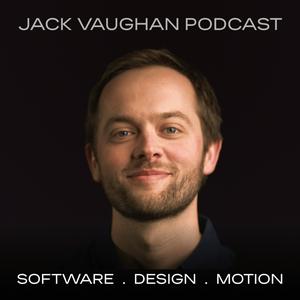
About Jack Vaughan Podcast
Conversations with heroes and colleagues in the world of Software, Design, and Motion.
Podcast websiteListen to Jack Vaughan Podcast, All-In with Chamath, Jason, Sacks & Friedberg and many other podcasts from around the world with the radio.net app
Get the free radio.net app
- Stations and podcasts to bookmark
- Stream via Wi-Fi or Bluetooth
- Supports Carplay & Android Auto
- Many other app features
Get the free radio.net app
- Stations and podcasts to bookmark
- Stream via Wi-Fi or Bluetooth
- Supports Carplay & Android Auto
- Many other app features
Jack Vaughan Podcast
Scan code,
download the app,
start listening.
download the app,
start listening.
Jack Vaughan Podcast: Podcasts in Family
 UK
UK