
Listen to this podcast in the app for free: Download for free in the App Store
radio.net
Sleep timer
Save favourites
51 episodes
What India Teaches Us About Trust in Tech: Shared Phones, Local Languages and Homegrown AI - Aditi Shah & Antara Madavane, Aapti Institute (EP 51)
27/11/2026 | 33 mins.🎙️ Aditi Shah and Antara Madavane, Managers, Aapti Institute
In two years of research at Aapti Institute, Aditi Shah and Antara Madavane asked women in India how they come to trust technology, and the first finding Aditi names is about whose phone it is. A father's phone might be his, but a mother's phone is the household phone, so trust gets negotiated with the family as much as with the app (one reason Aditi warns against reading usage as trust). With AI, Antara sees India at the start: plenty of curiosity and fascination, and so far few of the bad experiences that usually teach people distrust.
🎧 Episode overview
Aditi's case starts with community: debates about digital trust center the individual user, yet what a 15-year-old girl can do with the same phone is vastly different from what a mother of two can do. On a shared phone that means constant negotiation (one girl got the phone for two hours every evening, so she downloaded the app she wanted, used it and deleted it before handing the phone back), and when WhatsApp's disappearing messages took control away from them, some women switched to clone apps that keep the messages. For Aditi, that control is part of what enables trust, together with design that feels familiar: the home button, which means the same thing in every app, told women they could always find their way back to the start. On AI, India is pushing for models that speak its users' languages, built with compute and data from India, while Antara pushes back on the idea that AI sets its own pace: "There are very real human beings behind AI", and friction, as small as a passcode, has value in products and in regulation. Their lesson for European product teams: question the one-person, one-device assumption, design technology as a shared resource, and learn about users in one-on-one conversations, since surveys "barely scratch the surface".
💡 Key themes
Why usage is so easily read as trust, and what trust includes beyond security
What a shared household phone means for privacy, control and the apps women keep
Why India wants AI models that speak its users' languages, built at home
Whether India's fascination with AI is trust yet, and what a first bad experience might change
Whether participation can keep pace with AI, and why some friction helps
👤 About the guest
Aditi Shah and Antara Madavane are managers at Aapti Institute in Bengaluru, a research institute that studies how people interact with and negotiate technology. With a larger team, they spent two years researching women's digital trust in India, much of it in one-on-one conversations with women about the phones they share and the apps they install and delete again, and they presented the work at the UN Internet Governance Forum in 2025.
⏱ Chapters
00:00 Seen from India: why trust in tech starts with the community
05:25 Homegrown AI: models that speak India's languages
08:20 Curiosity and fascination: is AI in India trusted yet?
14:10 The household phone, clone apps and the home button
22:45 Does AI have to move this fast? Participation and friction
26:05 What European product teams can learn, and the in-between moments
🔗 Links
Aditi Shah on LinkedIn - https://www.linkedin.com/in/aditis27/
Antara Madavane on LinkedIn - https://www.linkedin.com/in/antaramadavane/
Eva Simone Lihotzky on LinkedIn - https://www.linkedin.com/in/evalihotzky/
raidiant, Eva's responsible AI advisory - https://www.raidiant.eu/
Aapti Institute - https://aapti.in/
Unbundling Women's Digital Trust, Aapti Institute - https://trust.aapti.in/report
Related episode - Why Trust Retreats Into Our Own Circles: Optimism, Transformation and the Empathy AI Is Missing - Nils Giese, Edelman Germany (EP 47) - https://open.spotify.com/episode/0TfbAmVVtw1advxMcHCNnZAfter the Week That Shook Big Tech: Arms Races, Robot Companions and The AI Bubble - Elisabeth L’Orange, Founder, Podcast Host and AI Expert (EP 50)
20/11/2026 | 32 mins.🎙️ Elisabeth L’Orange, Founder, AI Expert And Researcher, Host of Tech & Tales
Elisabeth L’Orange came back from Shenzhen impressed: a city built “from zero to one in 30 years”, quiet streets without combustion engines, technology that simply works. Her trust in technology holds; her trust in the big companies building it is (her words) “somewhat broken”. In the 50th episode of the show, she and Eva ask whom we can still trust when chips, models and robots become cheap, subsidized and everywhere.
🎧 Episode overview
Elisabeth sees Nvidia as the company building “the weapons” of a Sino-American arms race, and what she saw in China fits that picture: technology funded so heavily by the state that every product is “like a VC or a PE case”, and an internal market so competitive that prices keep falling. She expects models and robots to become commodities the way cloud did, and what struck her most is that the main use case of the robots she saw is companionship, sold with the tagline “you’ll never be alone again”. Her concern is what that does to us: a companion that always says what you want to hear leaves “no friction to grow”. For Europe she wants far more public capital, a large later-stage fund and federated speed instead of waiting for Brussels, because “if we spend years relocating a frog for a train station”, the trains from China overtake us. On Anthropic’s IPO she is very bullish, on AI inside companies patient, and for 2027 she expects the bubble to burst.
💡 Key themes
Whom to trust when the companies building the technology lose that trust
What China’s state-funded speed costs, and who pays for prices that keep falling
What companion robots and sycophantic AI do to relationships that need friction
What Europe would need to play at the scale of China and the US
Whether investors in Anthropic buy a promise or a solid company, while AI inside companies lags behind
👤 About the guest
Elisabeth L’Orange co-founded the Hamburg AI start-up Oxolo, worked as a VC and CFO before that, and hosts the German tech podcast Tech & Tales. She recorded this episode just after returning from Taipei and Shenzhen, so the conversation keeps moving between what she saw on the ground and what it means for Europe.
⏱ Chapters
00:00 After a week like this: can we still trust the tech narrative?
04:00 Back from Shenzhen: subsidies, car battles and technology that works
08:45 The same playbook for robots and models, and the missing friction
17:35 What Europe needs to play at scale
23:50 Anthropic’s IPO, and why AI inside companies takes longer
29:25 2027, the bubble and the in-between moments
🔗 Links
Elisabeth L’Orange on LinkedIn - https://www.linkedin.com/in/lislorange/
Elisabeth L’Orange - https://www.elisabethlorange.com/
Tech & Tales podcast - https://www.talespod.com/
Eva Simone Lihotzky on LinkedIn - https://www.linkedin.com/in/evalihotzky/
raidiant, Eva’s responsible AI advisory - https://www.raidiant.eu/
Related episode - Anthropic's Model Suspension, Europe 2031, and G7 World Leaders Lunching with Frontier and Tech CEOs - A Week in Tech & Trust with Eva Simone Lihotzky - https://open.spotify.com/episode/2mu9SeFbydOYgbhhFjFH9iEurope’s Perfect Storm? Tech Dependence, Capital and a Positive Outlook on Europe - Eva Simone Lihotzky (EP 49)
16/11/2026 | 14 mins.🎙️ Eva Simone Lihotzky, solo episode
In this solo episode, Eva Simone Lihotzky looks at how Europe is challenged between the US and China in technology, AI and capital, starting from what she heard at Estonia’s Digital Summit in Tallinn and the SZ Wirtschaftsgipfel. She doesn’t talk the squeeze away (asked whether Europe is in a perfect storm, she says “yes, for now”). What interests her is where it is headed: a Europe of 2035 that builds on what already works, and on people trusting each other across 27 countries.
🎧 Episode overview
The squeeze can be counted: nearly 80 percent of Europe’s digital infrastructure and technology comes from non-EU providers, and when the US put export controls on two AI models in June, they were switched off for 19 days (in October, China proposed export controls of its own on 23 AI technologies). Eva’s first objection is to how we perceive all this: opinions built only on negative outlooks become “a self-fulfilling prophecy”. Her second is history: Jean Monnet wrote that Europe will be forged in crises, and this January the EU and India concluded a trade agreement after almost twenty years of talks. The Europe of 2035 she describes starts from what exists today: 72 percent clean electricity, seven AI gigafactories on the way, and Mistral, “a French lab with a Dutch shareholder and a site in Sweden”. What still has to happen is the harder part: Europe is home to 45 percent of the world’s deep tech startups and gets 17 percent of the funding, and working across 27 countries needs leaders who can “explain a compromise so that people trust it”.
💡 Key themes
How dependent Europe is on technology from the US and China, and what that dependence costs
Why a negative outlook can turn into a self-fulfilling prophecy
Whether crises weaken Europe or make it act
What role Europe can play between the US and China without choosing a side
Where the money to grow European tech comes from, and what leading across 27 countries asks of people
👤 About the host
Eva Simone Lihotzky hosts The In-Between Tech & Trust and advises European companies and boards on responsible AI adoption. She previously co-founded the Serviceplan AI Lab and led it as Managing Director, and she is co-author of “10 Moral Questions: How to Design Tech & AI Responsibly”. This episode is built on two events she attended this November: Estonia’s Digital Summit in Tallinn and the Wirtschaftsgipfel of the Süddeutsche Zeitung in Berlin.
⏱ Chapters
00:00 A question from Tallinn: is Europe in a storm?
01:00 Two summits and a scale from zero to ten
02:34 The squeeze: tech, AI, the economy and capital
05:16 How we perceive the storm, and what crises do to Europe
06:23 Europe in 2035: society, tech, power and togetherness
10:38 Europe’s role in between, and what has to happen
🔗 Links
Eva Simone Lihotzky on LinkedIn - https://www.linkedin.com/in/evalihotzky/
raidiant, Eva’s responsible AI advisory - https://www.raidiant.eu/
Tallinn Digital Summit - https://www.tds.icds.ee
SZ Wirtschaftsgipfel - https://www.sz-gipfel.de/wirtschaftsgipfel/
Bitkom, 16 months without digital imports (October 2026) - https://www.bitkom.org/Presse/Presseinformation/16-Monate-koennten-Deutschlands-Unternehmen-ohne-Digitalimporte-ueberleben
Epoch AI, AI Chip Imports Explorer - https://epoch.ai/latest/introducing-the-ai-chip-imports-explorer
Global Deep Tech Report 2026 - https://www.htgf.de/wp-content/uploads/2026/05/Global-Deep-Tech-Report-2026.pdf
Stanford HAI, AI Index Report 2026 - https://hai.stanford.edu/ai-index/2026-ai-index-report
DIHK on the EU and CPTPP - https://www.dihk.de/en/newsroom/eu-and-cptpp-forging-a-strong-alliance-against-protectionism-184344
Related episode - Sten Saluveer - https://open.spotify.com/episode/0gPKehnoNppMY0y3Jvdry0
Related episode - Eva’s episode on the June export controls - https://open.spotify.com/episode/18XwhWmuEgvws9oOcFzsVnFrom SaaSpocalypse to Reinvention: AI’s Ambivalent Times and What Still Sets Builders, Data and Infrastructure Apart - Christopher Craig, Google Cloud (EP 48)
05/11/2026 | 33 mins.🎙️ Christopher Craig, AI GTM Startups Lead Nordics & DACH, Google Cloud | Founder & Angel Investor
In February, new AI agents wiped about a trillion dollars off software stocks within days; by May, they had rebounded. Christopher Craig, who works with AI startups at Google Cloud and invests in founders on the side, sees both moves up close: software is not dead, he says, but it may lose the users who used to log in. And if a team of five can now build what took fifty, what earns his trust is what is hard to copy: the founders’ conviction, the data they own and the infrastructure underneath (chips, bandwidth, energy).
🎧 Episode overview
Chris starts from the builder: we are all “in a way a software engineer now”, a company idea can be built in four or five days, and AI gets a product “eighty, eighty-five percent there” before a person has to understand and orchestrate the rest. For SaaS, that cuts both ways: he expects software to go “headless”, opened up to AI labs, with the risk that vendors turn into database companies nobody visits. Eva brings in Alphabet’s worst day on the stock market, the day before the recording, and Chris reads it as short term, points to AI demand he sees rising, and still names the open question himself: “Do we overshoot that?” The next bottlenecks, in his view, sit underneath: bandwidth in data centers (the reason he invested in the Zurich photonic chip company Lightium, “the plumbing in a data center”) and energy, where he bets the market will outweigh local resistance. What sets people apart, he says, has not changed: founders with conviction “to the point where it’s like insane”, and the habit of choosing carefully what to read.
💡 Key themes
Whether software is dying or losing only the screen people log into
What a person still adds when AI gets a product most of the way
Whether the AI spending pays off, or the industry overshoots
Why the next bottlenecks are bandwidth and energy, not only chips
What still sets builders apart when everyone can build
👤 About the guest
Christopher Craig works with AI-native, robotics and deep tech startups at Google Cloud across DACH and the Nordics, and invests in founders through his own angel platform, Blue Trail. He came to Zurich in 2020 after five years in San Francisco, including at Uber, and today he stands on two sides of the AI build-out: selling the compute to startups, and backing the hardware and energy companies that compute depends on.
⏱ Chapters
00:00 After the outage: AI demand and teams that start from AI
07:20 Five people doing the work of fifty
14:20 SaaSpocalypse, or software going headless?
16:50 Alphabet’s worst day, and three model families on one platform
22:30 The plumbing underneath: chips, bandwidth, energy
28:30 Everyone a builder: what still sets you apart
🔗 Links
Christopher Craig on LinkedIn - https://ch.linkedin.com/in/chris-craig
Eva Simone Lihotzky on LinkedIn - https://www.linkedin.com/in/evalihotzky/
raidiant, Eva’s responsible AI advisory - https://www.raidiant.eu/
Google Cloud - https://cloud.google.com
Google for Startups Cloud Program - https://cloud.google.com/startup/ai
Blue Trail - https://bluetrailventures.com/
Lightium - https://lightium.com/
Novele - https://www.novele.com
MicroAGI - https://www.microagi.ai
Related episode - Keeping Quantum Momentum: How Companies Stay Ready for a Computing Wave That Is Yet to Arrive - Christopher Trummer (EP 44) - https://open.spotify.com/episode/6Of8mRJG9KDCceSrODhTD6Why Trust Retreats Into Our Own Circles: Optimism, Transformation and the Empathy AI Is Missing - Nils Giese, Edelman Germany (EP 47)
29/10/2026 | 35 mins.🎙️Nils Giese, CEO, Edelman Germany
Only 8% of people in Germany believe the next generation will be better off, and Nils Giese, CEO of Edelman Germany, calls it the most shocking number in his firm’s Trust Barometer. Behind it he sees trust retreating onto “social islands”: small circles of people like us, now with high walls around them. That leaves leaders with a hard job (bringing people across those walls while asking them to change, AI included), and Nils is open that he isn’t very optimistic about the months ahead.
🎧 Episode overview
Edelman’s research breaks trust into five parts (ability, dependability, integrity, purpose and personal relevance), and Nils argues the human ones weigh more than competence, even in a country that likes to trust its engineering; for him personally, dependability and integrity come first when times are uncertain. The 8% tells him the contract between generations is “just collapsing”, and when Eva brings in KfW’s finding that a third of German Mittelstand firms postponed or scaled back their 2026 investments, he reads it the same way: not a lack of money or ideas, but how hard it has become to imagine the future. His answer is the employer as bridge builder, the most trusted institution in Germany because of the little word “my”. Eva pushes on how leaders can do that when everyone, Gen Z first, feels overwhelmed, and Nils points to what transformation stories leave out: empathy, and the rule that what the recipient hears matters more than what the sender says. On AI, he describes the fear in large companies as diffuse rather than experienced, sees trust rise after one good experience, and says AI “had the worst PR agency in the world”.
💡 Key themes
What trust is made of, and why honesty can outweigh competence
How companies invest in a future only 8% expect to be better
Whether employers can bridge the social islands people retreat to
What AI transformation loses when it speaks only to the rational case
Where trust can grow again: small steps, close to home
👤 About the guest
Nils Giese is CEO of Edelman Germany and leads Edelman’s healthcare marketing across EMEA; he joined the firm in 2021 to run its German healthcare business, after years in strategy at Saatchi & Saatchi. His firm has measured trust for 26 years through the Edelman Trust Barometer, and Nils reads those numbers as someone who has to move people through change himself: when he joined, he described his work as trusted, active and creative dialogue, long before the AI debate.
⏱ Chapters
00:00 What trust is made of
06:34 Only 8% expect a better future
11:55 Social islands with high walls
16:40 Overwhelmed, and the missing empathy
22:46 AI as a diffuse fear
27:14 Not optimistic yet: start small, start local
🔗 Links
Nils Giese on LinkedIn - https://www.linkedin.com/in/nils-giese-898058151/
Edelman Germany - https://www.edelman.com/de/de
Eva Simone Lihotzky on LinkedIn - https://www.linkedin.com/in/evalihotzky/
raidiant, Eva’s responsible AI advisory - https://www.raidiant.eu/
Edelman Trust Barometer 2026, Germany - https://www.edelman.com/de/de/trust/2026/trust-barometer
Edelman Trust at Work 2026 - https://www.edelman.com/newsroom/richard-edelmans-6am-blog/trust-at-work-2026
Edelman Flash Poll: Trust and Artificial Intelligence at a Crossroads - https://www.edelman.com/insights/familiarity-breeds-trust-in-ai
KfW-Mittelstandspanel 2026 - https://www.kfw.de/Über-die-KfW/Newsroom/Aktuelles/Pressemitteilungen-Details_910272.html
Related episode - Two Fears Behind Every AI Transformation - Dr. Charlotte Blum (EP 31) - https://open.spotify.com/episode/5A0aUErqMyqTKjBQqOuGaD?si=HWFJpD3VRhqquH1hpQ0WXQ
More Technology podcasts








Trending Technology podcasts























About The In-Between Tech and Trust Podcast
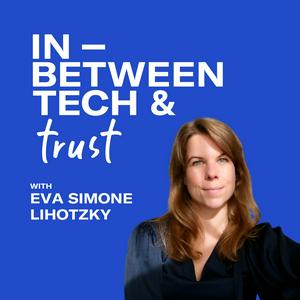
How do we build, break, and rebuild trust in a world shaped by technologies? The In-Between Tech & Trust is a weekly conversation about the human side of tech. Host Eva Simone Lihotzky, founder of raidiant (responsible AI advisory), talks with guests from business, politics, neuroscience, and tech about what they have learned about trust, and what they would pass on to you. Eva was formerly co-founder and MD of the Serviceplan AI Lab, holds the Global Moral Chair at the Value AI Institute and co-authored "10 Moral Questions: How to Design Tech & AI Responsibly".
Podcast websiteListen to The In-Between Tech and Trust Podcast, The Vergecast and many other podcasts from around the world with the radio.net app
Get the free radio.net app
- Stations and podcasts to bookmark
- Stream via Wi-Fi or Bluetooth
- Supports Carplay & Android Auto
- Many other app features

 UK