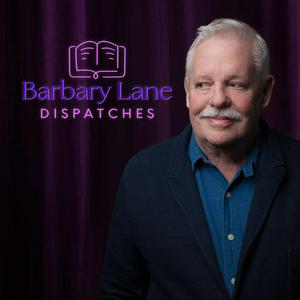
PodcastsDocumentaryBarbary Lane Dispatches Podcast

Barbary Lane Dispatches Podcast

Armistead Maupin
Barbary Lane Dispatches Podcast
Latest episode

43 episodes

  • Barbary Lane Dispatches Podcast

    I Found Freedom at the Baths

    15/04/2026 | 15 mins.
    Here’s a transcript of the video:I want to talk to you today about my experience in the bathhouses of San Francisco. To do that, I need to back up a little and talk about the way they first started in San Francisco. The biggest, most famous one was the Sutro bathhouse, which was out at the beach. It was a huge temple, really. It was built in 1896 and burned down in 1966.
    It was a notorious spot for men to meet each other. It was that simple. Whatever terms they wanted to meet on, they could meet there. It was open to everyone, but apparently there were private changing rooms which were frequented by gay men.
    There are several letters from that time where a straight man was hosting a gay man who was visiting town and wanted to entertain him, and he was told to go to the Sutro Baths.
    The ruins of the Sutro Baths are still a popular tourist spot in San Francisco. About the time they burned down in 1966—when I was graduating from college—I suppose that’s when the other bathhouses began to open
    The one I remember is Dave’s Baths, which was there when I was a young man in San Francisco. The first time I ever went down to it, I’d caught a cab. I was too embarrassed to tell the driver where I wanted to go, so I said, “Just Montgomery Street.”
    And he said, “The whole street?” And I said, “No, you know.” And he said, “Where do you want to go?” And I finally said, “Dave’s Baths.”
    And he said, “Oh, why didn’t you tell me so? I take a lot of people there.”
    He took me there, and I checked in at the desk. You had to sign your name in those days to say who you were. So, with a perverse sense of humor, I suppose, I signed mine Elloughby Branch. My great-great-grandfather was a Confederate general whose name was L.O.B. Branch, and I turned that into Elloughby like a first name, and signed that at the desk.
    I was given my towel, and I went off basically in search of cock—and found one. I can’t remember which one, appropriately enough, but it was a delightful thing to be able to do what I wanted in that regard, and to be in a place where I felt safe.
    I hadn’t been out of the closet that long—or even properly out. I can’t officially say I was out at that point, because I was still operating under cover, as it were. It was an amazing thing to be in this place where I knew it was other gay men. It was safe. It was freedom like I’d never experienced before.
    Dave’s Baths was a wonderland. I never found out who Dave was—never met him—but I have to thank him for creating the environment where my world changed.
    There was every race in there, all sorts of experiences that I’d never had before—mostly ones that involved being human with fellow human beings. It was extraordinary, really. I might look at it today and not think that at all, I suppose, but it was at the time. I was captivated by the freedom of the place.
    It drove me on to look for other horizons when I discovered there was a place called the Ritch Street Baths on the other side of town that was even more elaborate. I suppose I imagined it would be people I didn’t know, simply because it was across town.
    Ritch Street featured what they called a Minoan temple. I still don’t know what that was, but it was a pool at one end of the place with a slightly Grecian motif going on. And at the Ritch Street Baths, you could get a nine-grain sandwich with turkey only steps away from the Minoan Temple, so you could sit there and munch on your sandwich while you were waiting to get your cock sucked.
    I was in love with that place, and it opened up such wonders to me that I talked about it with several people that I knew, including my woman friend Jan Fox.
    She was captivated by the fact that I had such a place. She said, “Oh God, I wish I had something like that that girls could go to.”
    I tried going home once or twice with guys from there, but I learned that that didn’t work out. It was meant as a temporary pleasure, and I couldn’t go marry someone that I had met at the baths. I became resigned to that.
    Later, I discovered the Glory Holes on 6th Street, which was very basic. It was just a room with cubicles that had holes in them where dicks would come through… to my great astonishment and pleasure. That became my regular habit.
    I was working at the Chronicle by then, which conveniently was only two or three blocks away. So I would go over there on my lunch hour, while I was writing Tales of the City, and have fun.
    It was referred to publicly as the Good Health Club—GH, it said outside—so the joke was that stood for good health. I would go there and then go back and report to work as soon as I was done.
    One day, the editor of the Chronicle, this very distinguished elderly man named Charlie Thieriot, asked me to come up to his office.
    I don’t remember what he wanted to talk about, but as I was sitting there talking to him, I looked down and realized there was a big wad of bubble gum stuck to my knee. So I had to subtly move my hand over it so it could not be seen. I’m not sure he ever registered it, but it sure did with me. I was in a panic.
    I was able to mine my experience of the gay baths in Tales of the City. It’s referred to repeatedly—people saying so-and-so went to the baths. I didn’t get graphic about it. I couldn’t. But I acknowledged that they were a thing.
    There was also a place called the Sutro Baths—not the original ocean one, but a small place on Valencia Street—that was co-ed, if you can imagine such a thing.
    For a while they invited men and women to come there. It was mostly gay men, but some women. I don’t know how this worked, because I would run in terror from any woman who came into the place—it wasn’t what I was familiar with. They must have been brave souls. I have to give them credit for that. Or knew where to find the fun—I don’t know.
    Of course, I knew about the bathhouses in New York, which had their own reputation. It was not exactly like that of San Francisco, which was more raw sex. Bette Midler sang at the Continental Baths to a bunch of men in towels, accompanied by Barry Manilow. I’ll never figure out why people were shocked to discover that he was gay many years later after he had been working in that environment.
    It was where Bette got her start. For a long time she didn’t like to talk about that, but I think she’s over that now. It’s part of her history really. It’s part of what makes her special to us today.
    In San Francisco, once the AIDS crisis hit, the city decided to close down the bathhouses. Interestingly, they didn’t close down the sex clubs. I never quite understood the reasoning behind that.
    I always felt that was wrongheaded, because they could have used those spaces to educate people about AIDS—to have posters up, to inform people. The places that were left open had no communication at all. People wanted to do what was right and didn’t quite know how, as usual.
    That didn’t stop me from going completely, but what eventually stopped me was that I became too well-known. I didn’t have the joy of anonymity anymore. That came to me in full force when one day I was at the glory holes and some guy came up behind me, put his arms around me, and said, “I really love your work.” Talk about a boner killer. That sent me screaming out of the room. I had to stop and be polite, but it was more than I could handle.
    I suppose it was time. Sooner or later you have to realize that you’re not that person anymore. That didn’t come to me rapidly, but it came eventually. Your body tells you that, and a certain vanity comes into play because you don’t want to be seen as a ridiculous old man. There was some element of that for me.
    And I learned to have sex with the person I love. It came late in my life, and I was glad when it did.
    There’s so much shame attached to sex in our world, especially around gay sex. I realized that I needed to get rid of that, and the baths helped me do that—to eliminate my shame and become matter-of-fact about sex.
    I’m so glad that I had that experience, and that it occurred at a time before there was a dangerous epidemic to make people stop.
    It was worth it to me—more than worth it. It’s a fond memory. And while I don’t remember many of the people who were in those dark rooms with me, I do remember what it felt like—the communion you felt with your brothers.
    It gives me a warm glow even today. I’ll always be grateful for having had that youthful bacchanalia. It made every difference to me. It opened me up creatively, among other things, and made me accept who I am once and for all.
    I credit that to my time at the bathhouses. I really do.
    And I wish the same thing for you—not necessarily a bathhouse, but a chance to feel yourself once and for all.
    So thank you for coming along today and listening to me say lewd things. It was fun, and I hope I’ll see you soon.
    Correction: Armistead realized after shooting the episode that Dave’s Baths were on Broadway (not Montgomery Street).
    The wonderful music in this episode is by Michael Hearst.https://www.michaelhearst.com/


    This is a public episode. If you'd like to discuss this with other subscribers or get access to bonus episodes, visit armisteadmaupin.substack.com/subscribe

  • Barbary Lane Dispatches Podcast

    Lover Zero

    08/04/2026 | 13 mins.
    Here’s a transcript of the video:
    I want to tell you about the first time I fell in love—and the amazing connection we shared that I didn’t fully realize until years later.
    I was living in Charleston at the time. It was 1970, and I had rented an apartment at the house of Elizabeth O’Neill Verner, who was a very famous artist—or at least in Charleston. She was an older woman who sold her work out of the house itself, so customers and tourists would come in to see her paintings. I was living in her attic apartment, but I would come down to the ground floor, where all the drawings and paintings were, and hang out. It was just a fun place to be.
    One day I was down there, and in came a couple—a man and a woman. She was a striking brunette, and he was a beautiful blond. I couldn’t take my eyes off them. I chatted them up—their names were Curt Dawson and Barbara Caruso. I tell you this because they became permanent parts of my life in ways I didn’t expect.
    Curt Dawson had the most romantic name I’d ever heard. It sounded like something out of the Old West—Curt Dawson. And he was gorgeous to look at. They were both so friendly, and so kind to me.
    It turned out they were actors from New York City, on their way to Atlanta to be in a Chekhov play together. I assumed they were a couple because they were so intimate—so jokey and familiar with each other.
    I invited them out and gave them a little tour of the town. I took them to Middleton Plantation. I remember being there, and a couple of times when I was alone with Curt, I felt—well, I won’t say he was coming on to me—but he would smile at me in a way that was, at the very least, distracting. Mostly, though, it was just three friends getting to know each other.
    They invited me to come see their play in Atlanta. I didn’t know what my lodging situation would be, but when I got there, it turned out I’d be staying at Curt’s apartment.
    He had a party while I was there—a cast party, for The Cherry Orchard. And I remember being struck that night, watching people gather, by what a rare and wonderful thing it was to see actors in their natural habitat. They laughed together—men and women all having fun. It was nothing like anything I’d ever seen back in North Carolina. They felt connected to each other in a way I couldn’t quite fathom. They worked together, played together, and loved each other.
    I still wasn’t sure whether Curt and Barbara were a couple until that night, when he very gently took me into his bedroom. Up until that point, I had only had random, anonymous encounters on the Battery in Charleston. I wasn’t comfortable with my sexuality. It was something that happened in the dark of night, and that was that. Curt was the first man who made me feel like it was something to celebrate. And he did that very effectively that night in his bedroom.
    After that, Curt and Barbara invited me to go with them to a cabin in North Georgia. I can’t remember exactly where it was, but it was a sweet, private, wooded place. Curt had an amazing appreciation of nature. Not in a scholarly way—he wasn’t a botanist—but he would stop and really look at something beautiful and absorb it. I saw him do that many years later in California as well.
    I realized I was really falling for him—seeing him as someone who could be permanent in my life. I had never felt that way about any man before, certainly not the ones I met on the Battery.
    So I fell head over heels. And he had to let me down gently. He said, essentially, “We’re having fun—but you don’t love me.”
    He then said something to me that has stuck with me since: “Don’t worry about it. You’re just a young queen, and I’m an old queen.” He was 33 and I was 27—it was ridiculous, really. But I understand now what he meant. He had experience; he’d been in New York. I had none. So naturally, I thought the first gorgeous man who was nice to me must be the one.
    I was heartsick for a while, but I got over it. I went to visit him in New York, and by then it was clear we were friends. I accepted that, because I wanted to know him. I wanted to be in his life.
    Not long after, I moved to San Francisco. He came to visit me there, and we took a trip to the Russian River. We stayed in a lodge that was known for people parking up above and picking each other up. We had a great time—just hanging out as friends.
    We stayed in touch over the years. I even saw him in After Dark magazine—a theatrical magazine with a very queer flavor. An older woman named Norma McLean Stoop interviewed him, and she was obviously as taken with him as I had been.
    I found the magazine at my corner store in San Francisco, and it made me feel like he was still part of my life. We’d talk on the phone occasionally. I would get a report on what he was doing and the soap operas he was working in, as well as the serious theatrical ventures. He was mostly a stage actor, but he made his bread and butter doing soap operas.
    Sadly, he died of AIDS in 1985.
    Years later, I spoke with Barbara, who told me about the end. When he was too weak to get out of bed, she came to him and said, “Come on, darling, we’ve got to go to the hospital.” It was said in a very loving and resigned way that seemed totally like her and totally like him as well. I love knowing that she was with him—that he had a great old friend to be with him at the moment he left the world.
    In 1994, I was at Stonewall 25 in New York. Ian McKellen was performing a show called A Knight Out, reminiscing about his life. I’d known Ian since the ’80s, so it was quite a shock when he spoke about Curt Dawson as someone he had fallen for when he was young.
    Ian had met him when he was just out of Cambridge, and Curt was just out of RADA. They’d done an amateur production together. This was before Ian was getting any professional work. Ian really fell for this all-American boy from Kansas—Russell, Kansas—and said Curt had serenaded him with “Everything’s Coming Up Roses.” It had an effect. He’d been completely charmed by him and I think he fell in love with him for a brief time.
    After the show, I went backstage and said, “I can’t believe it—Curt Dawson—we have that in common.” And Terrence McNally, the famous playwright who was there in the room too, said, “Oh yes, me too.” Meaning he had also been smitten with Curt.
    After that, we jokingly referred to Curt as “Lover Zero,” because everything seemed to trace back to him. He broke a few hearts along the way, but never in a way that would be considered cruel. It was always done with love and tenderness.
    I’m so grateful to Curt, all these years later, because he opened my heart to the possibility of love. The fact that he did that for others too only confirms what a wondrous soul he was.
    I’m so happy he helped me move beyond the sense of shame, the thing that I had lived with since I was a boy. And of course, San Francisco helped me put an end to that once and for all when I arrived there shortly thereafter.
    Thank you for coming along today and listening to me ramble. I really appreciate it—and I hope I’ll see you next time.
    I don’t know the credit for some of the images in this post—if you know the source or are the photographer, please let me know. Thanks, Chris


    This is a public episode. If you'd like to discuss this with other subscribers or get access to bonus episodes, visit armisteadmaupin.substack.com/subscribe
  • Barbary Lane Dispatches Podcast

    A Love Letter to Laura Linney

    23/03/2026 | 16 mins.
    Here’s a transcript of the video:Today I want to tell you about one of my favorite people in the world. Judging from what I hear from fans, I think she may be one of your favorite people as well. So it’s a pleasure to talk to you about Laura Linney.
    We met on the set of Tales of the City in 1992. As I recall, we were out at Land’s End in San Francisco filming an exterior shot of some sort, and I was totally charmed by her — not only by the way she treated me, but the way she treated the people who worked on the show. She was courteous to everyone. She seemed intuitive about what people were thinking and feeling, and that kind of kindness always impresses me when I see it. She had it in spades.
    The first time I ever saw Laura was in a casting tape that was sent to me. She had come in to read for another role, but that role had already been filled, and they asked me, “Do you think this woman would work?” It was such a laughable question, because not only would she work — I couldn’t imagine anyone else playing Mary Ann Singleton. She grasped a lot about Mary Ann — about her naivete and her essential innocence — but also a kind of calculated way about her. She knew what impression she was making at all times, and the combination of those things made her irresistible in that role. I felt as if I’d seen Mary Ann Singleton come to life — she embodied that character so completely.
    And the joke is, of course, that Mary Ann Singleton is sort of me as well, and so that instantly connected me to Laura. I felt that we knew each other really well, and her understanding of that character seemed to be an understanding of me. I hate to bring it back to myself, but that’s what it felt like.
    I don’t know exactly when I realized that there was a serious friendship developing between me and Laura, but it came pretty quickly. We laughed about the same things. She had this sly little cackle, and at the same time that I was laughing about something, she would be. We just fit as friends. You know, we fit in the most beautiful kind of way. I was twenty years older than she was, but it didn’t matter a bit.
    Laura adjusted to whatever set we were on. When we moved the show to Montreal, she was suddenly speaking in a Montreal accent and making me laugh like crazy. It was never malicious, but she heard people and she knew how to recreate their voices.
    Laura is the kind of actor other actors come to for advice on how to play a scene. I’ve seen it happen many times on the set of Tales, and I’m sure it happens with every other production she’s ever been in because, one, she’s kind, and two, she’s knowledgeable, and she knows how to offer advice in a gentle way. It’s no surprise to me that recently she’s moving into a directorial role in some of her productions, like Black Rabbit with Jason Bateman. She directed several of those episodes because they trust her. Actors trust Laura, and that comes across in the performances.
    Laura had a bit of trouble breaking into a movie career. She was in the famously awful Congo. She used to be very funny about that on the set because she knew when something was good and when it wasn’t. Her first major film role was in The Truman Show. She played this chirpy housewife who’s the wife of Jim Carrey. He’s in a reality show and doesn’t know it, and she’s part of the conspiracy to keep him in the reality show. But she gets very angry when he’s not playing along with the game. It’s great comedy stuff, and it works. She understood it on every level.
    After that, in 2000, she got the first role for which she received an Oscar nomination, You Can Count On Me. In the movie she plays the sister of Mark Ruffalo. He’s kind of a hippie, kind of a ne’er-do-well who can’t keep a job. And she plays a really solid woman, and they are loving brother and sister. And the way in which they convey that is so brilliant. It breaks your heart before it’s over.
    The biggest thrill of my life came when Laura asked me to be her escort for the Oscars when she was nominated for Best Actress. I got to go to that amazing event with her and I can barely remember what happened in it. It was really kind of hallucinogenic for me. But it was thrilling, and we went to the Oscar party afterwards, the Vanity Fair party, and I ran into someone I knew, Bud Cort, who’d played Harold in Harold and Maude, and a number of other people that were known to me but didn’t know me. It was such a treat that she gave me. She knew it would be.
    She had broken up with a boyfriend, and she didn’t want to announce any new boyfriends to the world, and so she asked me. We had such a good time. We laughed so hard, which is always what we do when we have a good time. I was disappointed when she didn’t win. I think she should have won, but I don’t even remember who did win that year. For me, it was just a once-in-a-lifetime experience. So it sort of popped my cherry, as it were, to have that experience. And I could look at the ceremony from that point on and not see it as something too magical, but rather a very, very complicated act of artifice that everybody has to participate in.
    Of course after that she went from strength to strength. She was in Mystic River. She got her second Oscar nomination for Kinsey. Of course she was in Love Actually in 2003. And it was a hard time, as I recall, because she’d had some romantic difficulties, and she was forced to play a love scene with the handsomest guy on the set — Rodrigo Santoro. Of course during that love scene, which is really hot by the way, she also accomplishes an amazing thing of letting her own emotions come through. She was feeling sadness at that point about her solitary state, and she used it in the scene. She made you feel what was in her heart and soul. She’s always been able to do that. She’s always been able to use everything she knows in her work, and it pays off time and time again.
    Her third Oscar nomination was for Savages with Philip Seymour Hoffman… she was heartsick when he died. It really did affect her in a big way. Surprisingly, the most comments to her from the public come about Ozark, where she plays Wendy Byrde, a woman who is a very dark character, ultimately. It’s amazing how she can play anything, even a show that’s really dark. If there’s darkness in it, she can find her way to that darkness, and that’s why she keeps getting nominated for awards.
    She absolutely loved working with Jason Bateman. They collaborated on scenes, and he wanted her knowledge, her expertise in that show, and he invited her back to be in a directorial position for another production. That’s Laura. She’s very useful to people because she listens and she has opinions, but not dogmatic opinions. And she makes herself invaluable to anybody on the set.
    One of my more fond personal memories of Laura is when we were both Grand Marshals for the San Francisco Pride Parade in 2003. I remember it because Laura made up a little bit of nonsense doggerel that she sang in the car as we were driving along. She sang, “We’re two lonely people in the car, we’re two lonely people wondering where our boyfriends are.” It was the truth, but it was very funny. We would both eventually meet our boyfriends, our husbands, but it took a while, and she led me through that day in the sweetest kind of way.
    I met Chris less than a year after that pride march. Afterwards, I went to visit her in Connecticut, and she was so sweet and kind. That was an important thing to notice — sometimes friends who meet someone else are rejected by their old friends because they’re no longer around. It was nothing like that with Laura. She was amazing. And she celebrated my finding someone. She celebrated it.
    As luck would have it, she met Marc Schauer, her husband-to-be, only a few months after that.
    After she met Marc, Chris and I were on a Southwest road trip, and we realized we weren’t that far from Telluride, and we knew that’s where he was living. Chris said, “Should we just drive in and surprise him?” We really wanted to meet this guy that Laura had fallen for, and let’s be honest, to inspect him, as gay brothers would want to do.
    Marc was working at the Telluride Hotel at that point, so when we went to the front desk and asked if we could see him, he took a very long time to come out. We wondered if something was wrong. But he finally did come out and he was one sad puppy. He was depressed as hell because Laura had been there a couple of days before and was no longer there, and he was missing her. So we went on a little mini tour with Marc in Telluride and had the best time getting to know him. He was so intelligent and political and everything we like in a man… and so kind. I saw instantly why Laura had fallen for him and vice versa.
    A few years later, Chris and I got married, and I asked Laura if she would be my best man. She read a poem that we gave her, “The Bliss of With” by James Broughton. It’s such a magical poem. Chris had read it to me not long after we met, and Laura loved it so much that she asked me to come and read it at her wedding.
    Our wedding — the day, I’ll never forget it. It was a lovely day in Sausalito. We were at the home of Amy Tan. So many people that we loved were there in that bright California sunshine. It was a day I’ll always remember.
    Speaking of magical days, in 2014 Chris and I were living in Santa Fe. We’d bought a house there in Tesuque. And I was in a dentist chair when a phone call came through for me. It was Laura. She had just given birth, and they had decided to name the child after me. His name is Bennett Armistead Schauer. I couldn’t have been more thrilled. I still am thrilled by that.
    When Bennett was two or three years old, Laura and I were both in LA at the same time, and I invited her to come by Don Bachardy’s house where we were staying. And I wanted her to see the place. I wanted her to see Isherwood’s home base. It was important to me. And when we were there, Bennett spotted a portrait of Christopher Isherwood on the wall and went over and ran his hand down it, touched it, like he was connecting with him. And that was, for me, a really powerful moment because that was my past and my future connecting. I was very touched by it. It was a magical moment for me that I cherish, as I do with so many of my memories of Laura.
    We still see each other from time to time. It’s not always easy because we live on different continents now, but I think I’m going to be seeing her in about ten days when she comes here. She’s been so important to me in my life, so I’m happy that I’m able to share some of our stories together with you.
    Thank you for coming along, and I’ll see you next time.


    This is a public episode. If you'd like to discuss this with other subscribers or get access to bonus episodes, visit armisteadmaupin.substack.com/subscribe
  • Barbary Lane Dispatches Podcast

    The Teachers Who Made Me a Writer

    16/03/2026 | 10 mins.
    Here’s a transcript of the video: When I was a little boy, I had a terrible recurring nightmare. It wasn’t about a specific thing—it was just a kind of feeling, a sort of thrumming in my head that scared the hell out of me. And inevitably I would end up going into my parents’ bedroom and crawling in between them to feel safe from that nightmare.
    Then I developed the technique of telling myself a story at bedtime to get to sleep. It’s really where my serial fiction began in that form. I would tell a story and then make it continue the next night. I’d usually have a couple of stories going at the same time.
    I remember one was set in Florida, in Tarpon Springs—or at least that’s where the movie was set. I saw something called Beneath the 12 Mile Reef that really affected me in terms of making me fascinated by the undersea world. It was about these Greek-American fishermen who were going underwater with those big steel diving helmets, and it just made me think about the whole world of the undersea.
    The other one was something I called The Secret Crossroads, which was inspired by the Hardy Boys, really. A lot in those days was inspired by the Hardy Boys.
    I still tell myself stories sometimes at night. It’s an old habit, and I haven’t broken it easily. But that’s where most of my stories came from—from that habit of putting myself to sleep, a sort of self-hypnosis when I was a little boy.
    So storytelling really came first. Writing kind of crept up on me.
    I kept a diary when I was nine years old in which I recorded all sorts of useless information—but I still have that diary somewhere. I would write about movies I had seen and what I’d had for lunch. It was all over the place, really.
    I would write about my friend Bobby Ballance who, on the bus with me, would make up stories about mysterious murder cases and how we were going to solve them. Bobby was the only person I knew who had a tape recorder—a reel-to-reel recorder—and we would go over to his house and record the clues on the tape recorder.
    About the same time, I took shirt cardboards from my father’s shirts and used them as things I could write on, and I created a comic book called Little Tallulah, which was a merger of the two things I loved most: Little Lulu, the comic, and Tallulah Bankhead.
    As a child I would hear Tallulah Bankhead on the radio doing her “Big Show”, and I loved her. She had a voice that was as deep as a man’s, and a very warm way about her that was appealing to me as a little boy.
    At Ravenscroft School—which is where I went to grade school—I had a teacher named Mrs. Robertson. She brilliantly gave us an assignment called Word Pictures, where she would give us a postcard and ask us to describe what we saw in the postcard.
    She gave one to me which evoked a whole story about the Old West—a saloon at night with lights coming out of the window—and I built a story around it. I wrote about a piano tinkling at night, footsteps on the path, and a mysterious stranger coming into town. It started to build my imagination.
    I count her as one of my first really serious influences when it comes to telling stories—to writing. She read my story aloud to the class, which thrilled me and made me very proud.
    I wrote a story in the seventh grade about a boy that’s fixating on a girl—a beautiful girl in his class—and he thinks of her as a goddess, really, until he discovers that she has a vaccination mark, you know, a sign of her human nature. I was obviously trying to talk myself out of having a romance with anybody… I must have been dealing with that.
    But the person who really made a difference to me was Mrs. Phyllis Peacock, who was my senior English teacher.
    We’ve all had one of those teachers—or if we were lucky, you’ve had one of those teachers—that you remember all your life, and who changed the way you think and work and create.
    A lot of people thought she was kind of a loony because she was melodramatic. She would jump on a chair to make a point. But I thought she was charming—and the fact that she liked me had something to do with it, I suppose.
    She had two other students, Anne Tyler and Reynolds Price, both of whom became famous writers, and she was always telling me that she thought of me in the same way—that I could do that.
    She singled me out, in other words, and paid special attention to me. And while it must have annoyed the hell out of some of the other students, it charmed me and made a difference.
    I think she sensed that I was a bit of a wallflower—maybe even a prude—and so she gave me an assignment to explain the origins of the maypole.
    I had no idea what that meant, but I went home and asked my parents and saw great embarrassment in their faces… they couldn’t talk about it. So my mother left an Encyclopaedia Britannica on my bed with it open to “Maypole,” where it explained that it was a phallic symbol.
    So I went in to talk to Mrs. Peacock the next day, and she sat there, eyes twinkling, while I explained about penises and whatever symbolism was involved. She knew exactly what she was doing. She wanted to get that out of me—I look at it as an act of benevolence now.
    So the big finale for the year was a stage performance that we would do in the theater of the high school. I was comfortable with this because I had already been in the production of The Desperate Hours at the Raleigh Little Theatre—a grown-up play where I was the little boy on stage. The hardest part about being in that play was coming in with a football and throwing it around as if I knew what to do with it.
    So Sarah Pierce and I, a classmate, were assigned to do this performance that I called Sleep in Literature. We dressed all in white. We made columns out of Pine State Creamery ice-cream cartons—made Corinthian columns—and we read “The Lotus Eaters” by Tennyson.
    At the end of the reading, I looked out into the audience to see what kind of response I was getting, and Mrs. Peacock was feigning sleep. Her head was over to one side… and then she very melodramatically woke up.
    It was her way of telling me that it was doing exactly what I thought it would do—that she had fallen asleep in the course of listening to my poem.
    She was one of those rare teachers who really inspired me to do better—to create, to write, really.
    She died when she was in her nineties in 1998, I believe. And I certainly didn’t keep up with her at that point, but she lives in my memory so vividly. And a lot of other writers as well—not just writers, but people who loved her—remember what she was like, how inspirational she was, and how much she cared about what she did. It was an amazing thing to be a part of.
    The last time I saw her was when I went back to Raleigh for a book signing. I was signing a book for a couple of leather queens in full regalia when I looked up and there was Mrs. Peacock behind them, sort of twiddling her fingers at me and letting me know that she was there.
    It’s a perfect last memory of her, really.
    I was so blessed to have her—as well as my English grandmother—to be a kind of fairy godmothers to me in my youth. I don’t know what I would have done without them. They made a difference.
    So the person I turned out to be, for better or worse, was greatly due to those women, and I shall always be grateful that I had them in my life.
    Thank you all for coming along, and I’ll see you next time.
    A bit more about Phyllis Peacock (1904-1998):
    Reynolds Price who won the National Book Critics Circle Award for Fiction wrote of Mrs. Peacock- “She was a formidable guardian at the gates of good old censorious, rule-ridden, clear English and a magical teacher who worked a sort of inexplicable voodoo on her students.”
    Anne Tyler who won the Pulitzer Prize for her novel Breathing Lessons, dedicated her first novel - “To Mrs. Peacock, For everything you've done. Anne.”


    This is a public episode. If you'd like to discuss this with other subscribers or get access to bonus episodes, visit armisteadmaupin.substack.com/subscribe
  • Barbary Lane Dispatches Podcast

    Demigods and Crimes Against Nature

    10/03/2026 | 13 mins.
    Here’s a transcript of the video: When I was a teenager, my best friend was a guy named Eddie Russell.
    My parents didn’t approve of him, and I always assumed that was because he was a Yankee. He’d come from elsewhere and had lived in Miami, so he was very suspect.
    But I didn’t fully understand until my mother pulled me aside one day and said,“I think you should hang out less with your friend Eddie… because he’s a little bit sissy, so people might get the wrong idea.”
    This is a theme in the South. People are always worried that somebody’s going to get the wrong idea about something. In Eddie’s case, I didn’t see the sissy part. I saw him as simply another boy who liked movies the way I did and loved to talk about them.
    Because of this Southern mentality, my mother never stopped worrying about how I appeared to the world. I had bad skin at the time, so she was always on a hunt for blackheads. She would creep up on me sometimes and say, “Let me get this one right here,” which was hideously embarrassing to me.
    And she knew that I walked funny—like a duck with my feet turned out. It’s the way I still walk, by the way. So she would constantly say, “Straight—turn your feet straight.” I remember going up to the mountains of Virginia once with her, and she had a chance to be with me all the time then. She would practically follow me as I walked and give me that instruction:“Straight. Go straight.”
    I read a Dear Abby article when I was sixteen where Abby said that a parent should be concerned if their sixteen-year-old child has not kissed a member of the opposite sex. So I made that my project. One evening I took a girl I knew just slightly—a sixteen-year-old girl—out to Roy’s Drive-In, and we kissed a bit.
    When I’d done it, I felt that I had completed a merit badge. It was an assignment that had been given to me by Abby, and I had come through with flying colors, because I could no longer be suspected of being gay.
    I was certain at the time that I was mentally ill, because I had read somewhere that homosexuality was a mental illness. I knew I needed to tell my parents if I was to be cured of this terrible thing. But I couldn’t bring myself to do it.
    Then I decided that the way to save myself from shame would be to become paralyzed from the waist down, so I couldn’t act on those desires. It’s hard to say this, really. I can’t believe that I ever thought that, but I did. I don’t know whether I even considered ways that I could become paralyzed that weren’t too bad—in a minor car accident, for instance. Also, if I became paralyzed, there wouldn’t be any expectations from my future wife that I was bound to have. I would have an excuse for not performing.
    The afternoon I realized that I was beyond saving, I took my grandmother—Mimi—to her beauty parlor to get her hair done. It was in the Old Carolina Hotel, which had a newsstand in the lobby.
    When I walked in there, I saw this magazine that leapt out at me. It had a man on the cover who was clearly there for me and me alone. I felt like he wanted me. It wasn’t like your standard bodybuilding magazine or anything else. This was a man who was—well, I thought—very desirable. He was sitting behind satin sheets in bed and giving me a look.
    Well, I didn’t have the nerve to pick up the magazine, which is ironic since the guy who ran the newsstand was a blind man. But I even worried that his other senses might be heightened because of his blindness. He might be able to hear where I had walked. I was completely paranoid about the whole thing, so I left it alone.
    The magazine was called Demigods, and that name was emblazoned in my head so much that it lasted for years. I would remember the name of that magazine.
    When I went back out to my car in the hot summer afternoon—a little red Volkswagen, my first car—a song came on the radio called “Walk on the Wild Side.” It wasn’t the Lou Reed version. It was another one used in connection with the movie of that name. It starred Jane Fonda, and she played a hooker.
    It was a very smoky, sultry song.“You know the odds are against going to heaven six to one.”
    And I felt that I had finally reached my complete downfall, that I had been condemned to this life of sordid whatever.
    At the time in North Carolina, homosexuality was referred to officially as “the unspeakable crime against nature.” I had this illustrated for me when I was a high school student at Broughton High School in Raleigh. I had this really vile trigonometry teacher, a guy who was quite sadistic in his need to torture his students. I remember he told us very early on that many of us weren’t going to get this thing, and if we didn’t, watch out—because we were going to be out of there.
    Then one day we got word from the front office that the teacher was not going to show up for work that day. We were all delighted, because we figured he’d been fired for being cruel or something. But it turned out that he had been arrested for “crimes against nature” in the woods at William B. Umstead State Park.
    He was the first person who made it clear to me how terrible it would be to follow my desires. That was the lesson I brought out of that. I was glad to see him go because I didn’t have to take that class anymore, but he had been caught for unspeakable crimes against nature.
    And that was it for me. That was the only example I needed to shut down my life. I did not want to become a ho-mo-sex-ual… that war chant that so thrummed in my head at the time. So I didn’t. I made up my mind not to.
    Of course, I did come out. San Francisco helped, as I’ve said before, in a big way. It gave me a place to feel safe and to be myself.
    But it wasn’t until years later that my friend Nick Hongola heard this story from me. I told him the magazine was called Demi-Gods.
    And he said, “Oh my God, I think I’ve got one of those.”
    He had known some old gay man who had left him, in a sense, all his early porn. And the porn was very mild stuff, but one of them was called Demi-Gods.
    He showed up at my house the next day and said, “Is this the magazine?”
    And I said, “Nick, that’s not just one—that is the one.”
    So I had this chance many years later—thirty years later, maybe forty—to look at the magazine that I didn’t have the nerve to pick up on the stands.
    The guy on the cover that I was so in love with was named Larry Kunz. I hope that’s not the way it’s pronounced, but it looks like that: K-U-N-Z. He was wrapped in a shower curtain—a rather cheesy-looking shower curtain—and he was sitting on the edge of a bathtub, not in bed at all.
    But I paged through the magazine, and it was this time capsule of ’60s gay life. Everybody was in posing straps. It was really kind of wondrous, after all those years, to sit there and look at it and feel no guilt, no shame, no embarrassment—just to observe it for what it was.
    What struck me most about this fading artifact was how profoundly innocent it seemed. The guilt that it had once provoked in me wasn’t there at all. It was kind of silly in many ways. I flipped through it and found people whose names were Troy Saxon—which is about the most ’50s made-up name you can think of—and another one called Mr. Mike Nificent.
    There were ads in the back like the ones I remembered from my childhood—the ones where you’d buy sea monkeys and other such things. But these were for gay-themed things that the reader might enjoy. A pith helmet… what else? Anyway, you get the point. It was very silly. And I felt very silly for having ever feared this thing.
    I wish that I could go back and tell that terrified sixteen-year-old that this thing I had feared the most would be the source of great inspiration to me, and would inspire my life’s work—which is exactly what happened. Being a gay man has been my greatest joy. Letting go of that shame was the most important thing I ever did.
    And I hope that nobody out there—well, I know some of you are still living with that kind of shame—but don’t. Just don’t. You don’t have to. You can let it go. You can be yourself and not be punished for it.
    So thank you for coming along, and I’ll see you next time.


    This is a public episode. If you'd like to discuss this with other subscribers or get access to bonus episodes, visit armisteadmaupin.substack.com/subscribe


More Documentary podcasts

About Barbary Lane Dispatches Podcast

Pull up a chair on the porch of 28 Barbary Lane—tales, truth, and tea from Armistead Maupin. armisteadmaupin.substack.com
Podcast website

Listen to Barbary Lane Dispatches Podcast, Criminal and many other podcasts from around the world with the radio.net app

Get the free radio.net app

  • Stations and podcasts to bookmark
  • Stream via Wi-Fi or Bluetooth
  • Supports Carplay & Android Auto
  • Many other app features
Social
v8.8.13| © 2007-2026 radio.de GmbH
Generated: 4/29/2026 - 8:09:18 PM