

Listen to this podcast in the app for free: Download for free in the App Store
radio.net
Sleep timer
Save favourites
16 episodes
16. Heather Alexander: AI Rights and Legal Personhood
22/07/2026 | 59 mins.Heather is a lawyer and scholar of nationality, citizenship and statelessness. She began her career as an asylum lawyer with the UN Refugee Agency and spent fifteen years working on statelessness around the world. Her book on the nationality rights and legal identity of nomadic peoples was published by Oxford last year.
Heather brings that background to the emerging debate over the legal status of the AI systems and has co-founded the Lab for the Future of Citizenship with philosopher of mind Jonathan Simon, which treats citizenship and the rule of law as foundations of AI safety. She also writes a popular blog, “Future of Citizenship” where she discusses these questions in a more informal and accessible context.
Her recent research includes a report on US state bills that ban AI personhood, and papers on legal identity for future AI systems and the legal status of nonhuman speech.15. Eric Schwitzgebel: Exotic Minds and the Design Policies for Conscious AI
24/06/2026 | 1h 12 mins.Guest Bio
Eric Schwitzgebel is the Professor of Philosophy at the University of California, Riverside and one of the most distinctive voices working at the intersection of philosophy of mind, consciousness, ethics, and epistemology. His work is known for questioning assumptions about introspection, expertise, and the limits of human understanding; themes explored in books including The Weirdness of the World and The Unreliability of Naive Introspection. His forthcoming book, AI and Consciousness: A Skeptical Overview, examines how rapid progress in AI complicates long-standing debates about conscious experience and moral status.
Episode Summary:
In this episode, Eric joins Henry Shevlin and Calum Chace for a wide-ranging discussion on machine consciousness, philosophical uncertainty, and whether humanity may be forced to make ethical decisions before science gives us definitive answers. We discuss:
Why Eric remains skeptical of claims that philosophy, neuroscience, or AI research are close to solving consciousness, and why uncertainty itself may be more persistent than we assume.
His broader philosophical outlook: the idea that reality may be fundamentally stranger, messier, and less tractable than our theories suggest.
Whether current theories of consciousness can meaningfully tell us if advanced AI systems are conscious, and why Eric thinks we should be cautious about overconfidence in either direction.
The possibility that future AI systems could become conscious before humanity develops reliable ways to recognize or measure it.
How debates around machine consciousness intersect with questions of moral uncertainty, responsibility, and the ethics of creating potentially sentient systems.
Whether superintelligent systems might ultimately help humanity understand consciousness itself, or whether some questions remain permanently difficult.
The philosophical implications of alien minds, simulation arguments, and forms of intelligence radically unlike our own.
Why Eric would prefer a future containing conscious superintelligence over unconscious “zombie” intelligence; not because it benefits humanity, but because it may make the universe richer and more interesting.
The growing role AI already plays in intellectual work and whether language models will begin contributing genuinely original insights to research.
Eric argues that if AI forces us to confront consciousness before we fully understand it, then humility, moral caution, and intellectual openness may become more valuable than certainty.
Credits
Hosts: Henry Shevlin, Calum Chace
Guest: Eric Schwitzgebel
Podcast: Exploring Machine Consciousness
Produced by: PRISM
Editor: Gerry Okinyi14. Megan Peters: Metacognition, Neuroscience, and Tests for AI Consciousness
15/05/2026 | 53 mins.Megan Peters is Associate Professor in the Department of Cognitive Sciences at the University of California, Irvine, and incoming faculty at University College London, where her lab investigates consciousness, metacognition, uncertainty, and the computational principles underlying subjective experience. She is also a Fellow in the CIFAR Brain, Mind & Consciousness Program, an elected board member of the Association for the Scientific Study of Consciousness, and co-founder and president of Neuromatch, a global educational and research community spanning neuroscience, AI, and computational science.
Episode Summary: In this episode, Megan discusses the relationship between metacognition and consciousness, the limits of current AI systems, and the scientific challenges involved in testing for consciousness beyond biological organisms. Drawing from neuroscience, philosophy, and science fiction, she argues that machine consciousness is no longer a purely speculative topic, but an increasingly urgent scientific and societal question. We discuss:
How Megan’s early interests in philosophy of mind, cognitive science, and science fiction led her toward studying subjective experience and machine consciousness.
Why metacognition; the brain’s ability to monitor and model its own uncertainty, may play a central role in conscious experience, reality monitoring, and adaptive learning.
The distinction between effortful, reflective metacognition and the more automatic self-monitoring processes that may exist across humans, animals, and potentially artificial systems.
Why current large language models can imitate certain features of metacognitive reasoning while still failing at core forms of reality monitoring, belief stability, and self-consistency.
The problem of “privileged access” in AI systems, and whether current models possess any meaningful distinction between representations of themselves and representations of others.
Why Megan remains skeptical that present-day LLMs are conscious, particularly given the absence of temporal continuity, coherent selfhood, and persistent internal identity.
The difficulty of testing for consciousness in non-human systems, and why most existing consciousness tests are deeply constrained by assumptions rooted in human biology and language.
The “iterative natural kind strategy” for consciousness science: a framework for refining tests of consciousness by comparing how different measures co-vary across humans, animals, and potentially artificial systems.
Why debates between biological naturalism and computational functionalism may be less binary than they first appear, and how future research may clarify which functions are genuinely necessary for consciousness.
The ethical risks posed by both false positives and false negatives in machine consciousness; including social isolation, misplaced moral concern, legal ambiguity, and the possibility of large-scale “mind crime.”
How science fiction continues to shape public intuitions about AI consciousness, often conflating intelligence with sentience while overlooking the possibility of highly capable but entirely non-conscious systems.
Megan argues that consciousness science is entering a transitional moment: one in which questions that once belonged primarily to philosophy are rapidly becoming technological, empirical, and politically consequential. As increasingly capable AI systems become embedded in everyday life, the challenge is no longer simply defining consciousness, but determining how society should reason under deep uncertainty about minds unlike our own.
Credits
• Hosts: Henry Shevlin, Calum Chace
• Guest: Megan Peters
• Podcast: Exploring Machine Consciousness
• Produced by: PRISM
• Editor: Gerry Okinyi13. Henry Shevlin: Past, Present, and Future of AI Consciousness
29/04/2026 | 1h 7 mins.In this episode of Exploring Machine Consciousness, Dr. Henry Shevlin returns to explore how our understanding of consciousness is evolving in the age of advanced AI.
From philosophy and neuroscience to the rapid progress of modern language models, Henry examines whether intelligence alone is enough, or whether something deeper (like continuous experience) is required for consciousness.
Henry argues that consciousness is no longer just a philosophical or scientific puzzle, but a question that will increasingly be shaped by technological development and societal choice. As AI systems become more capable, more autonomous, and more socially embedded, how we interpret and respond to them may prove as consequential as the question of whether they are conscious in
the first place.12. Michael Graziano: Is Conscious AI Safer Than The Alternative?
02/03/2026 | 1h 3 mins.Michael Graziano is Professor of Psychology and Neuroscience at Princeton University and one of the most distinctive voices in consciousness science. His lab at Princeton investigates how information-processing systems arrive at the conclusion that they have an inner subjective experience; treating consciousness as a mechanistic, scientific question rather than an intractable mystery. That approach drives his Attention Schema Theory (AST) and its direct applications to machine consciousness. He is the author of several books including Rethinking Consciousness (2019) and Consciousness and the Social Brain (2014).
In this episode, Michael walks us through the core claims of AST and why he thinks the brain's simplified internal model of attention is what generates the experience of being conscious. We discuss:
Why attention is arguably the most important innovation in the evolution of the brain, and how the brain's need to monitor and control attention gives rise to a simplified self-model that we experience as consciousness.
Why Graziano dislikes the word "illusionism" despite accepting that AST belongs in that tradition, and why he prefers "caricature" to "illusion" when describing our inner experience.
Graziano’s nuanced perspectives on whether current LLMs already qualify as conscious: that they have some pieces of the puzzle, particularly at the level of conceptual representation, but lack the stable, automatic self-models that characterise human consciousness.
The case for building pro-social AI: why Graziano believes we are currently building sociopathic machines, and how embedding theory-of-mind and self-modelling capabilities could make AI genuinely cooperative rather than merely compliant.
The moral stakes of AI emotion: why the absence of an autonomic nervous system means current LLMs almost certainly lack genuine emotions, and why that changes, but does not eliminate, the moral calculus around AI.
How chatbots are already changing us through social contagion, and the surprising finding from his lab's research (led by Rose Guingrich) that most heavy users of companion chatbots report positive effects on their human relationships.
Why the choice between conscious AI and "zombie AI" may be one of the most consequential decisions we face — and why Graziano thinks the former is the safer bet.
Mind uploading: whether it's possible, what the "branching problem" means for personal identity, and why he compares the technological challenge to detecting gravitational waves.
Graziano argues that consciousness research has passed through philosophical and neuroscientific phases and is now irreversibly a technological issue; one sitting at the heart of our future as a species. Getting the theory right, he says, has never mattered more.
More Science podcasts
 Ologies with Alie WardComedy, Science, Society & Culture
 The Rest Is SciencePhilosophy, Physics, Science, Society & Culture, Technology
 Get BirdingLeisure, Natural Sciences, Nature, Science
 Science WeeklyScience
 Suspicious Minds: AI and the ApocalypseDocumentary, Health & Wellness, Mental Health, Science, Social Sciences, Society & Culture, Technology
 More or LessMathematics, News, News Commentary, Science, Society & Culture
 Boring History for SleepScience, Social Sciences
 The Infinite Monkey CageComedy, Science
 StarTalk RadioEducation, Science
 The World, the Universe and UsEducation, News, Science
Trending Science podcasts
 Inner Cosmos with David EaglemanEducation, Health & Wellness, Mental Health, Science, Self-Improvement
 Breaking Math PodcastArts, Books, Education, Mathematics, News, Performing Arts, Science, Tech News, Technology
 The Sociology ShowScience, Social Sciences
 New Books in PsychoanalysisScience
 Stanford Psychology PodcastScience, Social Sciences, Society & Culture
 New Books in Science, Technology, and SocietyScience, Social Sciences
 Oceanography | Marine Science and Ocean StoriesEarth Sciences, Nature, Science
 The Wild with Chris MorganNature, Science
 New Books in Systems and CyberneticsScience
 That Cancer ConversationScience, Technology
 Why This Universe?Astronomy, Physics, Science
 Reinvent Yourself with Dr. TaraHealth & Wellness, Life Sciences, Mental Health, Religion & Spirituality, Science, Spirituality
 Geology BitesEarth Sciences, Science
 Somewhere in the SkiesDocumentary, Government, Science, Social Sciences, Society & Culture
 Wild LivesNature, Science
About Exploring Machine Consciousness
A podcast from PRISM (The Partnership for Research Into Sentient Machines), exploring the possibility and implications of machine consciousness. Visit www.prism-global.com for more about our work.
Podcast websiteListen to Exploring Machine Consciousness, Ologies with Alie Ward and many other podcasts from around the world with the radio.net app
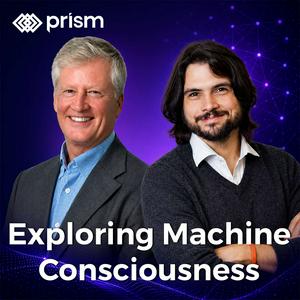
Get the free radio.net app
- Stations and podcasts to bookmark
- Stream via Wi-Fi or Bluetooth
- Supports Carplay & Android Auto
- Many other app features
Get the free radio.net app
- Stations and podcasts to bookmark
- Stream via Wi-Fi or Bluetooth
- Supports Carplay & Android Auto
- Many other app features

Exploring Machine Consciousness
Scan code,
download the app,
start listening.
download the app,
start listening.
Exploring Machine Consciousness: Podcasts in Family
 UK
UK