

Listen to this podcast in the app for free: Download for free in the App Store
radio.net
Sleep timer
Save favourites
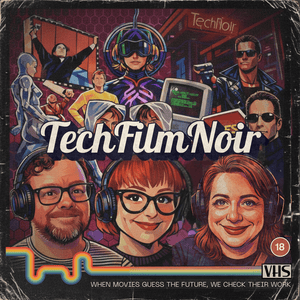
Tech Film Noir - A Technology and Film Podcast
Tech Film Noir - Part of the Compromising Positions Group
Latest episode
7 episodes
WEIRD SCIENCE (1985): Dial-up Genies, Acoustic Couplers, & Smashing up Memotech MTX500s
03/09/2026 | 38 mins.This week on Tech Film Noir, we're watching Weird Science (1985), John Hughes's hormone-fueled Frankenstein story that asked the ultimate 80s question: can a half-megabyte of RAM generate the perfect woman?
Join Lianne Potter, Simon Painter, and Jeff Watkins as they revisit a cinematic fever dream where two desperate teenagers bypass actual coding in favor of a acoustic coupler and a ceremonial bra on the head.
Anthony Michael Hall and Ilan Mitchell-Smith star as Gary and Wyatt, two nerds who hook up a Memotech MTX500 to a government mainframe and accidentally invent an AI girlfriend. Kelly LeBrock stars as Lisa, a magical digital genie who operates entirely on teenage logic, while the film hilariously sidesteps real tech to ask if feeding magazine clippings into a scanner can actually spawn human life (but to be fair, it isn’t much different to the frontier AI companies scanning books!).
Along the way, we break down the elite 80s hardware on display: from Casio CA-90 calculator watches to massive 8-inch floppy disks. We also dig into the slightly terrifying modern reality of AI companion forums, the charm of primitive wireframe 3D graphics, and the timeless tech-support troubleshooting method of just smashing a CRT monitor with a baseball bat.
When movies guess the future, we check their work.
Big shout out to the This Aged Great Podcast and the Starring the Computer websiteStrange Days (1995): Kathryn Bigelow's 90s Cyberpunk Vision of VR, Meta Glasses & Digital Memories
06/08/2026 | 40 mins.In this episode of Tech Film Noir, we're watching Strange Days (1995), Kathryn Bigelow's cyberpunk thriller, written by James Cameron, that imagined VR headsets, wearable recording technology and immersive first-person experiences decades before Meta Glasses became a reality.
Join Lianne Potter, Simon Painter and Jeff Watkins as they revisit one of the 90s' most ambitious science fiction films, exploring how Strange Days predicted wearable cameras, bodycam footage as "the only truth", memory streaming and our growing obsession with experiencing life through someone else's eyes.
Ralph Fiennes stars as Lenny Nero, an ex-cop turned black-market dealer of recorded memories, using the SQUID headset to sell other people's experiences. Think Meta Ray-Bans with a very illegal firmware update. Angela Bassett is, unsurprisingly, the coolest person in every room, while the film asks whether technology designed to bring us closer to reality actually leaves us more disconnected than ever.
Along the way we dive into Y2K paranoia, one of the best sci-fi soundtracks of the 90s, cyberpunk world-building, questionable predictions that thankfully never happened, and the ones that absolutely did. Nearly 30 years after its release, Strange Days feels less like forgotten science fiction and more like an instruction manual for the age of VR, wearable AI and smart glasses.
When movies guess the future, we check their work.
Join Lianne Potter, Simon Painter, and Jeff Watkins as they explore how The Running Man predicted many of today's biggest debates, from algorithm-driven entertainment and manufactured public opinion to surveillance, misinformation, and the commercialisation of violence. Inspired by Stephen King's novel, the film asks what happens when truth becomes secondary to ratings and audiences stop questioning the stories they're being sold.
Expect gladiatorial game shows, propaganda masquerading as entertainment, AI-worthy media manipulation, corporate dystopias, delightfully excessive one-liners, and a discussion about why one of the greatest 1980s action films may also be one of its most surprisingly prescient..
When movies guess the future, we check their work.The Dystopian Future That Became Our Deepfake Reality | The Running Man (1987)
09/07/2026 | 54 mins.This episode on Tech Film Noir, we watched The Running Man (1987), the Arnold Schwarzenegger sci-fi action classic that imagined a future where reality television, media manipulation, corporate power, and public spectacle collide. Nearly four decades later, its vision of entertainment-driven society feels less like science fiction and more like an uncomfortable reflection of the modern world.
Join Lianne Potter, Simon Painter, and Jeff Watkins as they explore how The Running Man predicted many of today's biggest debates, from algorithm-driven entertainment and manufactured public opinion to surveillance, misinformation, and the commercialisation of violence. Inspired by Stephen King's novel, the film asks what happens when truth becomes secondary to ratings and audiences stop questioning the stories they're being sold.
Expect gladiatorial game shows, propaganda masquerading as entertainment, AI-worthy media manipulation, corporate dystopias, delightfully excessive one-liners, and a discussion about why one of the greatest 1980s action films may also be one of its most surprisingly prescient..
When movies guess the future, we check their work.The 2002 Film That Predicted Deepfakes, Virtual Celebrities and AI Actors | Simone (2002)
11/06/2026 | 50 mins.This week on Tech Film Noir, we examine the Al Pacino comedy, Simone (2022), that accidentally saw the future. While the film itself is a chaotic mess of farce, misunderstandings, and increasingly questionable computer science, its central warning feels more relevant than ever: what happens when fake people become more valuable than real ones?
Join Lianne Potter, Simon Painter, and Jeff Watkins as they dissect the Al Pacino movie that accidentally predicted the future. From AI-generated celebrities and digital likeness rights to deepfakes and synthetic media, S1M0NE turns out to be far more relevant than anyone expected…even if the film itself spends most of its runtime desperately trying to avoid its own best ideas.
Expect virtual divas, Hollywood panic, questionable computer science, cyber security by floppy disk ejection, and a masterclass in how to waste a brilliant premise.
When movies guess the future, we check their work.Before Alexa, There Was Edgar | Electric Dreams (1984)
14/05/2026 | 1hThis week on Tech Film Noir, we plug ourselves into the strange, synth-soaked world of Electric Dreams — the gloriously weird 1984 cult sci-fi movie where a socially awkward architect, a spilled bottle of champagne on his brand new PC, and an overenthusiastic home computer accidentally create one of cinema’s earliest AI love triangles.
What starts as a light PG comedy quickly mutates into something far stranger: part rom-com, part techno-thriller, part MTV fever dream. We unpack why the film was massively mismarketed, why Edgar the computer has more chemistry than the actual romance, and why its depiction of AI learning feels surprisingly relevant in the age of generative AI and smart homes.
Expect retro tech nostalgia, Commodore 64s, Casio calculator watches, suspiciously British “San Francisco” locations, exploding smart appliances, and plenty of discussion about the iconic Together in Electric Dreams soundtrack from Philip Oakey and Giorgio Moroder.
As the song says, “we’ll always be together, however far it seems” - which becomes slightly more sinister once your house develops emotional attachment issues.
Listen now if you love cult sci-fi, retro tech, AI chaos, and weird 80s cinema.
When movies guess the future, we check their work.
Ps. Big up the Tech Time Traveller for their great video on the tech in this film
More Film History podcasts
 WHAT WENT WRONGFilm History, History, TV & Film
 Wool-Shift-Dust: a Silo TV podcastArts, Books, Fiction, Film History, Science Fiction, TV & Film
 Hammer Time: A Hammer Horror PodcastFilm History, TV & Film
 The Video Archives Podcast with Quentin Tarantino & Roger AvaryFilm History, TV & Film
 The Evolution of HorrorFilm History, TV & Film
 When They Were Making ItFilm History, History, TV & Film
 Journey Through Sci-Fi: Science Fiction Film HistoryFiction, Film History, History, Science, TV & Film
 Film Stories with Simon BrewFilm History, TV & Film
 The Plot ThickensFilm History, TV & Film
 Boring History For Sleep | Gentle Storytelling And Ambient Sounds (Official)Film History, TV & Film
Trending Film History podcasts
About Tech Film Noir - A Technology and Film Podcast
When Movies Guess the Future, We Check Their Work!
Welcome to Tech Film Noir where we break down the technology in classic and cult films!
We're talking about popping kernels, to processing power and diving into the wild, wild, world of cinematic technology!
Did it predict the future or just make us laugh?
A monthly podcast for those who love film and tech!
Featuring: Lianne Potter, Jeff Watkins and Simon Painter
Podcast websiteListen to Tech Film Noir - A Technology and Film Podcast, WHAT WENT WRONG and many other podcasts from around the world with the radio.net app
Get the free radio.net app
- Stations and podcasts to bookmark
- Stream via Wi-Fi or Bluetooth
- Supports Carplay & Android Auto
- Many other app features
Get the free radio.net app
- Stations and podcasts to bookmark
- Stream via Wi-Fi or Bluetooth
- Supports Carplay & Android Auto
- Many other app features
Tech Film Noir - A Technology and Film Podcast
Scan code,
download the app,
start listening.
download the app,
start listening.
 UK
UK