

Listen to this podcast in the app for free: Download for free in the App Store
radio.net
Sleep timer
Save favourites
113 episodes
Hala Alyan on baby loss, healing & the waiting that never ends
02/12/2025 | 1h 10 mins.Today, I’m so honoured to welcome Hala Alyan to the podcast. Hala is an award-winning Palestinian American writer, poet, and clinical psychologist whose work has long explored the intimate spaces between memory, home, displacement, and the inner worlds we navigate. Many readers know her through her poetry and her acclaimed novels Salt Houses and The Arsonists’ City, but her latest book, I’ll Tell You When I’m Home, brings us into an even more intimate landscape. Structured in twelve chapters - each corresponding to a month of pregnancy — the memoir unfolds at the pace of a body hoping, fearing, changing, and remembering.
In this conversation, we explore how Hala writes about belonging, grief, and the complicated terrain of family and identity. We also spend time with the memoir’s deeply personal themes: infertility, baby loss, and the ways these experiences reshape identity and belonging - how they alter one’s relationship to the body, to lineage, and to the idea of home. Hala writes with remarkable honesty about her struggle with alcohol addiction and the difficult, courageous work of recovery, and she is equally candid about the complexities of marriage: the tensions, the ruptures, and the quiet forms of repair that make long-term partnership both challenging and deeply human.
We also reflect on the past two years, and how this moment for Palestine — the grief, the witnessing, the insistence on remembering - has shaped her understanding of heritage, responsibility, and where we locate ourselves in times of collective pain.
It’s a thoughtful, layered, and profoundly honest conversation, and I’m truly grateful to share it with you.
Support the showOva Ceren on switching careers, fantasy and family secrets
26/11/2025 | 59 mins.This week, I'm joined by Ova Ceren, whose debut novel The Book of Heartbreak is a raw, tender, and compelling exploration of love, loss, and healing amid a fantasy world of angels and the other side. With lyrical prose and unflinching honesty, Ova takes readers on a journey through the intensity of different types of love and loss, while also throwing us into a family of secrets, unspoken histories and a journey of self-discovery.
Ova Ceren writes bittersweet tales of heartbreak and magic, often inspired by Turkish and Ottoman folklore. Blessed (or perhaps cursed) with a mathematical brain, she earned a degree in Computer Science and a master’s that led her into a career in IT, taking her from Türkiye to Britain. After years of wrestling with algorithms in corporate jungles, she finally eloped with a debut novel instead.Ova now lives in Cambridge, UK, with her husband, son, and a spirited flock of runner ducks.
In our conversation, we talk about what inspired her to write such a story, moving into writing from being a software engineer, the fantasy genre, heartbreak, Turkey and Turkish history and so much more. I'm so pleased to be sharing this conversation with you.
Support the showSaima Begum on the stories we inherit, trauma & memory
18/11/2025 | 1h 7 mins.Today I’m joined joined by Saima Begum, a British-Bangladeshi writer whose voice is courageous, lyrical, and intent on bringing untold histories out of the silence.
Saima Begum lives in London, and though The First Jasmines is her debut novel, she has already made her mark - she won the MFest Short Story Competition in 2021.
Her novel The First Jasmines (published 31 July 2025 with Hajar Press) is set during the final stages of the Bangladesh Liberation War, in 1971, and follows two sisters, Lucky and Jamila, who are captured by Pakistani soldiers and held in a detention-camp. Locked in a single room by the river, they see outside a barred window the white jasmines blooming day and night, even as the brutal violence of war rages all around.
What emerges in The First Jasmines is not just a story of war and the suffering inflicted, but a deeply human account of survival, memory, and the afterlives of violence. Begum explores how women in the detention camp develop inner lives even under extreme oppression: how they talk among themselves, remember their lives before, reflect on motherhood, marriage, beauty, bodily autonomy, and struggle for dignity.
In Begum’s words, she felt she “didn’t see that reflected in the literature” about Bangladesh and its war - this gap compelled her to write.
In this episode, we talk about silences, the stories we inherit, womanhood, identity, survival, hope and so much more. I'm honoured to share this conversation with you.
Support the showSunny Singh on war, love and stories that refuse silence
07/10/2025 | 1hThis week, I'm thrilled to be in conversation with Professor Sunny Singh.
Sunny Singh was born in India and over the years her life has spanned continents and languages. She earned a BA in English and American Literature at Brandeis University, followed by a master’s in Spanish Literature from Jawaharlal Nehru University, and a PhD from the University of Barcelona. Over time, she has written novels, creative nonfiction, essays, and short stories; she also serves as Professor of Creative Writing and Inclusion in the Arts at London Metropolitan University.
Beyond her writing, Sunny has been a powerful force for literary equity. In 2017 she launched the Jhalak Prize, a prize for writers of colour in the UK and Ireland, and continues to engage deeply with questions of decolonisation, representation and the literary ecosystem. In recognition of her contributions to letters, she was elected a Fellow of the Royal Society of Literature.
Her new short story collection, Refuge: Stories of War (and Love) (released August 2025) is a striking, ambitious volume that brings into conversation the most urgent and often silenced narratives of conflict, displacement, and resilience. Over its dozen or so stories, the collection moves across continents and histories - touching on war zones, refugee lives, gendered violence, memory, and the possibility of tenderness even amid devastation.
What sets Refuge apart is how it refuses easy binaries: perpetrators sometimes carry scars of suffering; survivors negotiate moral compromise and loss; the stories do not dwell on revenge but insist on empathy, nuance, and the endurance of human dignity. Still, the collection does not shy away from brutality—sexual violence, war crimes, colonial legacies—and the way these violences embed themselves in bodies, histories, homes and memory. And yet the final gesture of many of these stories is not surrender. They gesture toward renewal, connection, and the redemptive potential in telling the stories we fear.
Support the showTasneem Abdur-Rashid on writing YA, family & rebuilding after divorce
30/09/2025 | 1hFor today’s episode, I’m joined by Tasneem Abdur-Rashid for the third time in three years! Tasneem is a communications professional, writer, and author of the powerful new novel Odd Girl Out. Tasneem’s work explores identity, faith, family, and belonging, with characters and stories that speak to experiences rarely seen in mainstream publishing.
Odd Girl Out follows the story of 15-year-old Maariyah who is navigating friendship, love, and the weight of expectations, while also confronting the unspoken challenges of mental health and community pressures. Her life is uprooted following the divorce of her parents, and she leaves behind a life of glitz and glamour in Dubai, for the rather less impressive, London. It’s a novel that is both deeply relatable and refreshingly bold in its honesty.
In our conversation, we talk about the inspiration behind the book, Tasneem’s journey as a writer, divorce and family, and the importance of seeing authentic Muslim representation in literature.
I’m so honoured to share this conversation with you – it’s moving, insightful, and necessary.
Support the show
More Arts podcasts
 Table Manners with Jessie and Lennie WareArts, Food, Kids & Family, Music
 Sara & Cariad's Weirdos Book ClubArts, Books, Comedy
 ill-advised by Bill NighyArts, Books, Comedy, Music
 DishArts, Comedy, Food, Society & Culture
 Experience is EverythingArts, Performing Arts, Society & Culture
 THEMOVEArts, Sports
 The MothArts, Performing Arts
 The Magnus ArchivesArts, Drama, Fiction, Performing Arts, Science Fiction
Trending Arts podcasts
 The Jimmy Dore ShowArts, Comedy, News, Performing Arts, Politics
 A Jane Austen YearArts, Fiction, History
 Extraordinary CreativesArts, Leisure, Personal Journals, Society & Culture, Visual Arts
 The Creative Penn Podcast For WritersArts, Books, Business, Education, Entrepreneurship, Self-Improvement
 Faber Poetry PodcastArts
 Fashion PeopleArts, Business, Fashion & Beauty
 The Ghost Story Book ClubArts, Books
 The Apocalypse PlayersArts, Comedy, Games, Improv, Leisure, Performing Arts
 House Guest by Country & Town House | Interior Designer InterviewsArts, Design
 In Writing with Hattie CrisellArts, Books, Film Interviews, TV & Film
 Creative Pep TalkArts, Business, Design, Education
 Alt Shift X PodcastArts, Books, TV & Film
 Gretel le Maître Ponders Beauty, with Bede & other guestsArts, Books, Christianity, Documentary, Education, Health & Wellness, History, Mental Health, Nature, Personal Journals, Places & Travel, Religion & Spirituality, Science, Self-Improvement, Society & Culture, Spirituality
 The Strike & Ellacott FilesArts, Books
About The Diverse Bookshelf
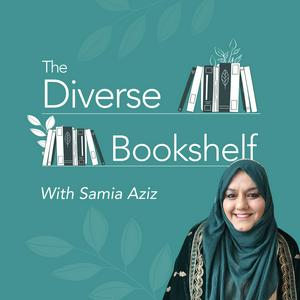
Welcome to The Diverse Bookshelf. I’m Samia Aziz, celebrating the power of literature and the voices of authors and change makers from the global majority. Join me as we explore the stories that inspire, connect, and transform our world. Each week I interview an inspiring guest about a whole host of themes and issues while focusing on diverse literature. Let’s uncover the stories that truly matter—together.
Podcast websiteListen to The Diverse Bookshelf, Table Manners with Jessie and Lennie Ware and many other podcasts from around the world with the radio.net app
Get the free radio.net app
- Stations and podcasts to bookmark
- Stream via Wi-Fi or Bluetooth
- Supports Carplay & Android Auto
- Many other app features
Get the free radio.net app
- Stations and podcasts to bookmark
- Stream via Wi-Fi or Bluetooth
- Supports Carplay & Android Auto
- Many other app features
The Diverse Bookshelf
Scan code,
download the app,
start listening.
download the app,
start listening.
 UK
UK