

Listen to this podcast in the app for free: Download for free in the App Store
radio.net
Sleep timer
Save favourites
163 episodes
Ep 155 - Skywalker Sound's Sean England on cattle gates, Brillo pads and Birkenstocks
07/09/2026 | 59 mins.Sean England has been at Skywalker Sound since 1993. He didn't arrive as a foley artist. He came in on the technical side, in the machine room and the transfer department, back when everything went to analog tape and film was spliced on a Kem. He calls those years his film school. He watched sound get made from one end of a picture to the other, then became a foley recordist, then a mixer, then went through the glass and became the artist.
The show where he cut his teeth was The Clone Wars. There was one foley stage at the Ranch in those days, so he and Ronni Brown took the night shift and cranked the episodes out, learning to work fast and picking up the Star Wars tricks handed down from Dennie Thorpe and Jana Vance.He's very good on what the job actually is. An egg crack might be an ice cream cone. The sizzle in the pan might be a candle held under tinfoil. He's got a recording of a cattle gate on his phone that he still hasn't cracked, and then somebody gave him a metal contraption built for hanging blueprints and it turned out to be exactly the sound.
He picks up leather purses in thrift shops and holds them to his ear to check for creak. He puts shoes on and looks for a hard surface to walk on.He's a drummer too, and he came up in the eighties being told drum machines would replace him, so he has a settled view on whether sound libraries and new tech are coming for his job.We cover the anatomy of a foley stage, why the mixer isn't watching his hands, the weight difference between Marvel and Star Wars and Pixar, Lincoln split between a day crew and a night crew who had to match each other, grasshopper footsteps for documentaries, mic placement as performance, and the off-mic tricks he doesn't always mention to the mixer.
Thanks so much for your continued support!
This podcast is completely independent and made possible by listener support. If you’d like to help me keep making these episodes, you can join my Patreon community here: https://patreon.com/jamiebenning
Watch more on YouTube:
Check out the Filmumentaries YouTube channel for behind-the-scenes clips and extra content: https://youtube.com/filmumentaries
All my links154 - Wolf Kahler - Colonel Dietrich from Raiders - Rerelease
27/08/2026 | 26 mins.Ep 154 — Wolf Kahler — Colonel Dietrich in Raiders of the Lost Ark
For Episode 154 of The Filmumentaries Podcast, I’m going back to one of my earliest and most memorable interviews: a conversation with German actor Wolf Kahler, best known to film fans as Colonel Dietrich in Raiders of the Lost Ark.Kahler’s wonderfully imposing performance as the Nazi officer who helps Belloq search for the Ark is one of the many unforgettable supporting performances in Spielberg’s 1981 adventure. But there’s much more to his career than one film.In this episode, Wolf talks about his acting career, how he came to be cast in Raiders of the Lost Ark, working with Steven Spielberg and the cast, and his memories of making one of the most beloved adventure films ever made.It’s also a chance to revisit the making of Raiders from the perspective of someone who was actually there — and to hear stories from behind the scenes that you won’t find in the finished film.Wolf Kahler has appeared in numerous films and television productions, often playing German military characters, including The Dirty Dozen: The Next Mission, The Bourne Identity, The Remains of the Day, Charlotte Gray, Wonder Woman and The Great Escaper.So, grab your hat, whip and favourite archaeological artefact, and join me for a conversation with Colonel Dietrich himself.
This podcast is completely independent and made possible by listener support. If you’d like to help me keep making these episodes, you can join my Patreon community here: https://patreon.com/jamiebenning
Watch more on YouTube:
Check out the Filmumentaries YouTube channel for behind-the-scenes clips and extra content: https://youtube.com/filmumentaries
All my linksEp 153 - Brad Fiedel - Film Composer - Terminator, T2 and more
11/08/2026 | 1h 17 mins.Brad Fiedel wrote one of the most recognisable pieces of music in film history, and he did it on a drum machine, a sequencer and a keyboard chained together with a computer ribbon cable, before MIDI was really a thing. The famous lurch in the rhythm is him hitting a button by hand and deciding the wobble was better than the fix. Years later Henry Mancini rang up wanting to record it with a big band, and the man writing the lead sheet couldn't work out the time signature.
There is a lot more to Brad than Terminator, and that's really what this conversation is about. He grew up inside his parents' school of the arts on Long Island, his dad a jazz musician, his mum a modern dancer who studied with Martha Graham. He spent years improvising live for dance classes, which turned out to be exactly the muscle a film composer needs, though nobody told him that at the time. He nearly signed to Columbia. He played keys for Hall and Oates in 1974 and jammed with the band that became the E Street Band. He was working with Arthur Miller and Vanessa Redgrave before James Cameron ever called.We get into temp tracks and why he never did his best work against one, when a scene is better off with no music at all, the direction Cameron gave him on the canal chase in T2, and the moment after the True Lies sessions when a small voice told him he was finished. These days his regular gig is writing musicals with first graders in Santa Barbara, and he's very clear that he gets as much out of it as they do.
This podcast is completely independent and made possible by listener support. If you’d like to help me keep making these episodes, you can join my Patreon community here: https://patreon.com/jamiebenning
Watch more on YouTube:
Check out the Filmumentaries YouTube channel for behind-the-scenes clips and extra content: https://youtube.com/filmumentaries
All my linksEp 152 John Goodson - Model Maker and Digital Artist
28/07/2026 | 51 mins.Episode 152: John Goodson (Part 1)
John Goodson is a model maker and digital artist who spent more than three decades at ILM. His credits span The Rocketeer, Star Trek: First Contact, the Star Wars prequel trilogy, Rogue One, and most recently The Mandalorian and Grogu. In this first of two episodes, I talk to John about his lifelong obsession with spacecraft and model-making, how he got to ILM, what the model shop was like at its peak, and the craft philosophy that has defined his career. In this episode:
Growing up obsessed with Lost in Space, Star Log, and the making-of books that shaped his ambitions
Writing letters to ILM at age 14 — and getting politely told to stop
How a childhood friendship and a homemade recreation of the Battle of Hoth eventually led to his first visit to ILM
The advice that sent him back to finish school — and why it was the right call
Getting hired for one week on Body Wars and spending the first three days hiding in the model shop hoping nobody would notice
What the ILM model shop culture was like at its peak, and what he absorbed from Bill George, Lorne Peterson, Larry Tan, and the rest of that team
The 18-foot Titanic model for Ghostbusters II and learning to just start building
The 33-foot Hindenburg for The Rocketeer — eight months of construction, a night shoot at a decommissioned Air Force base, kerosene running out of the holes, and a cherry picker at 25 feet
The pasta trick, pancake syrup, and other unexpected materials that found their way into ILM shots
Watching the digital wave arrive and feeling like parts of the machine were being taken away
The transition to digital model-making and eventually finding his footing with Mari
What it felt like to return to physical model-making for The Mandalorian — and what was hardest about working without the model shop around him
The mechanical language of spacecraft: why weathering works, what Star Crash got wrong, and the disposable camera exercise that taught a kit-bash class to see the real world differently
How the Razor Crest started as a 3D-printed assembly that couldn't survive construction — and what he did about it
Part two is coming soon...
This podcast is completely independent and made possible by listener support. If you’d like to help me keep making these episodes, you can join my Patreon community here: https://patreon.com/jamiebenning
Watch more on YouTube:
Check out the Filmumentaries YouTube channel for behind-the-scenes clips and extra content: https://youtube.com/filmumentaries
All my linksEp 151 | Ian Hunter - VFX Supervisor on Cameron, Burton and more
09/06/2026 | 1h 40 mins.Ian Hunter has spent four decades building miniatures, supervising visual effects and thinking like a filmmaker on some of the most demanding productions in Hollywood. In this episode, he traces a career that began in a garden shed with a punched-up piece of German black velvet and ended up — via James Cameron, Tim Burton, the Coen Brothers, and Christopher Nolan — on some of the most iconic screens in the world.
Ian grew up surrounded by art. His father painted oils and acrylics, played music and did pastel portraits, and encouraged his three sons to make things — even when those things destroyed the materials he'd given them. The moment that really clicked, Ian recalls, was being handed a model kit as a kid and taking to it immediately. That creative instinct only grew stronger. In high school, he and his brothers were making Super 8 films, scratching laser effects onto the film with a pin and blowing up overloaded resistors for explosions. One of those films required them to fake-rob a local bank — and the encounter that followed, with the surprisingly enthusiastic vice president of the Monrovia Wells Fargo, led to a meeting with the mother of Rick Baker, whose work Ian had recently encountered in a traveling special effects exhibition and been completely floored by.
After drifting away from an aerospace course at Cal Poly Pomona and working in an acid bath plastics factory, Ian answered a classified ad looking for model makers — and on the strength of a modest portfolio, was hired the same day. His first feature was The Abyss. He and fellow model maker Jim McGee built the flooded engine room of the Montana submarine with almost no direction beyond James Cameron's bare-bones description, and shipped it to South Carolina having never seen a frame of the live action. The production was not without its disasters — Ian found himself entangled in the notorious wax crane fiasco, and talks about the valuable early lesson of knowing when to call something out before it goes wrong.
From there, a friend pointed him toward Boss Film, Richard Edlund's company in Marina del Rey, where a chance encounter with departing model supervisor Mark Stetson changed everything. What was supposed to be a one-week favour on a music video turned into six years. Working with Stetson took Ian from being a junior model maker building things in isolation to visiting sets, talking directly with directors, and understanding that miniature work only succeeds when it becomes invisible — just more shots in a movie, telling the story rather than showing off the technique.
Among the projects from that period, Ian talks at length about Total Recall — including the behind-the-scenes chaos of a scale miscommunication on the final day of shooting, a scene involving a little person that nobody had accounted for, and the moment he glued a Coke can to a model building because they were running out of time. That Coke can, dressed up and shot from the front, made it into the finished film. So did one in Waterworld. And Inception. And Interstellar. And, after the story apparently got around, director Fede Álvarez greeted Ian on Alien: Romulus by asking exactly where he was planning to hide it.
Ian built the suburb for Edward Scissorhands — deliberately making it more bland and mundane than real life — and talks about one of his proudest in-camera shots: the final view through the bedroom window and out over the snow-dusted neighbourhood, achieved with a 1:24 scale model and real snow shakers on the night. On Batman Returns he built the Penguin's zoo, and describes receiving one of his all-time favourite compliments from Tim Burton — who, after watching a pyrotechnics test, asked simply: "Where did you shoot this?" Not realising he was looking at a miniature. The zoo also gave Ian one of his best examples of a happy accident: a polar bear sculpture that was supposed to explode but instead toppled slowly sideways with flames coming out of its feet. Tim Burton loved it. The entire subsequent engineering challenge was figuring out how to recreate the mistake.
On the X-Files movie, Ian and his partner Matthew Gratzner built a collapsing federal building on a tight budget, referencing Oklahoma City bombing photographs for the detail of damaged concrete and exposed floors. The late Roger Ebert reviewed the finished film and said the sequence should have been cut — because it was too reminiscent of real tragedy. Ian reflects on that as a marker: they'd gotten past the technique and into the emotion.
The conversation turns to Christopher Nolan, with whom Ian has worked across multiple films. Ian describes Nolan as collaborative but definitive, someone who discusses a shot in depth and then tells you exactly what he wants. He talks about the liberation Nolan offered on Interstellar when he told the crew to stop following the previs — pre-vis is just a guy at a computer on a Friday trying to get the shot out the door, Nolan told them; if you can see a better angle, do that instead. The result was that the miniature crew started shooting faster, and a number of shots that had been planned as digital moved across to the physical side. Ian also describes the meticulous sun-angle calculation that went into matching the Inception hospital sequence — setting up models in a parking lot at a precisely calculated skewed angle to hit the exact quality of light that had been captured in Calgary on a specific date.
On First Man with Damien Chazelle, Ian had drawn storyboards before the first meeting proposing a documentary approach — cameras attached to the spacecraft, nothing sweeping or cinematic, everything either very close or very wide as if shot from another ship. Chazelle walked in and described exactly the same idea. They spent twenty minutes together going through the sequence, working to an animatic cut to music, and Ian went off and shot it. That shorthand — that moment of being in sync before the conversation has really started — is something Ian describes as central to how he has survived in an industry where so many practical effects houses have not. He's a model maker, yes. But more than that, he's a filmmaker.
This podcast is completely independent and made possible by listener support. If you’d like to help me keep making these episodes, you can join my Patreon community here: https://patreon.com/jamiebenning
Watch more on YouTube:
Check out the Filmumentaries YouTube channel for behind-the-scenes clips and extra content: https://youtube.com/filmumentaries
All my links
More Film History podcasts
 Journey Through Sci-Fi: Science Fiction Film HistoryFiction, Film History, History, Science, TV & Film
 WHAT WENT WRONGFilm History, History, TV & Film
 Boring History For Sleep | Gentle Storytelling And Ambient Sounds (Official)Film History, TV & Film
 The Plot ThickensFilm History, TV & Film
 Halloweenies: A Horror Franchise PodcastFilm History, Film Interviews, Film Reviews, TV & Film
 The Evolution of HorrorFilm History, TV & Film
 Hammer Time: A Hammer Horror PodcastFilm History, TV & Film
 When They Were Making ItFilm History, History, TV & Film
 Going RogueFilm History, TV & Film
 General Witchfinders: The British Horror PodcastFilm History, Film Reviews, TV & Film, TV Reviews
Trending Film History podcasts
About The Filmumentaries Podcast
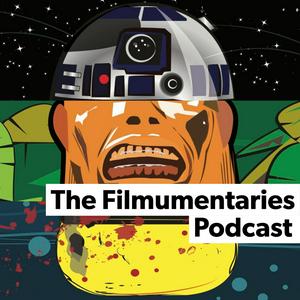
The Filmumentaries Podcast - deep dives into practical effects, model making, matte painting, creature creation and prosthetics, animatronics, puppetry, prop restoration and VFX. Hosted by filmmaker, author, and film historian Jamie Benning, The Filmumentaries Podcast features long-form interviews with the unsung heroes of cinema - the production designers, editors, composers, cinematographers, digital artists, puppeteers, model makers, sound designers and effects crews who actually bring our favourite films to life. Each episode dives into the real work of filmmaking, from practical, in-camera effects to cutting-edge digital techniques. You'll hear from art directors, production designers, VFX supervisors, model makers, matte painters, creature and animatronics experts, puppeteers, performance capture artists, motion control specialists, editors, sound designers, re-recording mixers, composers, animators, prop restoration experts and Propstore archivists who helped shape iconic films like Star Wars, Indiana Jones, Jurassic Park, Blade Runner, Jaws, Ghostbusters and Alien. With a strong focus on practical effects, physical filmmaking, and the craft behind the illusion, the podcast preserves the knowledge and stories of the people who built, shot and brought these worlds to life long before pixels took over - and those still pushing the boundaries today through performance capture, motion control and modern visual effects. Jamie is also a writer for Industrial Light & Magic (ILM) and Skywalker Sound, and has close ties to the BFI's film restoration and archive teams. Whether you're a cinephile, filmmaker, prop collector or simply curious about how films are really made, this podcast is your all-access pass to film history.What You'll Discover:First-hand stories from the artists, craftspeople and technicians behind the filmsDeep dives into practical effects, model making, matte painting, prosthetics, animatronics, puppetry, performance capture and VFXConversations on production design, art direction, cinematography, editing, sound design and film composingInterviews with veterans of ILM, Lucasfilm, Skywalker Sound, Weta, DNEG, Digital Domain and Stan Winston StudioHistoric coverage of iconic films including Star Wars, Indiana Jones, Jaws, Jurassic Park, Blade Runner, Ghostbusters, Alien and many moreA celebration of cinema's hidden heroesNew episodes every other week. Follow @filmumentaries on Instagram, Threads and Facebook, and @jamieswb on X. Visit filmumentaries.com for transcripts, archives and bonus content.
Podcast websiteListen to The Filmumentaries Podcast, Journey Through Sci-Fi: Science Fiction Film History and many other podcasts from around the world with the radio.net app
Get the free radio.net app
- Stations and podcasts to bookmark
- Stream via Wi-Fi or Bluetooth
- Supports Carplay & Android Auto
- Many other app features
Get the free radio.net app
- Stations and podcasts to bookmark
- Stream via Wi-Fi or Bluetooth
- Supports Carplay & Android Auto
- Many other app features
The Filmumentaries Podcast
Scan code,
download the app,
start listening.
download the app,
start listening.
 UK
UK