

Listen to this podcast in the app for free: Download for free in the App Store
radio.net
Sleep timer
Save favourites
233 episodes
New Series
14/10/2026 | 0 mins.Misha Glenny introduces the brand new series of In Our Time, which begins with a discussion on Thomas More’s 16th-century ‘bestseller’ Utopia, his vision of a perfect republic. This follows his latest archive selection, from 2012, that explores timekeeping in the ancient world up to the modern digital clock.
This podcast collection is now unavailable. To continue listening, search for and follow the main In Our Time podcast on BBC Sounds or wherever you find your BBC podcasts. New episodes arrive weekly.A Message from Misha
12/10/2026 | 0 mins.This podcast collection is now unavailable. To continue listening, search for and follow the main In Our Time podcast on BBC Sounds or wherever you find your podcasts. New episodes arrive weekly.The Delian League
16/07/2026 | 54 mins.Misha Glenny and guests discuss the origins and evolution of an alliance which transformed the geopolitics of the classical world: the Delian League. Since the start of the 5th Century BCE, city states across Greece had been fighting a series of armed conflicts in the Greco-Persian Wars. After the defeat of a second Persian invasion in 478 BCE, a league of cities across Greece came together and formed a new alliance led by Athens. That alliance is now known as the Delian League, after the island of Delos where it was established. In the following decades, Athens used the Delian League to grow its own wealth and formidable naval power. Cities which tried to leave the alliance found themselves violently put down and their lands confiscated by the Athenians. What had begun as a cooperative alliance sworn to resist the Persian Empire gradually started to seem like it may have created another imperial power: the Athenian Empire.
With
Leah Lazar
Lecturer in Hellenistic Culture at the University of Manchester
Polly Low
Professor in the Department of Classics and Ancient History at the University of Durham
And
Paul Cartledge
AG Leventis Senior Research Fellow of Clare College, University of Cambridge
Producer: Martha Owen
Aristophanes (trans. David Barrett and Alan H. Sommerstein), The Birds and Other Plays (Penguin Classics, 2003)
Mary Beard, The Parthenon (Profile Books, 2010)
M. Canevaro and D. M. Lewis, 'Between ‘The Character of the Athenian Empire’ and The Origins of the Peloponnesian War (and beyond): The Popularity of the Athenian Empire Revisited' (Polis 41:1, 2024)
Paul Cartledge, Ancient Greece: A Very Short Introduction (Oxford University Press, 2011)
Lisa Kallet and John H. Kroll, The Athenian Empire: Using Coins as Sources (Cambridge University Press, 2020)
Leah Lazar, Athenian Power in the Fifth Century BC (Oxford University Press, 2024)
Polly Low (ed.), The Athenian Empire (Edinburgh University Press, 2008)
Malcolm F. McGregor, The Athenians and their Empire (UBC Press, 1987)
Robin Osborne (ed. and trans.), The Athenian Empire (Cambridge University Press, 2023)
P. J. Rhodes, The Athenian Empire (Clarendon Press, 1985)
Thucydides (trans. Robin Waterfield, introduced by Polly Low), The History of the Peloponnesian War (Basic Books, 2025)
Thucydides (ed. Robert B Strassler), The Landmark Thucydides: A Comprehensive Guide to the Peloponnesian War (Free Press, 1998)
Thucydides (trans. Rex Warner), History of the Peloponnesian War (Penguin Books, 2000)
Thucydides (trans. Martin Hammond), The Peloponnesian War (Oxford University Press, 2009)
In Our Time is a BBC Studios production
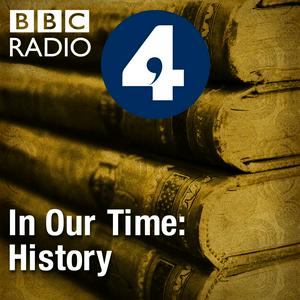
Spanning history, religion, culture, science and philosophy, In Our Time from BBC Radio 4 is essential listening for the intellectually curious. In each episode, host Misha Glenny and expert guests explore the characters, events and discoveries that have shaped our world.The Welsh Marches
25/06/2026 | 52 mins.At the Hay Festival, Misha Glenny and guests discuss the impact of the Norman invasion on the people and land of Wales and across the modern border with England in what became known as The Welsh Marches, march being a term for a militarized borderland. Hay was one of the first Marcher lordships. Even before 1066, William the Conqueror knew that he would have to subdue the Welsh if he were to control the English and he allowed more and more Norman warlords to establish virtually their own private kingdoms in these Marches. Later some of the Lords were to use these bases to invade Ireland rather than conquer the rest of Wales. Marcher Lords built numerous castles such as the one at Hay and many new towns would then grow up alongside these where there was one law for the English and another for the Welsh and, though the Acts of Union under the Tudors brought an end to much of the Marcher Lords' powers, the distinct identity of these Welsh Marches continued.
With
Rhun Emlyn
Lecturer in the Department of History and Welsh History at Aberystwyth University
Helen Fulton
Professor of Medieval Literature at the University of Bristol
And
Huw Pryce
Emeritus Professor of Welsh History at Bangor University
Producer: Simon Tillotson
Reading list:
R. R. Davies, The Age of Conquest: Wales 1063-1415 (Oxford University Press, 2001)
R.R. Davies, Lordship and Society in the March of Wales 1282-1400 (Oxford University Press, 1978)
John Fleming, The Welsh Marcher Lordships II: South-West (Logaston Press, 2023)
Ben Giles, The Welsh Marches: 40 Town and Country Walks (Pocket Mountains, 2012)
Philip Hume, The Welsh Marcher Lordships I: Central & North (Logaston Press, 2021)
Max Lieberman, The March of Wales, 1067–1300: A Borderland of Medieval Britain (University of Wales Press, 2018)
Max Lieberman, The Medieval March of Wales: The Creation and Perception of a Frontier, 1066-1283 (Cambridge University Press, 2010)
D. Huw Owen, The Lordship of Denbigh 1282-1543 (University of Wales Press, 2024)
Mike Parker, All the Wide Border: Wales, England and the Places Between (HarperNorth, 2024)
Dewi Roberts, Both Sides of the Border: An Anthology of Writing on the Welsh Border Region (Gwasg Carreg Gwalch/Eagle Rock Press, 1998)
Christopher Somerville, The Welsh Borders (Philips, 1991)
David Stephenson, Patronage and Power in the Medieval Welsh March: One Family's Story (University of Wales Press, 2021)
David Walker, Medieval Wales (Cambridge University Press, 2008)
In Our Time is a BBC Studios Production
Spanning history, religion, culture, science and philosophy, In Our Time from BBC Radio 4 is essential listening for the intellectually curious. In each episode, host Misha Glenny and expert guests explore the characters, events and discoveries that have shaped our world.The Levellers
18/06/2026 | 55 mins.Misha Glenny and guests discuss the group which came to be known as the Levellers and emerged during what would become arguably one of the bloodiest and most turbulent periods of English history. After the First English Civil War, the Levellers started calling for reforms to achieve legal and social equality. They pushed for a new constitution, extended franchise, popular sovereignty, and religious toleration. To do this, the Levellers pioneered the use of pamphlets and petitions, as well as taking to the streets in their thousands to demonstrate wearing their signature sea-green ribbons and sprigs of rosemary. To some they were radical, and to others not radical enough. Though the Leveller movement itself may have been short-lived, the arguments that they made have both inspired and challenged generations since.
With
Teresa Bejan
Professor of Political Theory and Fellow of Oriel College, University of Oxford
Ted Vallance
Professor of History and Dean of Research and Doctoral Study at the University of Roehampton
And
Clare Jackson
Honorary Professor of Early Modern History and Walter Grant Scott Fellow in History at Trinity Hall, University of Cambridge
Producer: Martha Owen
Reading list:
Teresa M. Bejan, First Among Equals: Visions of Equality before Egalitarianism (Belknap Press, forthcoming in 2026)
Michael Braddick, The Common Freedom of the People: John Lilburne and the English Revolution (Oxford University Press, 2018)
Rachel Foxley, The Levellers; Radical Political Thought in the English Revolution (Manchester University Press, 2013)
Christopher Hill, The World Turned Upside Down (Penguin, 1972)
Ann Hughes, Gender and the English Revolution (Routledge, 2011)
John Rees, The Leveller Revolution: Radical Political Organisation in England, 1640-1650 (Verso Books, 2016)
John Rees (ed.), John Lilburne and the Levellers: Reappraising the Roots of English Radicalism 400 years on (Routledge, 2017), including 'Reborn John: The Eighteenth-Century Afterlife of John Lilburne' by Edward Vallance
Andrew Sharp (ed.), The English Levellers (Cambridge University Press, 1998)
Edward Vallance, A Radical History of Britain: Visionaries, Rebels and Revolutionaries - the men and women who fought for our freedoms (Abacus, 2010)
Blair Worden, Roundhead Reputations: The English Civil Wars and The Passions of Posterity (Penguin, 2002)
In Our Time is a BBC Studios production
Spanning history, religion, culture, science and philosophy, In Our Time from BBC Radio 4 is essential listening for the intellectually curious. In each episode, host Misha Glenny and expert guests explore the characters, events and discoveries that have shaped our world.
More History podcasts

Trending History podcasts









About In Our Time: History
This podcast collection is now unavailable. To continue listening, search for and follow the main In Our Time podcast on BBC Sounds or wherever you find your podcasts. New episodes arrive weekly.
Podcast websiteListen to In Our Time: History, The Rest Is History and many other podcasts from around the world with the radio.net app
Get the free radio.net app
- Stations and podcasts to bookmark
- Stream via Wi-Fi or Bluetooth
- Supports Carplay & Android Auto
- Many other app features
Get the free radio.net app
- Stations and podcasts to bookmark
- Stream via Wi-Fi or Bluetooth
- Supports Carplay & Android Auto
- Many other app features

In Our Time: History
Scan code,
download the app,
start listening.
download the app,
start listening.
In Our Time: History: Podcasts in Family

 UK
UK