
Listen to this podcast in the app for free: Download for free in the App Store
radio.net
Sleep timer
Save favourites
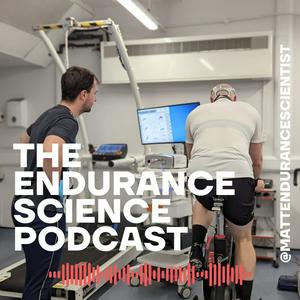
The Endurance Science Podcast with Matt Carpenter
Matt Carpenter
Latest episode
16 episodes
How to Make Sense of Strava Data - the Road to London 2027
21/09/2026 | 25 mins.In this episode I go through the science behind the data that Strava and your smart watches is giving you, and give my take on what data is useful, what's rubbish and what you should interpret with skepticism.
https://www.strava.com/athletes/10072190
https://www.justgiving.com/page/matthew-carpenter-6How to Periodise Training - the Road to London 2027
14/09/2026 | 32 mins.In this episode I discuss the main focus on my current training block, the races I have planned leading up to London Marathon and how to periodise your training over long periods of time.
https://www.justgiving.com/page/matthew-carpenter-6The Road to London 2027 #1 - Introduction
07/09/2026 | 18 mins.The Science of Endurance is back and better than ever!
New weekly series following my Journey to London Marathon 2027, where I'll be using my own training to talk about the science behind training, nutrition, supplementation, shoes and more, all in a bit to help you run faster, run better and understand the science behind how we train.
I'll be running London 2027 for Hospice UK, a fantasitc charity that supports people at the end of their lives. Any donations along this journey will be hugely appreciated - and thanks for tuning back in!
https://www.justgiving.com/page/matthew-carpenter-6The Pill That Made Exercise Work Less
12/05/2026 | 19 mins.For years, rapamycin has been hailed as the closest thing we have to a real longevity drug, taken by biohackers, prescribed by telehealth clinics, and promoted across the wellness internet.
The first proper randomised controlled trial combining it with exercise in older adults just dropped, and the results are a wake-up call about how we treat supplement hype.The Science of Ketones
14/04/2026 | 24 mins.In this episode, i discuss a major topic of my PhD, exognoeus ketones. Is the hype worth it? What does the research say? Do ketones really replicate altitude training? All are discussed in this episode.
References:
https://journals.physiology.org/doi/full/10.1152/ajpendo.00264.2022
https://physoc.onlinelibrary.wiley.com/doi/full/10.1113/JP284346
More Fitness podcasts




Trending Fitness podcasts

About The Endurance Science Podcast with Matt Carpenter
A podcast that cuts through the endless noise and misinformation social media noise presents us, and discusses what the science really says about endurance performance.
Podcast websiteListen to The Endurance Science Podcast with Matt Carpenter, UNTAPPED with Spencer Matthews and many other podcasts from around the world with the radio.net app
Get the free radio.net app
- Stations and podcasts to bookmark
- Stream via Wi-Fi or Bluetooth
- Supports Carplay & Android Auto
- Many other app features
Get the free radio.net app
- Stations and podcasts to bookmark
- Stream via Wi-Fi or Bluetooth
- Supports Carplay & Android Auto
- Many other app features

The Endurance Science Podcast with Matt Carpenter
Scan code,
download the app,
start listening.
download the app,
start listening.
The Endurance Science Podcast with Matt Carpenter: Podcasts in Family
 UK
UK