

Listen to this podcast in the app for free: Download for free in the App Store
radio.net
Sleep timer
Save favourites
181 episodes
Somerset Maugham's On a Chinese Screen: Missionaries, Taipans, and Expats Who Never Leave (but probably should)
29/07/2026 | 35 mins.In this Barbarians at the Gate x China Books Review crossover, Jeremiah Jenne is joined by CBR Associate Editor Alexander Boyd to discuss the latest addition to the China Archives: W. Somerset Maugham's On a Chinese Screen (1922), a collection of vignettes from Maugham's trip through China in the winter of 1919–1920.
Maugham came to China and mostly found... the English. Missionaries who profess love for a country they secretly loathe, taipans dreading burial in Chinese soil, diplomats who could be posted to Peking or Bern without noticing the difference. Jeremiah and Alexander match these hundred-year-old archetypes to expats they have known, and chart the "Cycle of China Funk," the wave pattern that should replace the PowerPoint version of culture shock and adaptation. They follow Maugham's habit of recycling real people into his fiction, including handing the scholar Gu Hongming's rebuke of Western power to a stage villain in East of Suez. And they bring Gerald Haxton out of the shadows: the hard-drinking companion who made the whole trip and never appears in the book.
Next month on the China Archives: Shen Fu's Six Records of a Floating Life.
Keywords: Somerset Maugham, On a Chinese Screen, China Books Review, Barbarians at the Gate podcast, Gu Hongming, Gerald Haxton, expat life in China, China travel writing, British colonialism in China, China ArchivesBarbarian Remix: The Secrets and History behind Beijing's Forbidden City
16/07/2026 | 40 mins.It’s the summer travel season, and one of the most popular sites here in Beijing is the Palace Museum at the Forbidden City. To talk about China’s most famous imperial palace, we are joined by Matthew Hu Xinyu, Trustee of the Beijing Cultural Heritage Protection Center (CHP) and founder of the Courtyard Institute. Matthew provides us with updates on renovated sections of the Palace Museum previously inaccessible to tourists, such as the Palace of Compassion and Tranquility (Cining Gong 慈宁宫), where the Empress Dowager celebrated her birthdays and worshipped the Buddha, and the living quarters of the imperial concubines located north and west of Longzong Gate. Matthew also gives us a fascinating overview of the complex task of renovating the centuries-old compound and the challenges the Palace Museum faces in restoring, protecting, and exhibiting its 1.8 million artifacts.
Palaces, artifacts, and historical figures mentioned on the podcast:
Hall of Mental Cultivation, Yangxin Dian养心殿
Palace of Established Happiness建福宮Jianfu Gong
jinzhuan金砖 ”metal/gold bricks”
Dr. Shan Jixiang 单霁翔, curator of the Palace Museum from 2012 to 2019
Imperial Fasting Palace Zhai Gong斋宫
“Dwelling in the Fuchun Mountains” Fuchun Shanju Tu 富春山居圖, a famous Yuan Dynasty painting by Huang Gongwang (黃公望, 1269-1354). The painting was divided into two pieces after being rescued from a fire. The two sections were later separated; the main section is now housed at the Taipei Palace Museum, and the smaller section, referred to as “The Remaining Mountain,” 剩山圖 Sheng Shan Tu, is part of the Beijing collection.
“Precious Works of the Stone Canal Pavilion” 石渠宝笈 Shiqu Baoji. A vast Qing collection of paintings and calligraphy by emperors and famous artists, divided into categories such as books, paintings, scrolls, and calligraphy.
Hall of Three Rarities Sanxi Tang 三希堂
“Reign behind the curtain” Chuilian tingzheng垂帘听政
Retirement Lodge Juanqin Zhai倦勤斋
Palace of Longevity and Health Shoukang Gong寿康宫
Fragile Cargo: China’s Wartime Race to Save the Treasures of the Forbidden City by Adam Brookes. “The gripping true story of the bold and determined museum curators who saved the priceless treasures of China’s Forbidden City in the years leading up to World War II and beyond.”
“Masters in the Forbidden City” Wo zai Gugong xiu wenwu 我在故宫修文物. State media documentary on the ongoing restoration projects of the Forbidden City. Available on YouTube:
https://www.youtube.com/watch?v=Pw6awYYu_6s
This episode originally aired in July 2023.Neysun Mahboubi on the past, present, and future of US-China Academic Exchanges
02/07/2026 | 1h 1 mins.We are honored to have Professor Neysun Mahboubi, Director of the Penn Project on the Future of U.S.-China Relations, a program that provides a platform for talented U.S.-based China scholars to contribute academically informed analysis on the most important issues in U.S.-China relations. Neysun recounts his experiences as a legal scholar in China during the 1990s Reform and Opening Up period, focusing on his mentors and the legal scholars who were at the forefront of legal reform in the PRC. A passionate advocate for scholarly research on China, Neysun emphasizes the value of on-the-ground research, for those who are able to do so, in these increasingly complicated times.
Neysun A. Mahboubi is Director of the Penn Project on the Future of U.S.-China Relations at the University of Pennsylvania, where he teaches courses on Chinese history, law, and policy and hosts the China Studies podcast. He is also a Non-Resident Senior Fellow with the Asia Program at the Foreign Policy Research Institute.AI Slop, AI Detectors, and Authentic Voice: A China-Tech Insider on Writing and Working With AI
18/06/2026 | 39 mins.Should we view today’s powerful AI language tools as intellectual crutches or as incredibly useful assets? Can they be safely integrated into our existing toolkit for business and academia, or should we approach them with justified caution? And why is the Western world terrified of AI, whereas China is already incorporating it into all sectors of society? Spoiler alert: The West views AI as a possible extinction risk, to be monitored and controlled, while China pragmatically views it as merely a tool to improve the lives of ordinary people.
In this episode, we’re delighted to welcome back Zhang Yajun, founder of Zhang Global Advisory. Yajun shares her insights on the rapidly expanding role of Artificial Intelligence in global business communication and academic research.
Yajun offers a more measured and practical take. From personal experience, she knows that non-native speakers can effectively use AI to produce writing that is clear, idiomatic, and faithful to their original ideas — while still preserving their authentic "human tone" and avoiding the sterile, formulaic output that AI often generates.China Books Review x Barbarians at the Gate: The Private Life of Chairman Mao
04/06/2026 | 26 mins.The Politburo had given Mao Zedong’s personal physician Li Zhisui a direct order: prepare the Chairman’s body so that he can be on permanent display. Li was aghast. It was not what Mao had wanted, and besides, “How to pickle your country’s leader” wasn’t one of the courses he studied in medical school. But after the turbulence of the Cultural Revolution, Mao’s death meant a potential political showdown between the Gang of Four, including Mao’s wife, Jiang Qing, and Mao’s chosen successor, Hua Guofeng. Dr. Li did not want to be caught in the middle. So Li and his team did the best they could. Spoiler alert: it involved a massage that nobody would want to give.
Li Zhisui’s controversial memoir, The Private Life of Chairman Mao, was published in 1994. Readers were titillated by Mao’s sex life, questionable hygiene regime, and gruesome medical maladies. Defenders of Mao labeled the book pure propaganda. Dr. Li was a disloyal liar, and his collaborators and publishers were pushing anti-Mao agendas.
Jeremiah is joined by Alexander Boyd, Associate Editor of the China Books Review, to discuss Mao Zedong, Li Zhisui, and Jeremiah’s recent retrospective essay about The Private Life of Chairman Mao. Who was Dr. Li? What did it take to survive in the courtyards of power at the peak of Mao’s paranoia? And did Dr. Li really witness all of the major events he described in his book?
More History podcasts
 After Dark: Myths, Misdeeds & the ParanormalHistory, Society & Culture, True Crime
 WW2 Pod: We Have Ways of Making You TalkEducation, History, Society & Culture
 You're Dead to MeComedy, History
 Dan Snow's History HitHistory
 The Rest Is HistoryHistory
 The Rest Is ClassifiedHistory
 The History PodcastHistory
 Empire: World HistoryHistory
 British ScandalDocumentary, History, Society & Culture
Trending History podcasts
 Pax Britannica: A History of the British EmpireEducation, History, Society & Culture
 The C-WordHistory, Society & Culture
 Past LivesHistory
 The Irish History BoysEducation, History, News
 Family LoreDocumentary, History, Society & Culture
 Biblical Time MachineChristianity, History, Religion & Spirituality
 Easy Money: The Charles Ponzi StoryDocumentary, History, Society & Culture, True Crime
 The English Heritage PodcastHistory
 Patented: History of InventionsHistory, Science, Technology
 D-Day: The Tide TurnsHistory
 History of the 90s: The Tupac Murder TrialDocumentary, History, Society & Culture, TV & Film
 UnobscuredDocumentary, History, Society & Culture
 Our Fake HistoryEducation, History, Society & Culture
 History That Doesn't SuckEducation, History, Society & Culture
 SPYCRAFT 101Education, Government, History
 Everything Everywhere Daily: History, Science, Geography & MoreEducation, History
 My Victorian NightmareHistory, True Crime
 In Our Time: CultureHistory
 No One Saw It ComingHistory
About Barbarians at the Gate
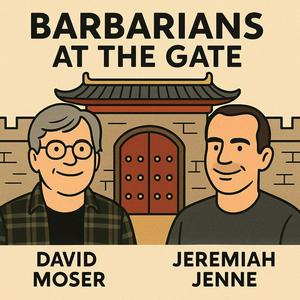
A semi-serious deep dive into Chinese history and culture broadcast from Beijing and hosted by Jeremiah Jenne and David Moser.
Podcast websiteListen to Barbarians at the Gate, After Dark: Myths, Misdeeds & the Paranormal and many other podcasts from around the world with the radio.net app
Get the free radio.net app
- Stations and podcasts to bookmark
- Stream via Wi-Fi or Bluetooth
- Supports Carplay & Android Auto
- Many other app features
Get the free radio.net app
- Stations and podcasts to bookmark
- Stream via Wi-Fi or Bluetooth
- Supports Carplay & Android Auto
- Many other app features

Barbarians at the Gate
Scan code,
download the app,
start listening.
download the app,
start listening.
Barbarians at the Gate: Podcasts in Family
 UK
UK