
Listen to this podcast in the app for free: Download for free in the App Store
radio.net
Sleep timer
Save favourites
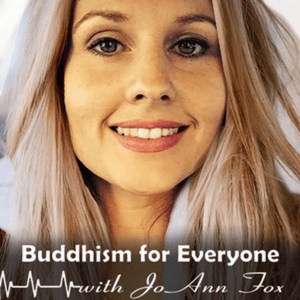
Buddhism for Everyone with JoAnn Fox
JoAnn Fox: Buddhist Teacher
Latest episode
232 episodes
Episode 231 - Reliance on a Teacher
06/08/2026 | 42 mins.In a world obsessed with DIY, YouTube tutorials, and learning everything ourselves, navigating the depths of our own minds can land us not knowing where to start or how to practice. In this episode of Buddhism for Everyone, JoAnn Fox breaks down a foundational practice in Tibetan Buddhism: Relying on a Spiritual Teacher.
Far from checking your brain at the door or surrendering your autonomy, relying on a spiritual guide is like hiring an experienced mountain guide before attempting to summit Everest. Having a teacher is genuinely a life-hack that saves you years of trial and error.
In this episode, JoAnn explores:
What Reliance Really Means: Why healthy devotion isn't about personality worship, but cultivating internal respect, admiration, and gratitude for someone's kindness.
The 10 Qualities Checklist: The traditional criteria to evaluate potential teachers (from mental discipline and deep compassion to resilience and mastery of wisdom).
The Highest Offering: Why material gifts mean very little compared to the ultimate gift you can offer your teacher, which is to put their teachings into practice. Your increasing happiness is the best offering.
Whether you're actively searching for a mentor or looking to deepen your relationship with the teachings you've already received, join JoAnn for a practical, warm, and heart-opening discussion on stepping off the "DIY treadmill" and walking the path with clarity.
"The actual reliance on a spiritual teacher is done through the cultivation of certain thoughts, particularly faith, admiration, and respect based on the recognition of your teacher's great kindness."
"The best way of making an offering to your teacher is to practice what you've been taught."
--Dalai Lama, from Illuminating the Path to Enlightenment
Resources:
The Fourteenth Dalai Lama (2002). Illuminating the Path to Enlightenment. Lama Yeshe Wisdom Archive.
Find us at the links below:
Our Link Tree: https://linktr.ee/BuddhismForEveryone
Facebook: https://www.facebook.com/Buddhismforeveryone
Private Facebook Group:: https://www.facebook.com/groups/sanghatalk/
Website: Buddhismforeveryone.com
Instagram: @buddhism4everyone
X: @Joannfox77
TikTok: @buddhism4everyone
YouTube: @Buddhism4Everyone
To learn more about the new Wednesday evening drop-in classes on Zoom, visit https://buddhismforeveryone.com/meditation-classes-for-peace
Interested in an online Study Program, visit https://buddhismforeveryone.com/ongoing-buddhist-study-program
To learn about Buddhist Coaching with JoAnn Fox visit www.BuddhismforEveryone.com or email JoAnn Fox at joann@buddhismforeveryone.comEpisode 230 - Gratitude & Emptiness
12/06/2026 | 37 mins.When we hear the word "emptiness" (shunyata) in Buddhist philosophy, it's easy to mistake it for nothingness or a bleak void. But true emptiness isn't an absence of life: it is the absence of separation. It means nothing exists independently. Everything is interconnected.
Everything depends on causes and conditions. One of the causes of how things exist is how we perceive them! So, how do we move this beautiful concept from our heads into our hearts? Through the daily practice of gratitude.
The Mind as a Creator
When we practice gratitude, we vividly see that things don't have a fixed, unchangeable "nature" out there on their own. Instead, their reality changes based on the lens we use to look at them. A dead-stop traffic jam can be a miserable prison, or it can be a rare, quiet moment to listen to a favorite podcast and breathe.
The traffic itself hasn't changed, but your mind's perception has. Gratitude proves that our experiences are "empty" of independent existence. They are actively shaped by our own awareness.
The Practice: A 7-Day Mindset Shift
To deeply experience this wisdom, try this daily reflection: Every morning this week, write down one thing you are grateful for. Challenge yourself to make it completely different every single day.
Transforming the Difficult: If there is an area of your life that feels heavy or frustrating, contemplate what there is to be grateful for within that very challenge. For example, you might deeply dislike your current job, but you aren't ready to quit just yet. If the job were inherently bad, it would be bad from every single angle. But when you look closer, you might contemplate how fortunate you are to have an income.
You might think about a specific co-worker you enjoy, or feel grateful for the unique skills you've gained there. By finding gratitude in the difficult, you prove to yourself that the situation isn't a fixed, solid block of "misery." Its existence depends entirely on how your mind interacts with it. That is the lived experience of emptiness, and realizing that your mind holds the power to reshape your reality is where your true freedom lies.
Find us at the links below:
Our Link Tree: https://linktr.ee/BuddhismForEveryone
Facebook: https://www.facebook.com/Buddhismforeveryone
Private Facebook Group:: https://www.facebook.com/groups/sanghatalk/
Website: Buddhismforeveryone.com
Instagram: @buddhism4everyone
X: @Joannfox77
TikTok: @buddhism4everyone
YouTube: @Buddhism4Everyone
To learn more about the new Wednesday evening drop-in classes on Zoom, visit https://buddhismforeveryone.com/meditation-classes-for-peace
Interested in an online Study Program, visit https://buddhismforeveryone.com/ongoing-buddhist-study-program
To learn about Buddhist Coaching with JoAnn Fox visit www.BuddhismforEveryone.com or email JoAnn Fox at joann@buddhismforeveryone.comEpisode 229 - Boundaries in Buddhism
25/05/2026 | 38 mins.In Buddhism, we're encouraged to cherish others more and deepen our compassion. Some may wonder if there is a contradiction between these heart-opening practices and having healthy boundaries.
But here is the truth: even the Buddha set boundaries.
In the texts, the Buddha frequently chose who to engage with, when to enter noble silence, and how to protect himself so he could serve the world effectively. In fact, true compassion requires boundaries. Sometimes the kindest thing to do for another is to set a strong boundary.
In this episode, JoAnn Fox explores the concept of boundaries through a Buddhist lens. We look at how creating a boundary isn't an act of anger or separation; it's an act of wise compassion for ourselves and others.
According to the American Psychological Association, healthy boundaries are not "walls" to keep people out, but rather "gates" that allow you to manage your energy and safety.
Buddhism offers perspectives to help us find the sweet spot between "porous" boundaries that leave us depleted, and "rigid" boundaries that keep us isolated or limit our growth.
" All the happiness in the world arises from wishing others to be happy
All the suffering in the world arises from wishing ourselves (alone) to be happy."
—Shantideva, Guide to the Bodhisattva's Way of Life
Shantideva (1997). A Guide to the Bodhisattva's Way of Life. Translated by Vesna and B. Alan Wallace. Shambala Publications.
Find us at the links below:
Our Link Tree: https://linktr.ee/BuddhismForEveryone
Facebook: https://www.facebook.com/Buddhismforeveryone
Private Facebook Group:: https://www.facebook.com/groups/sanghatalk/
Website: Buddhismforeveryone.com
Instagram: @buddhism4everyone
X: @Joannfox77
TikTok: @buddhism4everyone
YouTube: @Buddhism4Everyone
To learn more about the new Wednesday evening drop-in classes on Zoom, visit https://buddhismforeveryone.com/meditation-classes-for-peace
Interested in an online Study Program, visit https://buddhismforeveryone.com/ongoing-buddhist-study-program
To learn about Buddhist Coaching with JoAnn Fox visit www.BuddhismforEveryone.com or email JoAnn Fox at joann@buddhismforeveryone.comEpisode 228 - Be Love
12/05/2026 | 42 mins.If you've ever longed for love—and let's be honest, who hasn't?—you'll recognize the familiar dance our minds do. We build the "ideal" in our heads. We make lists of the qualities we need in a partner. We dissect our past heartbreaks like forensic investigators, trying to figure out exactly what went wrong.
We search and search, looking outward for that one person who will finally fill the cup. But what if we're looking at the map upside down?
Buddhist wisdom suggests that the path to fulfillment isn't about finding the perfect love, but about becoming it. We resolve to become a source of love for others. It's important to note that to "Be Love" isn't a practice just for single people. This practice is for parents, for people with parents, and for those with a partner, neighbors, or co-workers. Essentially, the practice of love opens an endless well of happiness for anyone who tries to get good at it.
In Buddhism, love isn't just a warm, fuzzy feeling that washes over you. Love is a verb. It is the active wish for another person to be happy. But more than just a wish, it's a wish with legs, a readiness to actually do something to move the needle on someone else's joy.
The intention of love manifests in a million different ways: from the BIG life sacrifices to the small moments, like taking out the trash, or the profound act of accepting someone exactly as they are. When we act from this place, we make others feel seen, understood, and accepted.
Essentially, we start giving the world exactly what we've been longing to receive. This is to Be Love.
Cultivating the intention of love has the power to:
- transform relationships
- level up our happiness
- give us profound peace
"Cease to do evil,
cultivate the good,
purify the mind;
this is the teaching of the Buddhas"
Buddha, Dhammapada (Verse 183)
Find us at the links below:
Our Link Tree: https://linktr.ee/BuddhismForEveryone
Facebook: https://www.facebook.com/Buddhismforeveryone
Private Facebook Group:: https://www.facebook.com/groups/sanghatalk/
Website: Buddhismforeveryone.com
Instagram: @buddhism4everyone
X: @Joannfox77
TikTok: @buddhism4everyone
YouTube: @Buddhism4Everyone
To learn more about the new Wednesday evening drop-in classes on Zoom with JoAnn Fox called 'Being Peace,' visit https://buddhismforeveryone.com/meditation-classes-for-peace
To learn about Life Coaching with JoAnn Fox visit www.BuddhismforEveryone.com or email JoAnn Fox at joann@buddhismforeveryone.comEpisode 227 - Always Rely on a Happy Mind Alone
07/04/2026 | 39 mins.Always rely on a happy mind alone. This Buddhist slogan for training the mind isn't about "positive thinking" or just being happy. A "happy mind" refers to a mind that is peaceful and free from delusions, like like anger, jealousy, pride or attachment.
When a delusion like anger is operating in the mind, we no longer see clearly. A delusion is like a warped mirror: everything we see in this mirror is distorted. For example, when we're hurt we might get angry at someone we love. Anger then makes us see that person as the cause of our pain, a threat, so that we speak and act in regrettable ways.
'Always rely on a happy mind alone' reminds us that when our mind isn't peaceful, it can't be trusted. The thoughts arising can't be trusted. Perhaps we need a timeout, a break, or a nap!
"When another person makes you suffer,
it is because he suffers deeply within himself, and his suffering is spilling over.
He does not need punishment; he needs help.
That's the message he is sending."
– Thich Nhat Hanh
"Always rely on a happy mind alone."--Geshe Chekawa
To learn more about the new Wednesday evening drop-in classes on Zoom with JoAnn Fox called 'Being Peace,' visit https://buddhismforeveryone.com/meditation-classes-for-peace
Find us at the links below:
Our Link Tree: https://linktr.ee/BuddhismForEveryone
Facebook: https://www.facebook.com/Buddhismforeveryone
Private Facebook Group:: https://www.facebook.com/groups/sanghatalk/
Website: Buddhismforeveryone.com
Instagram: @buddhism4everyone
X: @Joannfox77
TikTok: @buddhism4everyone
YouTube: @Buddhism4Everyone
To learn about Life Coaching with JoAnn Fox visit www.BuddhismforEveryone.com or email JoAnn Fox at joann@buddhismforeveryone.com
More Buddhism podcasts



Trending Buddhism podcasts
About Buddhism for Everyone with JoAnn Fox
Buddhism for Everyone with JoAnn Fox is a bi-weekly podcast that shares how to put the teachings of Buddhism into practice to be happier, more peaceful, or to become the spiritual warrior this world so desperately needs. JoAnn Fox has been teaching Buddhism for over 20 years and does so with kindness and humor.
Podcast websiteListen to Buddhism for Everyone with JoAnn Fox, Heart Wisdom with Jack Kornfield and many other podcasts from around the world with the radio.net app
Get the free radio.net app
- Stations and podcasts to bookmark
- Stream via Wi-Fi or Bluetooth
- Supports Carplay & Android Auto
- Many other app features
Get the free radio.net app
- Stations and podcasts to bookmark
- Stream via Wi-Fi or Bluetooth
- Supports Carplay & Android Auto
- Many other app features
Buddhism for Everyone with JoAnn Fox
Scan code,
download the app,
start listening.
download the app,
start listening.
 UK
UK