

Listen to this podcast in the app for free: Download for free in the App Store
radio.net
Sleep timer
Save favourites
13 episodes
Newcomb’s Paradox
05/09/2026 | 29 mins.After a three-month summer break, Theo and his mum are back — refreshed, motivated, and ready to get stuck into some seriously questions!
In this episode, they dive into the strange world of paradoxes, where things can seem completely logical… until they suddenly aren’t. The Card Paradox provides a relatively easy introduction, but things get considerably more heated when they tackle Newcomb’s Paradox!
And because no episode would be complete without a few distractions, the conversation eventually moves from philosophical puzzles to technology, Geometry Dash and Theo’s latest mathematical adventure, as he reveals the details of an exciting new maths coaching opportunity.
After a long break, the curious Casements are back — and it seems Theo and Mum still don’t agree on everything!
Sources & further learning:
Thanks to Veritasium for this video which inspired this heated debate:
https://youtu.be/Ol18JoeXlVI?is=W7BRXXGAdoFhZpw4
Main show description:
Theo Casement is a curious kid with a thirst for facts, and in this short, family-friendly podcast he explores big questions about maths, science, and how the world works through relaxed, curiosity-led conversations.
This podcast is designed to spark curiosity and a love of learning in children and families, encouraging discussion and exploration rather than formal teaching. Perfect for curious kids, parents, and educators who enjoy learning through conversation and big ideas explained simply.
Follow us on Instagram @educasement for extra resources, visuals, and topic support linked to each episode.
Got a big question you’d like Theo to explore? Get in touch — we’d love to hear from you.
Fancy a shout out or would you like to make a guest appearance? Send us some details in the comments and we'll get back to you.Hexagons: Nature’s Favourite Shape
14/05/2026 | 26 mins.Ever noticed how often hexagons appear in the world around us? Wondered why honeycombs use six sides, or how one of the world’s strongest materials is built from the very same pattern?
Then this episode is for you!
What begins as a simple look at a six-sided figure, soon turns into a fascinating discussion about efficiency, strength, and why certain patterns appear again and again throughout the natural world.
Together, they uncover the science behind honeycombs, snowflakes and ice crystals, pencil design, strange hexagonal patterns on Saturn, and graphene — the remarkable material made from carbon atoms arranged in hexagons, often described as one of the strongest materials ever discovered.
A thoughtful and curious look at how one simple shape quietly appears in some of nature’s smartest designs.
Punctuated with funny moments, spontaneous outbursts and ending with a joke and a tongue-twister song - this episode has it all!
Sources & further learning:
Thanks to CGP Grey for this video which inspired the topic…and for bringing us the phrase ‘hexagons are the bestagons’
https://youtu.be/thOifuHs6eY?si=VCdGgzifEqU0MGh4
Main show description:
Theo Casement is a curious kid with a thirst for facts, and in this short, family-friendly podcast he explores big questions about maths, science, and how the world works through relaxed, curiosity-led conversations.
This podcast is designed to spark curiosity and a love of learning in children and families, encouraging discussion and exploration rather than formal teaching. Perfect for curious kids, parents, and educators who enjoy learning through conversation and big ideas explained simply.
Follow us on Instagram @educasement for extra resources, visuals, and topic support linked to each episode.
Got a big question you’d like Theo to explore? Get in touch — we’d love to hear from you.
Fancy a shout out or would you like to make a guest appearance? Send us some details in the comments and we'll get back to you.Evolution (part 2): Natural Selection
19/04/2026 | 12 mins.Ever wondered how some animals survive while others don’t? Or why certain traits — like speed, strength, or camouflage — make such a difference in the wild?
In this episode, Theo and his mum continue their exploration of evolution by focusing on natural selection — the process that shapes which traits get passed on over time. Together, they discuss how strengths and weaknesses affect survival, how camouflage can mean the difference between life and death between predator and prey.
Building on Part 1, this episode brings evolution to life through simple, real-world examples that show how small advantages can have a big impact over generations.
Main show description:
Theo Casement is a curious kid with a thirst for facts, and in this short, family-friendly podcast he explores big questions about maths, science, and how the world works through relaxed, curiosity-led conversations.
This podcast is designed to spark curiosity and a love of learning in children and families, encouraging discussion and exploration rather than formal teaching. Perfect for curious kids, parents, and educators who enjoy learning through conversation and big ideas explained simply.
Follow us on Instagram @educasement for extra resources, visuals, and topic support linked to each episode.
Got a big question you’d like Theo to explore? Get in touch — we’d love to hear from you.
Fancy a shout out or would you like to make a guest appearance? Send us some details in the comments and we'll get back to you.Evolution (part 1): What came first…Chicken or Egg?
04/04/2026 | 21 mins.Ever wondered which came first — the chicken or the egg? Thought it was just a silly question? Or realised it might actually have a scientific answer?
Then this episode is for you!
In this episode, Theo and his mum take on one of the oldest and most debated questions of all time. What starts as a simple puzzle quickly turns into a fascinating discussion about evolution, how species change over time, and what we really mean when we say something is a “chicken”.
Together, they explore how eggs existed long before chickens, how tiny changes across generations can lead to entirely new species, and why the answer might not be as straightforward as it first seems.
We’re not experts, just curious Casements enjoying a fun debate, but here’s a link to a video we mentioned which helps support our conversation…
Sources & further learning:
‘Which came first - the chicken or the egg’ by AsapSCIENCE - https://youtu.be/1a8pI65emDE?si=-Ugh9QL8yB5YBzC1
Main show description:
Theo Casement is a curious kid with a thirst for facts, and in this short, family-friendly podcast he explores big questions about maths, science, and how the world works through relaxed, curiosity-led conversations.
This podcast is designed to spark curiosity and a love of learning in children and families, encouraging discussion and exploration rather than formal teaching. Perfect for curious kids, parents, and educators who enjoy learning through conversation and big ideas explained simply.
Follow us on Instagram @educasement for extra resources, visuals, and topic support linked to each episode.
Got a big question you’d like Theo to explore? Get in touch — we’d love to hear from you.
Fancy a shout out or would you like to make a guest appearance? Send us some details in the comments and we'll get back to you.Probability: The Lottery and Coin Flips
14/03/2026 | 22 mins.Ever wondered why winning the lottery is so unlikely? Thought a coin toss should always come out 50/50? Or questioned the odds when you roll a dice?
Then this episode is for you!
In this episode, Theo returns to one of his favourite topics — maths — to explore the curious world of probability. Together with his mum (and special guest), he unpacks what probability actually means, why some outcomes are far more likely than others, and how mathematicians work out the chances of things happening.
Along the way, Theo explains the odds behind winning the lottery, the logic of rolling dice, and introduces a simple heads-or-tails game to test whether things really do balance out over time. The conversation demonstrates Pascal’s Triangle, a surprisingly powerful mathematical pattern that helps explain combinations and probability.
Making a special appearance this week is the youngest member of the family — little sister Heidi — who joins the experiments and quickly turns the discussion into our funniest episode yet.
We’re not experts, just curious Casements enjoying a fun debate, but here’s a link to a video that might help with some visuals to support our conversation…
Sources & further learning:
Pascal’s Triangle by April Spiller - https://youtu.be/LDK_dBT7wTo?si=kczAlQabgboxvyCA
Main show description:
Theo Casement is a curious kid with a thirst for facts, and in this short, family-friendly podcast he explores big questions about maths, science, and how the world works through relaxed, curiosity-led conversations.
This podcast is designed to spark curiosity and a love of learning in children and families, encouraging discussion and exploration rather than formal teaching. Perfect for curious kids, parents, and educators who enjoy learning through conversation and big ideas explained simply.
Follow us on Instagram @educasement for extra resources, visuals, and topic support linked to each episode.
Got a big question you’d like Theo to explore? Get in touch — we’d love to hear from you.
Fancy a shout out or would you like to make a guest appearance? Send us some details in the comments and we'll get back to you.
More Education for Kids podcasts
 Brains On! Science podcast for kidsEducation for Kids, Kids & Family
 CBeebies PodcastEducation for Kids, Kids & Family
 12 Hour Sound Machines for Sleep (no loops or fades)Education for Kids, Health & Wellness, Kids & Family, Mental Health
 Mysteries of ScienceEducation for Kids, Kids & Family
 Fun Kids Science QuestEducation for Kids, Kids & Family, Science
 The Week Junior ShowEducation for Kids, Kids & Family, News, News Commentary
 Evie AsksEducation for Kids, Health & Wellness, Kids & Family, Mental Health, Parenting, Stories for Kids
 The Middle School Mary Poppins PodcastEducation, Education for Kids, Kids & Family, Parenting, Self-Improvement, Stories for Kids
 Smash Boom Best: A funny, smart debate show for kids and familyEducation for Kids, Kids & Family
Trending Education for Kids podcasts
 Moment Of UmEducation for Kids, Kids & Family
 Maddie's Sound ExplorersEducation for Kids, Kids & Family
 Culture KidsEducation for Kids, Kids & Family, Places & Travel, Society & Culture, Stories for Kids
 CheckPod - Der Podcast mit Checker TobiEducation for Kids, Kids & Family
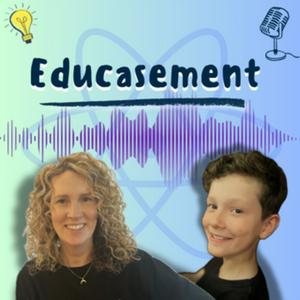
- EducasementEducation for Kids, Kids & Family
About Educasement
Short educational podcast for curious kids, parents and families who love science, maths, big questions and learning together.
Theo Casement is a curious kid with a thirst for facts, and in this bite-sized, family-friendly podcast he explores big questions about maths, science, and the world with his equally curious mum.
Each weekly episode breaks down complex ideas into fun, accessible conversations designed to spark curiosity and a love of learning in children and families.
Follow us on Instagram @educasement for extra resources, and get in touch with topics you’d like us to cover.
Podcast websiteListen to Educasement, Brains On! Science podcast for kids and many other podcasts from around the world with the radio.net app
Get the free radio.net app
- Stations and podcasts to bookmark
- Stream via Wi-Fi or Bluetooth
- Supports Carplay & Android Auto
- Many other app features
Get the free radio.net app
- Stations and podcasts to bookmark
- Stream via Wi-Fi or Bluetooth
- Supports Carplay & Android Auto
- Many other app features
Educasement
Scan code,
download the app,
start listening.
download the app,
start listening.
 UK
UK