

Listen to this podcast in the app for free: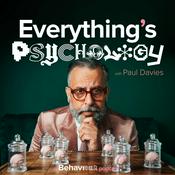 Download for free in the App Store
radio.net
Sleep timer
Save favourites
43 episodes
Best of Season 2
01/09/2026 | 58 mins.A great way to catch up or a lazy way to squeeze out another episode? You decide!
Here are some of the best bits of the podcast that I've cherry-picked from all six episodes of season/series two. And enjoy my tenuous segues from one episode to the next.
Timestamps
02:05 The Psychology of James Bond
11:34 The Psychology of Childhood
22:42 The Psychology of Weight Loss
35:08 The Psychology of The Odyssey
45:22 The Psychology of Dogs
50:41 The Psychology of Harry Potter
A massive thank you from me to Calvin Dyson, Adrian Fernham, Sue Roffey, Charlie Lewis, Joanna Silver, Matt White, Sam Akbar, Daniel Mills, Hanne Grice, Will Brooker and Nila Matthews for coming on.
Now, go and listen to the full episodes.
If you have any ideas for new episodes that I can include in the nest season, please let me know either by leaving me a voicenote or email me on paul@everythingspsychology.com
Send us Fan Mail
To leave a voicenote, just visit speakpipe.com/everythingspsychologyThe Psychology of Harry Potter
18/08/2026 | 52 mins.In this episode, the boy who lived. Why does a story about a bespectacled wizard still have its hooks in millions of people decades on? And can Harry Potter teach us anything about belonging, prejudice, personality, fandom, and why we fall so hard for a world that just doesn't exist?
With me to discuss the psychology of Harry Potter are Will Brooker, Professor of Film and Cultural Studies at Kingston University and author of Batman Unmasked and Why Bowie Matters and Nila Matthews, psychologist and former guide at the Warner Brothers Harry Potter Studio Tour in London.
My guests:
Professor Will Brooker – https://www.willbrooker.com
Batman Unmasked – https://amzn.eu/d/0eGjvBO1
Why Bowie Matters – https://amzn.eu/d/09ItaMjt
Never Ending Watchmen – https://amzn.eu/d/01XoPpjL
BBC article on Will's time living as David Bowie: https://www.bbc.com/culture/article/20160112-what-i-learned-when-i-lived-as-david-bowie
Nila Matthews – https://awakeningflow.com/
Nila's muggle life: https://www.linkedin.com/in/nilamatthews/
Send us Fan Mail
To leave a voicenote, just visit speakpipe.com/everythingspsychologyThe Psychology of Dogs
04/08/2026 | 59 mins.This has been the most requested topic after I previously did the psychology of cats; it’s the psychology of dogs. We think we know them better than any creature on earth, but what is actually going on behind those adorable eyes? Do they love us as completely as we think, and how much of canine psychology involves the human at the other end of the lead?
With me to unpack the psychology of dogs are Professor Daniel Mills, Professor of Veterinary Behavioural Medicine at the University of Lincoln and co-author of Life Skills for Puppies and Being Your Cat; and Hanne Grice, Trainer and Clinical Animal Behaviourist and author of Playing With Your Dog.
Professor Daniel Mills
https://staff.lincoln.ac.uk/dmills
https://companionanimalconsulting.com/
Life Skills for Puppies – https://amzn.eu/d/0hM7uuB2
Being Your Cat – https://amzn.eu/d/0111gvvH
Hanne Grice
https://www.hannegrice.com/
Clothing range - https://shophannegrice.com/
Playing With Your Dog - https://amzn.eu/d/00skqksB
Send us Fan Mail
To leave a voicenote, just visit speakpipe.com/everythingspsychologyThe Psychology of The Odyssey
28/07/2026 | 40 mins.Have you seen it yet? The film of the summer? Have you forked out for the most padded seats in the cinema to watch Christopher Nolan’s three-hour bum-numbing epic of Matt Damon struggling to get home in a world without satnav?
If you have, did you sit there thinking:
Why has a three thousand year old story got any relevance to today?
Is there real psychology in here?
Did the Greeks work something out about being human that we've ignored ever since?
Well, these are exactly the questions my guest asks in their new book: The Odyssey Mindset. So, with me in this episode to discuss the psychology of The Odyssey is Dr Sam Akbar, clinical psychologist, Oxford classicist and author of the wonderful new book The Odyssey Mindset.
– – –
The Odyssey Mindset (Amazon UK): https://amzn.eu/d/0hprLgcy
The Odyssey Mindset (Amazon US): https://a.co/d/07gDDhrD
Follow Dr Akbar on Instagram: https://www.instagram.com/drsam_akbar/
Send us Fan Mail
To leave a voicenote, just visit speakpipe.com/everythingspsychologyThe Psychology of Weight Loss
21/07/2026 | 55 mins.Are you on a diet? Have you got a shelf full of books to help you shed the pounds and get that summer beach bod or are you considering a weight loss jab such as Ozempic or Mounjaro? When the world seems to focus on the need to have a fit and firm body, what is this doing to people’s self-esteem and body image?
With me on this episode are Dr Joanna Silver, a leading psychologist specialising in eating disorders, body image & mental health; and Matt White, author of The Snack Monkey: How to Stop Eating the Whole Packet.
– – –
Guests
You can find more about Dr Joanna Silver on LinkedIn: https://www.linkedin.com/in/dr-joanna-silver/
Or at Orri, the eating disorder clinic: https://www.orri-uk.com/team/dr-joanna-silver/
You can buy your copy Matt's book, The Snack Monkey, on Amazon or visit https://therealsnackmonkey.com/
– – –
Other resources
Get a copy of the book 'Self-Help Without The Hype' by Robert Epstein as a paperback here or as an eBook on Amazon.
Share your email with me to have the chance of getting a physical copy of my new book, Behaviour First, when it comes out in October. Visit behaviourfirst.co.uk
Send us Fan Mail
To leave a voicenote, just visit speakpipe.com/everythingspsychology
More Science podcasts
 The Infinite Monkey CageComedy, Science
 BBC Inside ScienceScience
 Curious CasesScience
 A Question of ScienceHealth & Wellness, Medicine, Science, Technology
 Get BirdingLeisure, Natural Sciences, Nature, Science
 The Seán ChorusKids & Family, Natural Sciences, Pets & Animals, Science
 Science WeeklyScience
 Boring History for SleepScience, Social Sciences
 More or LessMathematics, News, News Commentary, Science, Society & Culture
 The Rest Is SciencePhilosophy, Physics, Science, Society & Culture, Technology
Trending Science podcasts
 Navigating NeuropsychologyScience, Social Sciences
 Sleepy FactsScience
 Lingthusiasm - A podcast that's enthusiastic about linguisticsScience
 Expanded PerspectivesHistory, Science, Society & Culture
 The Science of Everything PodcastNatural Sciences, Science
 Show Me the Science with Luke O'NeillScience
 Okay, But... BirdsEducation, Nature, Science
 Speaking of PsychologyHealth & Wellness, Life Sciences, Mental Health, Science
- Everything's PsychologyScience, Social Sciences
 The Pasture PodBusiness, Natural Sciences, Science
 Ask the Naked ScientistsHealth & Wellness, Life Sciences, Medicine, Natural Sciences, Science
 Houston We Have a PodcastScience
 Inner Cosmos with David EaglemanEducation, Health & Wellness, Mental Health, Science, Self-Improvement
About Everything's Psychology
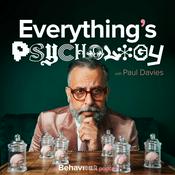
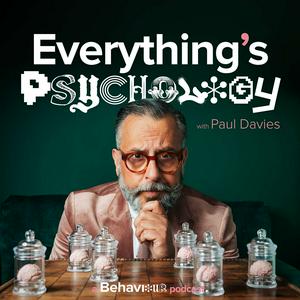
Chatting with incredible minds about the psychology of our everyday world. Join Paul Davies, behavioural psychologist, as chats with guests about the mechanisms of human behaviour and the motivations behind people’s actions.
Podcast websiteListen to Everything's Psychology, The Infinite Monkey Cage and many other podcasts from around the world with the radio.net app
Get the free radio.net app
- Stations and podcasts to bookmark
- Stream via Wi-Fi or Bluetooth
- Supports Carplay & Android Auto
- Many other app features
Get the free radio.net app
- Stations and podcasts to bookmark
- Stream via Wi-Fi or Bluetooth
- Supports Carplay & Android Auto
- Many other app features
Everything's Psychology
Scan code,
download the app,
start listening.
download the app,
start listening.
 UK
UK