
Listen to this podcast in the app for free: Download for free in the App Store
radio.net
Sleep timer
Save favourites
98 episodes
Jev, NVIDIA's agent safety platform, APM, and OpenAI DevDay
02/10/2026 | 31 mins.Send us Fan Mail
Murilo and Vitale go through the latest in data and AI: Jev, TypeSafe's System One model built for decisions instead of text (and Laya, the open weights model that showed up three days later), NVIDIA's Open Agent Safety Platform with OpenShell and Sentry after the OpenAI agent swarm that broke into Hugging Face, Microsoft's APM for pinning the skills and MCP servers your coding agents use, and OpenAI DevDay, where dots, GPT-6.1 Sol and a $500 Pro tier point to a consumer bet while Anthropic sticks with enterprise.
Links and references
Introducing System One Models & Jev (TypeSafe AI) | 2026-09-15
https://typesafe.ai/blog/introducing-system-one-models-and-jev
Diogo Almeida's talk on what RLHF gets wrong (AI Council)
https://www.youtube.com/watch?v=o-y1HJ6buGQ
Jev in Pydantic AI
https://pydantic.dev/docs/ai/models/typesafe/
Laya, the open weights alternative (Convai Innovations)
https://huggingface.co/convaiinnovations/laya
Jev vs Laya: Hosted API or Open Weights? | 2026-09-24
https://huggingface.co/blog/sora-2/jev-vs-laya-hosted-api-or-open-weights-2026-guide
NVIDIA Launches Open Agent Safety Platform | 2026-09-28
https://nvidianews.nvidia.com/news/open-agent-safety-platform
NVIDIA Open Agent Safety Platform: A Reference for Continuous In-Silicon Agent Monitoring (NVIDIA Developer)
https://developer.nvidia.com/blog/nvidia-open-agent-safety-platform-a-reference-for-continuous-in-silicon-agent-monitoring/
NVIDIA OpenShell
https://github.com/NVIDIA/OpenShell
Anatomy of a Frontier Lab Agent Intrusion (Hugging Face) | 2026-07-27
https://huggingface.co/blog/agent-intrusion-technical-timeline
The Hugging Face incident and the road ahead (OpenAI) | 2026-08-26
https://openai.com/index/hugging-face-incident-and-the-road-ahead/
APM, Agent Package Manager (Microsoft)
https://github.com/microsoft/apm
https://microsoft.github.io/apm/
DevDay 2026 Recap (OpenAI) | 2026-09-29
https://openai.com/index/devday-2026-recap/
Introducing dots (OpenAI)
https://openai.com/index/introducing-dots/
Introducing GPT-6.1 Sol (OpenAI)
https://openai.com/index/introducing-gpt-6-1-sol/
OpenAI adds a $500 Pro subscription, nerfs its $200 tier (Engadget) | 2026-09-29
https://www.engadget.com/2272106/openai-adds-dollar500-pro-subscription-nerfs-its-existing-dollar200-tier/
#datatopics #ai #datanews
Watch on YouTube: https://youtu.be/PHt_ybt_Lrs
Chapters
(0:00) Welcome
(1:11) Jev and Laya: models for decisions, not text
(7:42) NVIDIA's agent safety platform and the Hugging Face incident
(10:31) OpenShell and Sentry: policies in software and in silicon
(15:23) APM, a package manager for agent skills and MCPs
(20:58) OpenAI DevDay: dots, Pro tiers, GPT-6.1 Sol
(27:01) OpenAI goes consumer, Anthropic stays enterprise
(31:39) Wrap-upHow TVH tackles today's AI challenges through transparency & collaboration - with Sophie Van Nevel
22/09/2026 | 30 mins.Send us Fan Mail
How do you build an AI strategy that delivers value today while preparing your organization for what comes next?
In this episode of Datatopics, we sit down with Sophie Van Nevel, Director Data Products & AI at TVH, to explore how a global spare parts company approaches that challenge: with a clear strategic vision, close collaboration across the business and room to adapt as AI evolves.
Sophie explains how TVH maps AI opportunities across core business capabilities and involves department leaders in turning those opportunities into priorities. We discuss balancing visible results with the foundations needed to scale.
We also explore the human side of AI adoption, from TVH’s “Forwards with AI” program and hands-on transformation labs to the changing role of AI throughout the software development lifecycle. Transparency runs through the conversation: how do you help people experiment, share what they learn and understand the boundaries as tools and capabilities change?
A practical conversation for anyone working on enterprise AI strategy, adoption or enablement.
Enjoyed the episode? Share it with a colleague working on AI in their organization.DeepSeek's harness, frontier models at home, Claude's watermark
21/08/2026 | 43 mins.Send us Fan Mail
Murilo and guest Vitale go through the latest data and AI news: DeepSeek's open coding harness where every capability is a plugin, running near-frontier models on your own MacBook, Claude watermarking its own text to meet the EU AI Act, the argument that the code is just the byproduct of understanding, and what Anthropic found when agents start working together.
Links and references
DeepSeek's coding harness
https://deepseek.com/harness/en/
How Claude's text watermark works (Anthropic)
https://www.anthropic.com/news/claude-text-watermark
Code is the byproduct
https://yagmin.com/blog/code-is-the-byproduct/
Anthropic on multi-agent systems
https://www.anthropic.com/research/multiagent-systems
ds4, running DeepSeek locally (antirez)
https://github.com/antirez/ds4
#datatopics #ai #datanews
Watch on YouTube: https://youtu.be/fippNXe70_M
Chapters
(0:00) Welcome and guest intro
(2:14) DeepSeek's coding harness, everything is a plugin
(9:24) Running frontier models on your own machine
(11:14) Claude watermarks its text, and the EU AI Act
(22:33) Is the code just a byproduct?
(30:18) Codex vs Claude, reverting to 4.8
(32:41) When agents work together, and collude
(42:57) Wrap-up#95 GEO vs SEO: The New Battle for Discoverability
29/04/2026 | 30 mins.Send us Fan Mail
Google still drives most search traffic, but the rules of discoverability are changing fast. Today we sit down with Cyril, a client data partner at Dataroots, to unpack what search engine optimization actually is, why the first results page captures the vast majority of clicks, and how small changes in content clarity can shift who finds you and when.
We get practical about classic SEO fundamentals: on-page SEO that makes services crystal clear for the right persona, off-page SEO signals like backlinks that build authority, and the technical SEO basics that quietly decide whether you rank at all. Page speed, mobile-first indexing, and user experience are not “nice to have” anymore, and we talk through how tools like Google Lighthouse can reveal what is slowing a site down and where to focus first.
Then we move into the 2026 reality of AI search and generative engine optimization (GEO). If ChatGPT or Google Gemini can answer a question instantly, traffic can drop, but trust can rise if your brand gets cited. We explain how to write content that LLMs can use: add a TLDR summary, include FAQ sections, publish structured documentation where it makes sense, and build real authority across the web through credible mentions. If you care about SEO keywords, AI citations, and turning discoverability into revenue through better funnel data, this one is for you.
Subscribe for more, share this with a teammate who owns your website, and leave a review if it helped. What part of SEO or GEO feels most confusing in your company right now?#94 Agents Are Rising: Why Data Quality Matters More Than Ever
27/02/2026 | 30 mins.Send us Fan Mail
Trust collapses fast when a dashboard misleads or an AI agent learns from messy data. We dig into how data quality became business critical—and how to move from reactive fire drills to proactive systems—through real stories from clinical trials and large platforms where a single broken test could escalate to the C‑suite. With Stan and David, we map the shifts driving this moment: AI adoption, rising reliance on metrics, and the urgent need for shared definitions, lineage, and monitoring that let teams find root causes before customers feel the impact.
We get practical about agents that actually help. Instead of vague hype, we break down a low‑risk architecture for read‑only, metadata‑aware agents that handle repetitive, high‑leverage tasks: writing dbt documentation, proposing data tests, performing lineage‑driven root cause analysis, and auto‑drafting tickets with queries, diffs, and impact notes. We explain why integrated agents beat copy‑paste prompts, how to add guardrails that limit scope and permissions, and what human‑in‑the‑loop review should look like to build real trust without slowing the work.
Expect candid guidance on adoption and observability: two layers of visibility—agent behavior and data quality posture—help teams track costs, measure time to resolution, spot repeating incidents, and choose structural fixes. We also explore buy vs build as platforms begin embedding agent capabilities, and we share a clear starting path for any team: prioritize critical datasets, standardize KPIs and definitions, enable tests, and surface lineage so automation has the context it needs. By the end, you’ll have a blueprint to reduce firefighting, improve stakeholder confidence, and make your AI agents smarter by feeding them cleaner, governed data. If this resonates, follow the show, share with your data team, and leave a review with the one task you’d automate first.
More Technology podcasts





Trending Technology podcasts









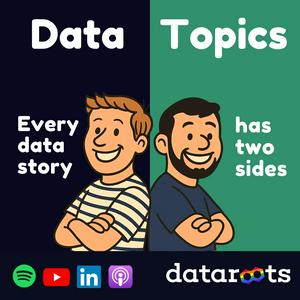
About DataTopics: All Things Data, AI & Tech
Welcome to the cozy corner of the tech world where ones and zeros mingle with casual chit-chat. Datatopics is your go-to spot for relaxed discussions around tech, news, data, and society.Dive into conversations that should flow as smoothly as your morning coffee (but don't), where industry insights meet laid-back banter. Whether you're a data aficionado or just someone curious about the digital age, pull up a chair, relax, and let's get into the heart of data, unplugged style!
Podcast websiteListen to DataTopics: All Things Data, AI & Tech, Darknet Diaries and many other podcasts from around the world with the radio.net app
Get the free radio.net app
- Stations and podcasts to bookmark
- Stream via Wi-Fi or Bluetooth
- Supports Carplay & Android Auto
- Many other app features
Get the free radio.net app
- Stations and podcasts to bookmark
- Stream via Wi-Fi or Bluetooth
- Supports Carplay & Android Auto
- Many other app features
DataTopics: All Things Data, AI & Tech
Scan code,
download the app,
start listening.
download the app,
start listening.
 UK
UK