

Listen to this podcast in the app for free: Download for free in the App Store
radio.net
Sleep timer
Save favourites
163 episodes
EP 162 - PM First Principles in the Age of AI Summary with Matt & Moshe
30/09/2026 | 45 mins.After a full series exploring what product managers should retain, and rethink, in the age of AI, Matt and Moshe sit down for an honest wrap-up. What did we learn, what changed our minds, and where do humans still matter most?
In this special episode, we look back at the conversations on human judgment, empathy, vision, strategy, and stakeholder alignment, then connect them to our own day-to-day experiments with AI. Moshe shares what he learned while building and publishing his new mobile app, Mental Health Wallet, using tools like Kiro. Matt reflects on building an agentic orchestration product, and where AI has genuinely helped sharpen strategy and execution.
The big takeaway?AI can dramatically accelerate product work, but speed, output, and confidence are not the same as understanding. The PM role is not disappearing. It is shifting toward stronger context-setting, better judgment, deeper customer understanding, and more intentional collaboration.
Join Matt and Moshe as they reflect on:Rebecca Douglas’s conversation on human judgment and empathy, and why product managers still need to interpret ambiguity, understand users as people, validate AI outputs, and decide what not to build
John Fontenot’s perspective on vision and strategy, including why AI can be a powerful thinking partner but cannot fully own long-term direction, strategic tradeoffs, market context, or business accountability
Joy Adamson’s insights on stakeholder alignment, and why trust, relationship-building, incentives, organizational dynamics, negotiation, and emotional intelligence remain deeply human work
How AI can support product work through research synthesis, organization, ideation, prototyping, requirements, competitive exploration, and strategic feedback
Why AI-generated advice can sometimes feel like generic validation, and how better context and sharper prompts lead to more useful strategic feedback
Why market context, competitive insight, and business goals still need to come from humans
The changing balance between AI and human involvement across different product activities:Human judgment and empathy remain deeply human-led
Vision and strategy can be increasingly AI-assisted, but remain dependent on human context
Stakeholder alignment is heavily human, because trust, incentives, relationships, and politics cannot be fully automated
Why user interviews and real customer conversations remain more valuable than AI-generated “users” or synthetic feedback
How the importance of human involvement may shift by company stage, team size, and the number of stakeholders involved
The potential future of product work, including AI agents, agent marketplaces, new workflows, and changing expectations for PMs
And much more!
You can connect with us and find more episodes:Product for Product Podcast: http://linkedin.com/company/product-for-product-podcast
Matt Green: https://www.linkedin.com/in/mattgreenproduct/
Moshe Mikanovsky: http://www.linkedin.com/in/mikanovsky
Note: Any views mentioned in the podcast are the sole views of our hosts and guests, and do not not represent the products mentioned in any way.
Please leave us a review and feedback ⭐️⭐️⭐️⭐️⭐️EP 161 - Stakeholder Alignment with Joy Adamson
16/09/2026 | 45 mins.When AI can summarize meetings, draft updates, and even recommend priorities, what remains uniquely human about stakeholder alignment? In this episode, product coach and advisor Joy Adamson joins Matt and Moshe to explore why alignment is still one of the most essential, and most human, parts of a product manager’s work.
As part of our First Principles for PMs in the Age of AI series, Joy shares why stakeholder alignment is much more than keeping people informed or collecting feature requests. It is the ongoing work of connecting organizational needs with real customer and user needs, creating shared understanding of priorities, navigating competing incentives, and building enough trust to make difficult tradeoffs together.
Join Matt and Moshe as they explore with Joy:What stakeholder alignment really means, and why true alignment reduces the need for constant stakeholder management
Why the word “stakeholder” itself can create friction when people assume their request should automatically become a roadmap item
How PMs can set healthy boundaries, say no with clarity, and prevent feature requests from becoming unchallenged commitments
Why emotional intelligence, negotiation, trust, and informal relationship-building remain critical product skills
The difference between simply considering stakeholder input and actually aligning on priorities, tradeoffs, and resource allocation
How hidden motivations, incentives, politics, and organizational culture shape product decisions in ways AI cannot fully understand
Where AI can help: meeting summaries, follow-ups, tailored stakeholder communications, preparation, and negotiation support
Why AI-generated recommendations still need human oversight, accountability, and judgment, especially when trust, risk, or ambiguity are involved
Could AI agents eventually become stakeholders themselves? What that might mean for product teams and decision-making
Why junior PMs should deliberately build their human relationship and influence skills as AI takes on more operational tasks
And much more!
Want to connect with Joy?Website: https://www.digitaljoy.nl/
LinkedIn: https://www.linkedin.com/in/adamsonj/
You can also connect with us and find more episodes:Product for Product Podcast: http://linkedin.com/company/product-for-product-podcast
Matt Green: https://www.linkedin.com/in/mattgreenproduct/
Moshe Mikanovsky: http://www.linkedin.com/in/mikanovsky
Note: Any views mentioned in the podcast are the sole views of our hosts and guests, and do not represent the products mentioned in any way.
Please leave us a review and feedback ⭐️⭐️⭐️⭐️⭐️EP 160 - Vision & Strategy with John Fontenot
02/09/2026 | 49 mins.We’re back with a familiar voice on the podcast: John Fontenot returns to continue our *First Principles for PMs in the Age of AI* series, this time focused on Vision and Strategy. In a conversation that blends product thinking, personal reflection, and a healthy dose of AI skepticism, John helps us explore what it really means for PMs to define where they’re going, and how to get there.
John defines vision as the desired end state or future outcome, and strategy as the path, phases, and tradeoffs required to reach it. With examples ranging from long-term business goals to the realities of regulated industries, he explains why product managers still need to lead on vision and strategy even when leadership doesn’t provide a clear direction, and why AI can support this work, but not fully own it.
Join Matt and Moshe as they explore with John:
What vision and strategy actually mean in product management, and why they’re easy to confuse - How to connect a big vision to practical milestones, obstacles, and key results
Why AI can help with analysis and brainstorming, but can’t replace human creativity, empathy, or rule-breaking thinking - The limits of AI in regulated spaces like finance and healthcare, where context and compliance matter
Why PMs often have to create strategy when the organization doesn’t hand it to them - How to use AI as a thinking partner without outsourcing your strategic judgment
The balance between staying anchored in the long-term vision and adjusting to the realities of the market, user needs, and constraints
John’s perspective on where product teams should be careful not to let AI flatten nuance or over-automate strategy
And much more
Want to connect with John?
LinkedIn: https://www.linkedin.com/in/johnrfontenot/
You can also connect with us and find more episodes:
Product for Product Podcast: http://linkedin.com/company/product-for-product-podcast
Matt Green: https://www.linkedin.com/in/mattgreenproduct/
Moshe Mikanovsky: http://www.linkedin.com/in/mikanovsky
Note: Any views mentioned in the podcast are the sole views of our hosts and guests, and do not represent the products mentioned in any way.
Please leave us a review and feedback ⭐️⭐️⭐️⭐️⭐️EP 159 - Human Judgement and Empathy with Rebecca Douglas
19/08/2026 | 56 mins.We’re continuing our new series on "First Principles for PMs in the Age of AI" with a conversation about two things AI can support, but not replace: human judgment and empathy. In this episode, Rebecca Douglas joins Matt and Moshe to unpack why these skills matter even more as product teams lean harder on AI tools.
With 14+ years in product and a career that started in customer service and client relationships, Rebecca brings a grounded view of what product managers actually do when the stakes are real: prioritize tradeoffs, interpret messy context, build trust with stakeholders, and make decisions that AI can help inform but not own. Together, they explore where AI saves time, where it creates new risks, and why PMs still need to slow down, validate, and think deeply before shipping.
Join Matt and Moshe as they explore with Rebecca:
What human judgment really means in product work, and why it matters most in prioritization, tradeoffs, and strategic decisions
What empathy looks like in practice for PMs, especially when serving both users and non-users like legal, operations, and compliance teams
Why AI can help with synthesis, documentation, and repetitive work, but still needs human oversight and validation
How regulated environments raise the bar for judgment, trust, and accuracy
The risk of “empathy debt” when teams move too fast with AI and skip genuine user understanding
How Rebecca uses AI in her own work to save time on research, competitive intelligence, and requirements, while keeping decision-making human
Why product managers shouldn’t let AI become the answer to every problem just because it’s available
How to balance AI fluency with restraint, especially when accuracy thresholds matter
Why Rebecca’s poll choice of Human judgment and Empathy resonated so strongly with product leaders
And much more!
Want to connect with Rebecca?
LinkedIn: https://www.linkedin.com/in/rebeccardouglas
Workforce Intelligence Labs: https://www.workintellabs.com/
You can also connect with us and find more episodes:
Product for Product Podcast: http://linkedin.com/company/product-for-product-podcast
Matt Green: https://www.linkedin.com/in/mattgreenproduct
Moshe Mikanovsky: http://www.linkedin.com/in/mikanovsky
Note: Any views mentioned in the podcast are the sole views of our hosts and guests, and do not represent the products mentioned in any way.
Please leave us a review and feedback ⭐️⭐️⭐️⭐️⭐️EP 158 - PM First Principles in the age AI with Matt & Moshe
05/08/2026 | 30 mins.We’re kicking off a new series with a very timely question: what does product management look like in the age of AI? In this first episode, Matt and Moshe set the stage for *First Principles and Beyond for Product Managers in the Age of AI*, exploring how PM work is changing, what should stay human, and where AI can genuinely help.
The conversation ranges from Matt’s work implementing software for government agencies to Moshe’s hands-on experiments with AI coding tools like Cursor, Kirk, and Claude Code. Along the way, they dig into the tension between speed and judgment, debate what “product sense” really means, and start shaping the core theme of the series: identifying the first principles of product management before layering AI on top.
Join Matt and Moshe as they explore:
- How product management is evolving as AI becomes part of the workflow
- Why human-centered value delivery still matters, even when tools can generate work faster
- What “product sense” means in practice, and whether it can be defined as a set of first principles
- Experiments with AI coding tools, local development, and the possibilities of building faster with more leverage
- The idea of using AI to augment product work without removing human judgment from the loop
- Bring it to the audience by polling where PMs should remain involved, and where AI can take more of the load
- And much more!
Want to share your thoughts on the series or follow along?-
- Product for Product Podcast: http://linkedin.com/company/pr...
- Matt Green: https://www.linkedin.com/in/ma...
- Moshe Mikanovsky: http://www.linkedin.com/in/mik...
Note: Any views mentioned in the podcast are the sole views of our hosts and guests, and do not represent the products mentioned in any way.
Please leave us a review and feedback ⭐️⭐️⭐️⭐️⭐️
More Business podcasts

Trending Business podcasts








About Product for Product Management
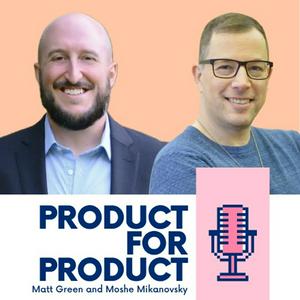
Product for Product is a show hosted by Matt Green and Moshe Mikanovsky aimed at helping listeners navigate the growing depth of product management tools while also providing our insights into the categories that make up the PM role. We will take listeners with us on a journey of discovery through areas of product analytics, road mapping, productivity and many others. If you want to keep up with the latest in product management come along for the ride! Connect with us on LinkedIn: https://linkedin.com/in/mattgreenproducthttps://linkedin.com/in/mikanovskyConnect with us on Youtube:https://www.youtube.com/@productforproduct
Podcast websiteListen to Product for Product Management, The Martin Lewis Podcast and many other podcasts from around the world with the radio.net app
Get the free radio.net app
- Stations and podcasts to bookmark
- Stream via Wi-Fi or Bluetooth
- Supports Carplay & Android Auto
- Many other app features
Get the free radio.net app
- Stations and podcasts to bookmark
- Stream via Wi-Fi or Bluetooth
- Supports Carplay & Android Auto
- Many other app features

Product for Product Management
Scan code,
download the app,
start listening.
download the app,
start listening.
 UK
UK