
Listen to this podcast in the app for free: Download for free in the App Store
radio.net
Sleep timer
Save favourites
13 episodes
EP12 Science Diplomacy, Talent Mobility, and the Scientific Diasporas with Dr. Derya Büyüktanır Karacan
13/11/2026 | 45 mins.AFTER THE SHOW: Our conversation with Dr. Derya Büyüktanır Karacan continues in Global Signals. Read it here: https://www.glsd.ai/the-systems-behind-global-talent/
OVERVIEW
Science diplomacy is increasingly shaped by research mobility and the ways scientific diasporas keep expertise and collaboration connected across borders. In this episode of The Global Lens, host Daniella Sussman speaks with Dr. Derya Büyüktanır Karacan about how countries approach global talent mobility, international research collaboration, and the changing relationship between science diplomacy and foreign policy.
EPISODE SUMMARY
Drawing on her work at George Washington University and EURAXESS North America, Dr. Karacan explains why researcher mobility extends beyond brain drain and competition for talent. They discuss how programs like Horizon Europe support international research, the barriers researchers face, and how scientific diasporas strengthen home countries through partnerships, mentorship, and knowledge sharing without requiring permanent return. The conversation also explores how AI is shaping research needs and the importance of building inclusive, sustainable research systems.
In this episode, we discuss:
02:19 - The growing role of science diplomacy in international affairs
06:28 - Rethinking brain drain through the concept of geotalent
10:28 - Competition between countries to attract and retain research talent
19:13 - The personal side of researcher mobility
26:42 - How scientific diasporas contribute to their countries without permanently returning
31:13 - Building fair and reciprocal partnerships between diaspora researchers and local institutions
39:46 - Making international research mobility more inclusive and sustainable
ABOUT THE GUEST
Dr. Derya Büyüktanır Karacan is a Scholar and researcher at George Washington University’s Elliott School of International Affairs and the Regional Coordinator for EURAXESS North America, a European Commission initiative supporting researcher mobility and career development. Her work focuses on science diplomacy, talent and researcher mobility, and the European Union, and she contributes to international projects on AI, data infrastructures, and their role in global cooperation. She is the guest editor for special issues on science diplomacy in the Global South and on scientific diasporas for development.
MENTIONED IN THE EPISODE:
⚇ (Editorial) From brain drain to geopolitical talent competition: scientific diasporas and the future of Global South development - https://www.frontiersin.org/journals/research-metrics-and-analytics/articles/10.3389/frma.2026.1898634/full
⚇ (Studies or Research) Empowering Women in STEM in Emerging Economies Through a Science Diplomacy Approach - The Palgrave Handbook of Science Diplomacy - https://link.springer.com/chapter/10.1007/978-3-032-29473-9_13
⚇ (Article) Science Diplomacy in the Global South – An Introduction - https://academic.oup.com/spp/article-abstract/50/4/742/7197239?redirectedFrom=fulltext
⚇ (Editorial) Engaging Scientific Diasporas for Development: Policy and Practices - https://www.frontiersin.org/research-topics/25332/engaging-scientific-diasporas-for-development-policy-and-practices/magazine
⚇ (Studies or Research) Science Diplomacy in an Era of Disruption – https://www.aaas.org/sites/default/files/2025-02/Final_Science%20diplomacy_15%20years%20on_report_WEB.pdf
⚇ (Reference) European Union Framework for Science Diplomacy – https://www.consilium.europa.eu/en/press/press-releases/2026/05/29/council-defines-a-new-framework-for-science-diplomacy/
⚇ (Website) Choose Europe for Science – https://rea.ec.europa.eu/funding-and-grants/horizon-europe-marie-sklodowska-curie-actions/msca-choose-europe-science_en
⚇ (Website) Horizon Europe – https://research-and-innovation.ec.europa.eu/funding/funding-opportunities/funding-programmes-and-open-calls/horizon-europe_en
⚇ (Website) European Research Council – https://erc.europa.eu/
⚇ (Website) Marie Skłodowska-Curie Actions – https://marie-sklodowska-curie-actions.ec.europa.eu/
⚇ (Editorial) Linking Knowledge Across Borders: Science Diasporas and Global South Development – https://www.frontiersin.org/research-topics/73302/linking-knowledge-across-borders-science-diasporas-and-global-south-development
⚇ (Reference) SESAME – Synchrotron-light for Experimental Science and Applications in the Middle East – https://www.sesame.org.jo/
————
AFTER THE SHOW: Our conversation with Dr. Derya Büyüktanır Karacan continues in Global Signals, going deeper on diaspora strategy, the role of the Global South, and the evidence policymakers need to understand where talent is going.
Read the After the Show conversation: https://www.glsd.ai/the-systems-behind-global-talent/
Global Signals is our science diplomacy intelligence brief and member community for decision makers in policy, research, industry and investment.
Join Global Signals: https://glsd.ai
————
CONNECT WITH DR. DERYA BÜYÜKTANIR KARACAN:
⚇ George Washington University: https://elliott.gwu.edu/
⚇ EURAXESS North America: https://euraxess.ec.europa.eu/worldwide/north-america
⚇ LinkedIn: https://www.linkedin.com/in/deryabuyuktanir/
CONNECT WITH DANIELLA:
⚇ Podcast Website: https://the-global-lens.captivate.fm/
⚇ Global Lens Website: https://glsd.ai
⚇ Global Signals: https://global-signals.ghost.io/
⚇ Book: The Science Diplomacy Playbook – Kindle and Paperback: https://www.amazon.com/author/daniellasussman
⚇ LinkedIn: https://www.linkedin.com/in/daniellasussman/EP11 AI in 2035: A Humane Future with AI with Thilo Stadelmann
28/05/2026 | 50 mins.OVERVIEW
In this episode of The Global Lens, Daniella Sussman sits down with Thilo Stadelmann to explore how artificial intelligence is actually evolving beyond the headlines. The conversation touches on machine learning and the role of science diplomacy while questioning common assumptions about rapid breakthroughs. Together, they focus on what it really takes to build technology that people can trust and that works in service of society.
EPISODE SUMMARY
Thilo Stadelmann challenges dominant narratives around artificial general intelligence, arguing that current AI systems remain fundamentally limited despite rapid progress. The discussion explores how machine learning scaling is reaching diminishing returns and why new paradigms may be needed for meaningful breakthroughs. The episode also dives into AI ethics, digital sovereignty, and the risks of poorly designed human-AI interaction, particularly in relation to mental health and trust. Ultimately, the conversation presents a compelling case for pro-human technology, open-source AI ecosystems, and the role of policy in shaping a more equitable AI-driven future.
In this episode, we discuss:
02:02 - Questioning the plausibility of near-term artificial general intelligence timelines
06:02 - Why scenario based thinking matters more than prediction in AI policy
09:03 - Exploring the limitations of current machine learning systems and scaling laws
12:29 - How AI interaction may reshape human behavior and relationships
27:53 - Digital trust, sovereignty, and the risks of centralized AI ecosystems
33:35 - Open source AI and the future of local innovation and global competition
43:26 - What policymakers and science diplomats can do to support humane AI futures
ABOUT THE GUEST
Thilo Stadelmann is Professor of Artificial Intelligence and Machine Learning at the ZHAW School of Engineering in Switzerland and Founding Director of its Centre for Artificial Intelligence. With over 15 years of experience, he leads research in machine perception and cognition, focusing on representation learning across image, audio, and signal data with real-world applications.
He is a co-founder of Alpine AI AG, the ZHAW Datalab, and the Data Innovation Alliance, and advises on AI policy and governance. He is also the author of Applied Data Science and his 2025 essay AI in 2035 outlines a vision for efficient, open, and trust-centered AI systems.
MENTIONED IN THE EPISODE:
⚇ (Book) Applied Data Science – https://link.springer.com/book/10.1007/978-3-030-11821-1
⚇ (Studies or Research) Assessing Deep Learning – https://link.springer.com/article/10.1007/s43681-023-00408-z
⚇ (Studies or Research) A Guide to AI – https://stdm.github.io/downloads/papers/GRW_2025.pdf
⚇ (Studies or Research) Debate: Evidence-Based AI Risk Assessment for Public Policy – https://www.tandfonline.com/doi/full/10.1080/09540962.2025.2541304
⚇ (Studies or Research) The Stochastic Nature of Machine Learning and Its Implications for High-Consequence AI – https://stdm.github.io/downloads/papers/AIEthics_2026.pdf
⚇ (Video) TEDx Talk on How Not to Fear AI – https://www.youtube.com/watch?v=deVbP-hViMQ
⚇ (Website) AI in 2035 – https://stdm.github.io/AI-in-2035/
⚇ (Website) How Not to Fear AI – https://premium-speakers.com/en/magazin/thilo-stadelmann-how-not-to-fear-artificial-intelligence/
⚇ (Reference) How Bad Are A.I. Delusions? – https://www.nytimes.com/2026/01/26/us/chatgpt-delusions-psychosis.html
————
This episode is brought to you by Global Signals, a curated bi-weekly paid newsletter for globally minded policymakers, international researchers, strategic industry leaders, and investors.
Subscribe here: https://tinyurl.com/Global-Lens
————
CONNECT WITH THILO STADELMANN:
⚇ Website: https://thilo-stadelmann.com
⚇ LinkedIn: https://www.linkedin.com/in/thilo-stadelmann/
⚇ YouTube: https://www.youtube.com/channel/UCqEjuibTwlVoO9bUW0oI0pA
CONNECT WITH DANIELLA:
⚇ Podcast Website: https://the-global-lens.captivate.fm/
⚇ Global Lens Website: https://glsd.ai
⚇ Global Signals: https://global-signals.ghost.io/
⚇ Book: The Science Diplomacy Playbook – Kindle and Paperback: https://www.amazon.com/author/daniellasussman
⚇ LinkedIn: https://www.linkedin.com/in/daniellasussman/EP10 Can Scientists Succeed Where Politicians Fail? Featuring Dr. Peter Agre
06/03/2026 | 21 mins.OVERVIEW
Science Diplomacy takes center stage in this episode of The Global Lens, where Nobel Laureate Dr. Peter Agre of Johns Hopkins University reflects on how scientific collaboration can advance international relations in ways politics cannot. Through his remarkable experiences in global engagement and research, Dr. Agre reveals how empathy, evidence, and dialogue remain the most powerful tools for bridging divides.
EPISODE SUMMARY
In a moving conversation with host Daniella Sussman, Dr. Agre recounts his extraordinary journey from molecular biologist to global envoy for peace. Drawing from his new book Can Scientists Succeed Where Politicians Fail?, he shares personal stories from North Korea, Cuba, and Iran—moments where shared scientific curiosity opened channels of trust amidst deep conflict. He discusses how science diplomacy can protect researchers, strengthen international partnerships, and foster hope even in divided times. Listeners will gain insight into how education, compassion, and persistence can turn science into a force for global cooperation.
In this episode, we discuss:
00:48 - Curiosity and empathy as foundations for a life in science and global engagement
03:34 - How recognition in science can evolve into a platform for dialogue and cooperation
05:29 - Science as a language of trust in politically divided places like Cuba and North Korea
07:44 - Lessons in humility and respect from diplomatic exchanges across geopolitical divides
13:55 - Institutions protecting openness and collaboration in global research
17:12 - Mentorship and education shaping the next generation of globally minded scientists
20:41 - Science diplomacy as a bridge for peace, understanding, and shared progress
ABOUT THE GUEST
Peter Agre, awarded the 2003 Nobel Prize in Chemistry for discovering aquaporins, is a physician, molecular biologist, and Director of the Johns Hopkins Malaria Research Institute. As former President of the American Association for the Advancement of Science (AAAS), he has led scientific delegations around the world, advancing cooperation across political divides to address shared global scientific challenges. Dr. Agre champions science diplomacy as a vital tool for international cooperation.
MENTIONED IN THE EPISODE:
⚇ (Book) Can Scientists Succeed Where Politicians Fail? by Dr. Peter Agre and Dr. Seema Yasmin - https://www.amazon.com/Scientists-Succeed-Politicians-Hopkins-Wavelengths/dp/1421452995
⚇ (Studies or Research) Discovery of the Aquaporins and Their Impact on Basic and Clinical Physiology - https://pmc.ncbi.nlm.nih.gov/articles/PMC7129575/pdf/main.pdf
⚇ (Website) Johns Hopkins Malaria Research Institute - https://publichealth.jhu.edu/malaria-research-institute
⚇ (Website) American Association for the Advancement of Science (AAAS) - https://www.aaas.org/
⚇ (Reference) Science Magazine - https://www.science.org/
————
This episode is brought to you by Global Signals, a curated bi-weekly paid newsletter for globally minded policymakers, international researchers, strategic industry leaders, and investors.
Subscribe here: https://tinyurl.com/Global-Lens
————
CONNECT WITH DR. PETER AGRE:
⚇ Website: https://bdp.jhu.edu/bd-professors/peter-agre/
CONNECT WITH DANIELLA:
⚇ Podcast Website: https://the-global-lens.captivate.fm/
⚇ LinkedIn: https://www.linkedin.com/in/daniellasussman/
⚇ Instagram: https://www.instagram.com/daniellasussmanglobal/EP9 Inspiring Talk Series with Ugo Amaldi
09/02/2026 | 28 mins.OVERVIEW
In this episode of The Global Lens, host Daniella Sussman speaks with Professor Ugo Amaldi about science diplomacy and international scientific collaboration through the lens of CERN and global research cooperation. Drawing on decades of leadership in large-scale experiments, Amaldi reflects on how sustained partnerships shape the future of research, from quantum technologies to medical innovation. The conversation highlights how collaborative science advances discovery while building trust across geopolitical boundaries.
EPISODE SUMMARY
From Cold War collaborations with Soviet scientists to pioneering CERN experiments and advancing cancer therapy with hadron beams, this episode traces the evolution of global scientific cooperation. Amaldi shares lessons learned from managing large international teams, translating fundamental physics into life-saving treatments, and establishing durable networks across nations. The conversation also examines disparities in research investment within Europe and advocates for sustained, long-term commitment to science as a foundation for diplomacy and progress. Throughout, collaboration is presented not just as an ideal, but as a practical necessity for advancing knowledge and fostering peace.
In this episode, we discuss:
01:41 – Introduction to the importance of international scientific collaboration
03:30 – Cold War era science and cross-cultural cooperation with Soviet physicists
04:10 – Building large-scale international collaborations at CERN
05:54 – Balancing innovation and stability in complex experiments
09:08 – Transition from work in particle physics to pioneering cancer therapy
18:20 – European disparities in research funding and investment
21:35 – Advice to future scientists: curiosity, optimism, and collaboration
ABOUT THE GUEST
Ugo Amaldi is a particle physicist and pioneer in hadron therapy. A CERN Scientist Emeritus, he co-discovered the rising proton-proton cross section in 1973, founded and led the 500-member DELPHI collaboration at LEP, and proposed the cyc-linac accelerator for cancer treatment. In 1992 he created the TERA Foundation, leading to Italy’s CNAO center and influencing facilities worldwide. As Scientific Director of the Tera-Care Foundation, he now advances clinical helium facilities with CERN. Author of more than 600 papers (h-index 83), accelerator physics textbooks, and popular science books including Particle Accelerators: From Big Bang Physics to Hadron Therapy (Springer). Co-author of ~40 physics textbooks used by millions of students globally.
MENTIONED IN THE EPISODE:
⚉ (Reference) European Organization for Nuclear Research (CERN) - https://home.cern/
⚉ (Studies or Research) DELPHI experiment - https://home.cern/science/experiments/delphi
⚉ (Reference) National Center for Oncological Hadrontherapy (CNAO) - https://fondazionecnao.it/en/
⚉ (Reference) European Network for Hadron Therapy (ENLIGHT) - https://enlight.web.cern.ch/
CONNECT WITH UGO AMALDI:
⚉ Inspire HEP: https://inspirehep.net/
CONNECT WITH DANIELLA:
⚉ Podcast Website: https://glsd.ai/
⚉ LinkedIn: https://www.linkedin.com/in/daniellasussman/
⚉ Instagram: https://www.instagram.com/daniellasussmanglobal/EP8 AI and Higher Education: Dakota State's Cyber Vision with Dr. José-Marie Griffiths
26/01/2026 | 27 mins.OVERVIEW
This episode of The Global Lens explores the intersection of artificial intelligence, cybersecurity, and science diplomacy, and how these forces are transforming national security and global cooperation. Daniella Sussman and Dr. José-Marie Griffiths explore Dakota State University’s role in turning applied AI research into real-world impact. Education emerges as a strategic force and soft power in the evolving AI landscape.
EPISODE SUMMARY
Dr. Griffiths reflects on transforming Dakota State University into a cyber and AI powerhouse by aligning research, policy, and workforce development. She outlines how applied labs, global partnerships, and inclusive education models help translate innovation into real-world impact. The episode also explores how higher education can function as science diplomacy by building trust, shared standards, and ethical AI frameworks across borders. Throughout, Dr. Griffiths stresses the responsibility educators and policymakers share in shaping AI to benefit society rather than control it.
In this episode, we discuss:
01:39 - Building Dakota State’s strong and advanced cyber-AI foundation
04:08 - AI's transformative and evolving impact on higher education
07:16 - Empowering accessible and ethical global AI innovation through inclusion
09:32 - Higher education driving real-world global impact and discovery
15:00 - Shaping ethical global AI standards and open data sharing
17:37 - Policymakers learning from DSU's integrated AI education approach
24:31 - Ensuring responsible AI design, development, and collaboration
ABOUT THE GUEST
Dr. José-Marie Griffiths is President of Dakota State University, where she has led transformational growth since 2015. Her leadership and contributions have earned her more than 20 major awards, including recognition as a USA Today Woman of the Year and one of InspiredMinds!’ 50 Influential Women in AI.
A physicist and information scientist by training, Dr. Griffiths has held leadership roles across research, government, and higher education, with a special focus on STEM and cyber fields. She has served on the National Science Board, the U.S. President’s Information Technology Advisory Committee, and the National Security Commission on Artificial Intelligence. Today, she continues this work as an advisor to the Special Competitive Studies Project (SCSP).
Dr. Griffiths has led projects with more than 28 federal agencies, including NASA and the Department of Energy, collaborated with major corporations such as IBM and Apple, and partnered with international organizations including NATO and the United Nations.
MENTIONED IN THE EPISODE:
⚉ (Reference) Madison Cyber Labs (MAD Labs) - https://dsu.edu/research/madison-cyber-labs/
⚉ (Reference) Google Cybersecurity Clinics Fund - https://cyberclinics.withgoogle.com/
⚉ (Reference) Dakota State's Governors Cyber Academy - https://dsu.edu/admissions/undergraduate/cyber-academy.html
⚉ (Reference) Dakota State Applied Research Corporation (DARC) - https://dsu-arc.org/
————
This episode is brought to you by Global Signals, a curated bi-weekly paid newsletter for globally minded policymakers, international researchers, strategic industry leaders, and investors.
Subscribe here: https://tinyurl.com/Global-Lens
————
CONNECT WITH DR. JOSÉ-MARIE GRIFFITHS:
⚉ Website: https://dsu.edu/directory/griffiths-jose-marie.html
⚉ X (Twitter): https://x.com/josegriffiths
⚉ LinkedIn: https://www.linkedin.com/in/jose-marie-griffiths-9106b7b/
CONNECT WITH DANIELLA:
⚉ Podcast Website: https://the-global-lens.captivate.fm/
⚉ LinkedIn: https://www.linkedin.com/in/daniellasussman/
⚉ Instagram: https://www.instagram.com/daniellasussmanglobal/
More Education podcasts









Trending Education podcasts

















About The Global Lens - Science Diplomacy in Focus
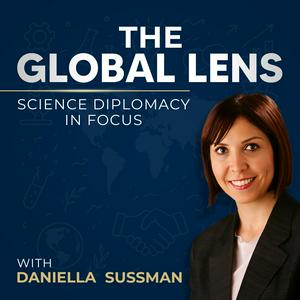
The Global Lens is a podcast showcasing science diplomacy through conversations with leaders at the forefront of innovation, research, and international partnerships. Hosted by Daniella Sussman, the show brings into focus how higher education institutions, research organizations, diplomats, policymakers, and private sector experts are building partnerships that address shared challenges and shape our future.
Each episode highlights real-world collaboration across higher education, research institutions, government, and industry, exploring how diplomacy and partnership in science and technology are shaping strategic engagement around the world.
Podcast websiteListen to The Global Lens - Science Diplomacy in Focus, Coffee Break Spanish and many other podcasts from around the world with the radio.net app
Get the free radio.net app
- Stations and podcasts to bookmark
- Stream via Wi-Fi or Bluetooth
- Supports Carplay & Android Auto
- Many other app features

 UK

