

Listen to this podcast in the app for free: Download for free in the App Store
radio.net
Sleep timer
Save favourites
44 episodes
Does science have a trust problem?
12/10/2026 | 28 mins.How much do people around the world trust in science? How has that trust changed since 2018?
In the first episode of our special mini-series on trust in science, Alisha Wainwright is joined by social researcher Dr Cary Funk and Dr Jerome Kim, Director General of the International Vaccine Institute, to explore new findings from the Wellcome Global Monitor 2026, the world's largest study on how people think and feel about science.
Together, they go beyond the headline figures to look at how levels of trust in science have changed over time, where it varies between regions, and why earning trust is essential if we want science to improve health for everyone.
Listen until the end for a behind-the-scenes look at what it took to collect and analyse responses from over 140,000 people across 140 countries.
***
Mentioned in this episode & further resources:
The Wellcome Global Monitor – To access the key findings from the report, the full publication, an interactive data dashboard, and access to the data set, go to: wellcome.org/podcast/globalmonitor
Earning public trust in science – To learn more about the work that Wellcome is doing on trust, go to: wellcome.org/engagement-and-advocacy/engaging-people/trust-in-science
Ipsos - https://www.ipsos.com/en-uk
Gallup World Poll - https://www.gallup.com/home.aspxIs tackling super pollutants an emergency brake for climate change?
03/06/2026 | 40 mins.We may think of carbon dioxide as the main culprit in climate change, but could tackling "super pollutants" provide an emergency brake for global warming?
Dr Tom Grylls tells Alisha Wainwright how we already have the tools to reduce these gases and particles, and Bidya Banmali Pradhan describes a successful effort to do just that by re-engineering brick kilns in Nepal.
But this isn't only a question of climate. Professor Zorana Andersen explains air pollution's impact on our bodies, and we hear how a holistic view of climate and health could help slow down global warming and save millions of lives.
***
Mentioned in this episode and further reading:
What are super pollutants and how do they impact our health? - Wellcome (https://wellcome.org/insights/articles/what-are-super-pollutants-and-how-do-they-impact-our-health)
Why reducing super pollutants isn't just good for the climate – Clean Air Fund (https://www.cleanairfund.org/news-item/reducing-super-pollutants/)
Building cleaner brick kilns in Nepal - CCAC (https://www.ccacoalition.org/projects/building-cleaner-brick-kilns-nepal)Is hope on the horizon for treating drug-resistant TB?
27/05/2026 | 44 mins.Tuberculosis has been with us so long that traces appear in mummies. But today, the challenge is different: how do we respond to TB that's resistant to modern drugs?
Professor Salome Charalambous tells Alisha Wainwright about the challenges of treating the half-million people with drug-resistant TB, and Professor Nazir Ismail explains how it gets harder in countries where resources are scarce.
But there may be hope on the horizon. Salome gives a glimpse of the new tests and treatments already saving lives, and we hear from Enalkachew Fekadu, a drug-resistant TB survivor who now advocates for others with the disease.How can we respond to extreme heat and its effect on mental health?
20/05/2026 | 46 mins.We know how extreme heat impacts us physically, but science is still uncovering its effects on mental health.
Professor Andrea Mechelli tells Alisha Wainwright what analysing millions of datapoints is teaching us, we hear from participants in his London-based research about their struggles with heat and mental health, and Mete Çoban, London's Deputy Mayor for Environment and Energy, talks about efforts to future-proof the city. Looking beyond London, Dr Benedict Weobong explains why his research in Ghana and Zimbabwe shows that local context is crucial for dealing with heat-related mental health issues, and Alisha explores how reconnecting with nature - and each other - could also help us tackle the causes of rising heat.
***
Mentioned in this episode and further reading:
Prof. Andrea Mechelli's Substack on how nature and climate shape our mental health: https://andreamechelli.substack.com/
The effects of extreme heat events on mental health in vulnerable urban communities: towards evidence-based policy and practice (https://www.kcl.ac.uk/research/the-effects-of-extreme-heat-events-on-mental-health-in-vulnerable-urban-communities-towards-evidence-based-policy-and-practice)
Urban Mind – an app that measures your experience of urban & rural living in the moment (https://urbanmind.info/)
Heat Exposure, Sleep, Cognition and Mental Health - HEATSCAPE-Africa (https://www.yorku.ca/dighr/project/heatscape-africa/)Have 10 minutes? Help us shape Season 5 + a chance to win £50
19/05/2026 | 0 mins.We're running a listener survey for When Science Finds a Way and we'd love your input. Takes around 10 minutes, completely anonymous, and there's a £50 gift card draw for everyone who completes it. Survey closes 28 May: https://www.surveymonkey.com/r/SX6X8X3
More Science podcasts



Trending Science podcasts











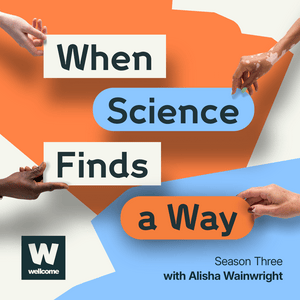
About When Science Finds a Way
Science is always adding to our knowledge of health, but how do ideas become breakthroughs, and how can those breakthroughs bring about a better world?
Could mosquitos help prevent disease? Will AI tools transform mental healthcare? How is a once-ignored drug now being used to save lives? And what can science do to keep us healthy as we age?
Join botanist-turned-Hollywood actor Alisha Wainwright as she meets the scientists, innovators, and communities working together to solve our biggest health challenges.
****
Brought to you by Wellcome, an independent global foundation that supports science to solve the urgent health challenges facing everyone. Please visit wellcome.org for more information.
Podcast websiteListen to When Science Finds a Way, Boring History for Sleep and many other podcasts from around the world with the radio.net app
Get the free radio.net app
- Stations and podcasts to bookmark
- Stream via Wi-Fi or Bluetooth
- Supports Carplay & Android Auto
- Many other app features
Get the free radio.net app
- Stations and podcasts to bookmark
- Stream via Wi-Fi or Bluetooth
- Supports Carplay & Android Auto
- Many other app features
When Science Finds a Way
Scan code,
download the app,
start listening.
download the app,
start listening.
When Science Finds a Way: Podcasts in Family
 UK
UK