

Listen to this podcast in the app for free: Download for free in the App Store
radio.net
Sleep timer
Save favourites
81 episodes
How Britain Lost Ireland: Prime Minister Asquith’s Fatal Mistakes
15/10/2026 | 42 mins.Join Tim McGarry and Dr. Cormac Moore on The Irish History Boys as they explore what British policy looked like towards Ireland between 1912 and 1921, including home rule.
This episode focuses specifically on the chequered careers and legacies of two consecutive British Prime Ministers: Herbert Henry Asquith and David Lloyd George.
They discuss Lloyd George's secret double-dealing with unionists and nationalists, the backfiring 1918 Conscription Crisis, and the passage of the 1920 Government of Ireland Act, which formally partitioned the six Ulster counties.
Hosted on Acast. See acast.com/privacy for more information.Ireland's Sovereignty and the 1926 Imperial Conference
08/10/2026 | 41 mins.Join Tim McGarry and Dr. Cormac Moore on The Irish History Boys as they explore Ireland's diplomatic push for co-equality at the 1926 Imperial Conference and the Balfour Declaration.
This episode also dives into a 1976 church initiative attempting to tackle 'them and us' politics in Northern Ireland, alongside a look at the 1926 Soviet power struggle that paved the way for Joseph Stalin's rise.
Hosted on Acast. See acast.com/privacy for more information.The Darkest Year in Ireland’s History: The Brutal 1798 Rebellion
01/10/2026 | 1h 3 mins.In this episode of the Irish History Boys, hosts Cormac Moore and Tim McGarry are joined by Dr Gavin Hughes to examine the bloody, highly complex tragedy of the 1798 Irish Rebellion.
We reflect on the brutal counter-insurgency campaign led by General Gerard Lake—exploring horrific tactics like "pitch-capped" burning tar hats, widespread executions, and the sheer terror of the "dragooning of Ulster".
We examine this chaotic uprising within the broader context of post-Atlantic radicalism, tracing how the ideals of Thomas Paine and the French Revolution inspired Wolfe Tone to unite "Catholic, Protestant, and Dissenter" in 1791. We unpack the strange paradoxes of the conflict—from Gaelic-speaking Catholic militias fighting for the Crown to soldiers telling "fibs" about their religion to secure army careers.
Additionally, we detail the strategic collapse following the arrest of Lord Edward Fitzgerald, Wolfe Tone's foiled French invasion at Bantry Bay where ships were so close you could "throw a biscuit box", and Napoleon's fateful decision to head to Egypt instead of Ireland.
We also explore the tragic human cost through local eyewitness accounts, including postmistress Mary Ledbetter's memories of the sacking of the pacifist Quaker village of Ballytore, as well as the horrific sectarian atrocities at Scullabogue and Carrick-na-Cessna.
To conclude, we trace the campaign from the "Races of Castlebar" to the last stand at Vinegar Hill, examining how an estimated 50,000 casualties paved the way for the 1800 Act of Union and why figureheads like Daniel O'Connell—who served in the Kerry Yeomanry—distanced themselves from the rebellion's bloody legacy.
Hosted on Acast. See acast.com/privacy for more information.The Bloodiest Chapter in Irish History: Drogheda, Wexford & Cromwell in Ireland
24/09/2026 | 1h 1 mins.In this episode of the Irish History Boys, we reflect on Oliver Cromwell’s brutal 10-month invasion of Ireland in 1649, a devastating campaign marked by the massacres at Drogheda and Wexford that left a 400-year shadow over the island.
We examine these horrific sieges within the grim context of 17th-century European warfare, comparing Cromwell's relentless tactics to the atrocities of the Thirty Years' War and exploring how black propaganda surrounding the 1641 Rebellion fuelled sectarian revenge.
Additionally, we dissect the paradox of Cromwell himself: was he a ruthless dictator, a cross between Stalin and Napoleon, or a disciplined military strategist who mastered supply lines and logistically bound his army together?
To conclude, we tackle the tragic aftermath of the Commonwealth campaign, exploring the catastrophic loss of up to 20% of Ireland’s population, the forced transportation of 50,000 Irish men and women to Barbados, and why Cromwell's legacy continues to walk beside history on the island to this day.
Hosted on Acast. See acast.com/privacy for more information.The IRA Bombing That Shook Northern Ireland’s Free Press
17/09/2026 | 45 mins.In this episode of the Irish History Boys, we reflect on the September 1976 IRA bomb attack on the Belfast Telegraph offices and the tragic death of 60-year-old print worker Joe Patton. We examine how rival publications—including the nationalist Irish News —stood in unprecedented solidarity to defend a free press against paramilitary intimidation.
We analyze this targeted attack within the context of 1976's grim violence, highlighting the rare targeting of journalists during the Troubles and the paper's defiance in publishing its famous four-page "Penny Marvel" edition straight from the rubble.
Additionally, we explore Vanguard leader William Craig’s astonishing political U-turn in September 1976.
We discuss his controversial proposal for a voluntary power-sharing coalition with the SDLP, his immediate expulsion from the unionist coalition, and the political paralysis that left Northern Ireland in a bleak stalemate.
To conclude, we tackle the long history of British political disinterest in Ireland, tracing a pattern of neglect from G.K. Chesterton’s 1918 warnings to border visits in 1924 and modern Brexit confusion.
We also answer listener questions regarding Ireland's World War II defense forces and diplomat Seán Lester's role leading the League of Nations.
Hosted on Acast. See acast.com/privacy for more information.
More Education podcasts



Trending Education podcasts





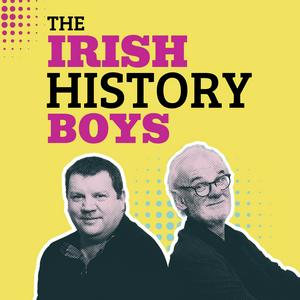
About The Irish History Boys
Comedian Tim McGarry and Historian Cormac Moore select the stories from the archives of The Irish News that bring Irish history to life in enlightening and amusing ways. Hosted on Acast. See acast.com/privacy for more information.
Podcast websiteListen to The Irish History Boys, The Studies Show and many other podcasts from around the world with the radio.net app
Get the free radio.net app
- Stations and podcasts to bookmark
- Stream via Wi-Fi or Bluetooth
- Supports Carplay & Android Auto
- Many other app features
Get the free radio.net app
- Stations and podcasts to bookmark
- Stream via Wi-Fi or Bluetooth
- Supports Carplay & Android Auto
- Many other app features
The Irish History Boys
Scan code,
download the app,
start listening.
download the app,
start listening.
 UK
UK