
Listen to this podcast in the app for free: Download for free in the App Store
radio.net
Sleep timer
Save favourites
377 episodes
DOP 373: Are Layoffs Really Because of AI?
21/10/2026 | 45 mins.#373: A company lays off 4,000 people the same day it posts record revenue, and the stock jumps. Is that really because of AI? Or just a really good press release?
Layoffs used to mean a company was bleeding cash. Now they show up next to record quarters, and AI gets the credit. Doesn't matter much if you're the one who got rapidly reallocated. You still need a job.
In this episode, Darin and Viktor talk about AI as the current layoff scapegoat and what to do when you end up on the wrong side of it.
YouTube channel:
https://youtube.com/devopsparadox
Review the podcast on Apple Podcasts:
https://www.devopsparadox.com/review-podcast/
Slack:
https://www.devopsparadox.com/slack/
Connect with us at:
https://www.devopsparadox.com/contact/DOP 372: Using AI Every Day Doesn't Make You Good at It
14/10/2026 | 49 mins.#372: Your company bought everyone a ChatGPT or Claude license. Problem solved, right? A few people never touch it. Most use it like a drive-through window -- type a question, grab the answer, leave. And the ones using it all day for emails assume that makes them good at it.
But think about it. Your kid had to pass a written test before driving the car. Your team got the keys and a login.
In this episode, we speak with Chris Daigle, founder and CEO of ChiefAIOfficer.com, about what actually turns daily AI use into real skill.
Chris's contact information:
LinkedIn: https://www.linkedin.com/in/doctordaigle/
YouTube channel:
https://youtube.com/devopsparadox
Review the podcast on Apple Podcasts:
https://www.devopsparadox.com/review-podcast/
Slack:
https://www.devopsparadox.com/slack/
Connect with us at:
https://www.devopsparadox.com/contact/DOP 371: Should You Vibe Code Your Own CRM?
07/10/2026 | 30 mins.#371: You've got an idea, two friends, and a coding agent. Why would you pay for a CRM when you can vibe code one this weekend? Day one, it looks great. You love it.
Then day 30 shows up. Somebody else needs access, a new feature breaks an old one, and you're asking yourself where this thing is even hosted. Pretty soon you're spending more time maintaining your CRM than running your business.
In this episode, we speak with Eddie Cliff, VP and GM of SMB and Growth Products at Salesforce, about when to build and when to buy.
Eddie's contact information:
LinkedIn: https://www.linkedin.com/in/eddiecliff/
X: https://x.com/eddiecliff
YouTube channel:
https://youtube.com/devopsparadox
Review the podcast on Apple Podcasts:
https://www.devopsparadox.com/review-podcast/
Slack:
https://www.devopsparadox.com/slack/
Connect with us at:
https://www.devopsparadox.com/contact/DOP 370: Will AI Replace QA Testers?
30/09/2026 | 1h 1 mins.#370: Will AI replace QA testers? Three years ago, manual testers were told to learn automation or find another job. Now the automation engineers are hearing the same thing about AI. Same speech, new audience.
Here's the thing. Nobody can test everything. Somebody still has to decide what quality means for your product and which workflows can't break, and your team is shipping ten times the code it used to. The conveyor belt got faster. You still have two eyes.
In this episode, we speak with Shubha Govil, Chief Product Officer at Sauce Labs, about why the testing roles stay but the work doesn't.
Shubha's contact information:
LinkedIn: https://www.linkedin.com/in/shubhagovil/
YouTube channel:
https://youtube.com/devopsparadox
Review the podcast on Apple Podcasts:
https://www.devopsparadox.com/review-podcast/
Slack:
https://www.devopsparadox.com/slack/
Connect with us at:
https://www.devopsparadox.com/contact/DOP 369: Vibe Coding Without the Slop
23/09/2026 | 48 mins.#369: Vibe coding is great until it isn't, and the until part usually shows up fast. Ten different ways to calculate sales tax. An agent that switches programming languages in the middle of a request. One team on NodeJS, another on Python, and nobody with a rule about either. So who's supposed to stop that?
Turns out that's a job now. Somebody has to tell the agents what they can and can't do, encode it, and then prove it held.
In this episode, we speak with Dan Fernandez, Vice President of Product for Developer Services at Salesforce, about harness engineering, what actually counts as slop, and why Heroku isn't dead.
Disclosure: Salesforce paid for Darin's travel and hotel to attend Dreamforce 2026. They did not review, approve, or influence this episode. The questions, the opinions, and the editing are ours.
Dan's contact information:
LinkedIn: https://www.linkedin.com/in/danfernandez/
YouTube channel:
https://youtube.com/devopsparadox
Review the podcast on Apple Podcasts:
https://www.devopsparadox.com/review-podcast/
Slack:
https://www.devopsparadox.com/slack/
Connect with us at:
https://www.devopsparadox.com/contact/
More Technology podcasts








Trending Technology podcasts
















About DevOps Paradox
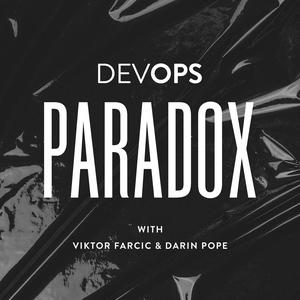
What is DevOps? We will attempt to answer this and many more questions.
Podcast websiteListen to DevOps Paradox, Waveform: The MKBHD Podcast and many other podcasts from around the world with the radio.net app
Get the free radio.net app
- Stations and podcasts to bookmark
- Stream via Wi-Fi or Bluetooth
- Supports Carplay & Android Auto
- Many other app features
Get the free radio.net app
- Stations and podcasts to bookmark
- Stream via Wi-Fi or Bluetooth
- Supports Carplay & Android Auto
- Many other app features

DevOps Paradox
Scan code,
download the app,
start listening.
download the app,
start listening.
 UK
UK