

Listen to this podcast in the app for free: Download for free in the App Store
radio.net
Sleep timer
Save favourites
52 episodes
Minisode how UX drives digital transformation at the IPO with Gill Richardson
13/08/2026 | 4 mins.Summary
Lucy Collins sits down with Gill from the IPO to discuss how user research can drive meaningful change inside a government organisation. They explore the balance between staying independent and working closely with design, analysis, and delivery teams to make research more actionable.
Takeaways
Independence can improve research quality
Research works best when it’s embedded in teams
Shared ownership creates better outcomes
Co-design helps teams challenge assumptions early
Accountability keeps user needs visible
Soundbites
“User research is a team sport.”
“Everybody needs to get involved.”
“We’re all part of that UCD community.”
“Question how this design decision meets a user need.”Ep43. Building a humane web: how digital can work for people and planet
16/07/2026 | 36 mins.Summary
Lucy Collins is joined by Chris Lewis, Managing Director of Wholegrain Digital, to explore the idea of the Humane Web and why good digital experiences should respect both the people using them and the planet we all share. The conversation explores why accessibility, sustainability and human-centred design are inseparable, and why creating better digital experiences often requires organisations to be brave enough to trust real user insight.
Sound Bites
“Humane web principles that matter”
“Design for people and planet”
“Accessibility, trust, and empowerment”
“AI should serve users first”
Takeaways
Humane web design is built on trust, empowerment, and human-centered thinking.
Accessibility and sustainability are core parts of ethical digital design.
AI can support humane web goals, but only when it serves real user needs.
Success should be measured beyond traditional business metrics.Minisode I bet your website isn’t accessible!
09/07/2026 | 3 mins.Summary
The Web Usability team explores why web accessibility still matters, what WCAG compliance means, and why many websites continue to fall short. She also highlights the business value of accessibility and the barriers disabled users still face online.
Sound Bites
“Why accessibility is still a challenge”
“Most websites still miss the mark”
“Accessibility is good business”
“Inclusion starts with better design”
Takeaways
WCAG compliance is still difficult for many websites.
Accessibility improves both user experience and business reach.
Inaccessible websites can cause disabled users to give up.
Legal and ethical pressure around accessibility keeps growing.Ep42. Accessible video is better video
17/06/2026 | 39 mins.Summary
In this episode, Lucy Collins interviews Ross Exton, a video and multimedia producer with a focus on accessibility and visual storytelling. They explore what makes a good video, the impact of AI on video production, and how inclusive communication enhances engagement.
Sound Bites
"Your job is to convince the audience, not me"
"My hearing loss has made me a better communicator"
"Trust is key in AI-generated content"
Takeaways
Audience-Centric Content: Understand your audience to create engaging and trust-building content.
Accessibility by Design: Integrate accessibility from the start to enhance clarity and reach..
Authenticity and Human Touch: Emphasise genuine human stories to build trust.
Iterative Creation: Frequent content creation builds skills and confidence.
Find out more about Ross here...
LinkedIn: https://www.linkedin.com/in/rossexton/
Watch and Learn Productions: Watch & Learn ProductionsEp41. The role of AI in UXR
15/05/2026 | 40 mins.Summary
In this episode, Lucy Collins chats with user research expert Nikki Anderson about the rapid evolution of AI in user research. They explore how AI tools are shaping research processes, their benefits, limitations, and the responsible ways to integrate AI without losing human nuance.
Sound Bites
"AI is transforming user research by accelerating processes and refining analysis."
"Maintaining human strategic thinking is crucial despite AI advancements."
"AI moderation has potential but cannot replace deep, nuanced conversations."
"Ethical use of AI requires practical guardrails and human oversight."
Takeaways
AI enhances desk research and scenario planning, offering significant time savings.
Over-reliance on AI can lead to a loss of critical thinking and depth.
Practical guardrails are essential for ethical and effective AI use in research.
AI-moderated interviews and synthetic personas have potential but also limitations.
Human-AI collaboration is key to understanding diverse user groups.
More Business podcasts
 A Bit of OptimismBusiness, Careers, Education, Self-Improvement
 Hot Smart Rich with Maggie Sellers ReumBusiness
 This is Money PodcastBusiness, Business News, Investing, News
 The Resilient Retail Game Plan - retail insights, retail trends and best practicesBusiness, Entrepreneurship, Management, Marketing
 UnhedgedBusiness, Business News, Investing, News
 Working Hard with Grace BeverleyBusiness, Education, Health & Wellness, Marketing, Self-Improvement
 The Diary Of A CEO with Steven BartlettBusiness, Education, Society & Culture
 The Martin Lewis PodcastBusiness
 Aspire with Emma GredeBusiness, Entrepreneurship, Society & Culture
 The Story of MoneyBusiness, Business News, History, News
Trending Business podcasts
 The GaryVee Audio ExperienceBusiness, Marketing
 Mouthy Money: Building wealth with long term investing and saving strategiesBusiness, Investing
 Coffeez with Joe ShalabyBusiness, Careers, Entrepreneurship, Management
 Hot Smart Rich with Maggie Sellers ReumBusiness
 Forward GuidanceBusiness, Business News, Investing, News
 Moonshots with Peter DiamandisBusiness
 Eat Sleep Work Repeat - better workplace cultureBusiness, Management, Science, Social Sciences
 Marketing School - Digital Marketing and Online Marketing TipsBusiness, Marketing
 Executive Decisions with Steve SedgwickBusiness, Management
 How To Become A...Business, Careers, Education, Society & Culture
 APM Project Management TrainingBusiness, Careers, Management
 The Startup Ideas PodcastBusiness, Entrepreneurship
 Money Maze PodcastBusiness, Business News, Investing, Management, News
 Rich Dad Radio Show: In-Your-Face Advice on Investing, Personal Finance, & Starting a BusinessBusiness, Entrepreneurship, Investing
 She's On The MoneyBusiness, Investing
 MarketplaceBusiness, News
 The Savvy Wallet PodcastBusiness, Education, Investing, Tutorials
 The Psychology of Money with Morgan HouselBusiness
 The Art of InvestingBusiness, Education, Investing, Tutorials
 Masters in BusinessBusiness, Investing
 The Bottleneck PodcastBusiness, Entrepreneurship, Marketing
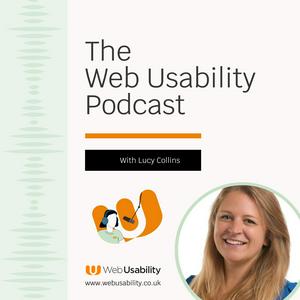
About The Web Usability Podcast
Join Lucy Collins, Director of Web Usability, as we explore what it takes to make the web a more accessible and enjoyable place for everyone.
Whether you're a website owner, developer, or just a curious mind, we're here to share insights, tips, and stories that can help you improve the user experience of your digital world.
Web Usability is an established User Experience (UX) agency. We are UX specialists. We provide inclusive UX research and advice to optimise your digital services.
If you need a transcript of our podcasts, just visit our website at www.webusability.co.uk.
Podcast websiteListen to The Web Usability Podcast, A Bit of Optimism and many other podcasts from around the world with the radio.net app
Get the free radio.net app
- Stations and podcasts to bookmark
- Stream via Wi-Fi or Bluetooth
- Supports Carplay & Android Auto
- Many other app features
Get the free radio.net app
- Stations and podcasts to bookmark
- Stream via Wi-Fi or Bluetooth
- Supports Carplay & Android Auto
- Many other app features

The Web Usability Podcast
Scan code,
download the app,
start listening.
download the app,
start listening.
 UK
UK