
Listen to this podcast in the app for free: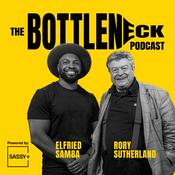 Download for free in the App Store
radio.net
Sleep timer
Save favourites
29 episodes
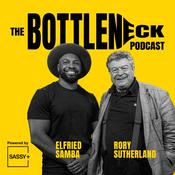
Rory Sutherland, Elfried Samba & Jacob Shwirtz on The Death of The Keyboard
01/11/2026 | 1h 19 mins.Jacob Shwirtz, Head of Celebrity & Cultural Partnerships at Wispr Flow, joins Rory and Elfried to ask why we're still typing and what changes when the keyboard stops being the default way we talk to computers and to AI.
He covers why the keyboard is the real pinch point between brain and text, why voice may matter more as AI gets better, and what it means to build a marketing programme around trust rather than a brief.
Jacob's background is in creative fields. He studied film production and has worked at MTV, in TV and film, casting, and with celebrities and digital influencers. He now leads the evangelist programme at Wispr Flow, a voice dictation tool that works as a keyboard replacement across computers and phones.
What we cover
The keyboard as a bottleneck: Rory applies Goldratt's theory of constraints. If you want to improve a system, intervene at the pinch point, and the pinch point between brain and text is the keyboard. Jacob argues it has made us antisocial, kept our heads down and led us to censor our thoughts.
The Zoom of voice: Rory compares Wispr Flow to Zoom, which crossed a "threshold of non-crappiness" by getting the technology and the psychology right at the same time. He explains why Zoom could sacrifice picture quality but not audio.
Why keyboards got worse: The IBM Selectric, thin laptops, and why the BlackBerry beat the iPhone for typing. Thinness is easy to see when you buy a laptop. Typing feel isn't.
Electrification and AI: Factories gained little from swapping a steam engine for an electric motor until they redesigned around it. Rory argues language models work the same way. They reward long, rich, multi-dimensional questions that people won't type but will say.
Perdurance: Giles Ellis's idea that great products keep rewarding you after the purchase. From stairlifts and air fryers to voice dictation, why products with hidden extra uses create evangelists, and why finance models can't see it.
Evangelists, not influencers: Jacob describes a contract with no deliverables, no timeline and no scripts, in which the word "trust" appears far more than usual. He explains why Rory and the digital artist Paisley Lee can sit on the same budget line.
AI should be social: Rory on why the best AI has always been other people, why email turns a three-minute conversation into a five-day exchange, and what offices lost when we stopped overhearing each other.
Voice, access and equality: Who gets left out when everything runs through a keyboard: people with dyslexia, repetitive strain injury or visual impairments, and anyone who speaks better than they write. Rory argues the best orators are often better when they leave the script, citing Martin Luther King's "I have a dream" speech.
Fame bias and original voices: Rory worries that AI has the same bias towards the famous and the articulate that humans do and talks about using whatever influence you have to lift other people.
Hyper-human marketing: Jacob's case for costly signalling and things that don't scale, and Rory's case against the "fetish of accountability", illustrated by a restaurant that becomes a wine bar.
Chapter Markers
(00:00:00) Episode Intro
(00:01:34) Meet Jacob and Wispr Flow
(00:03:46) The Zoom of voice dictation
(00:07:57) The keyboard as a bottleneck
(00:14:16) Electrification and AI
(00:18:27) Perdurance: stairlifts to air fryers
(00:24:30) Evangelists, not influencers
(00:32:17) Why voice matters in the AI era
(00:42:59) AI should be social
(00:55:25) Original voices and fame bias
(01:01:09) How to use Wispr Flow today
(01:14:24) Hyper-human marketing
Follow Rory
Instagram: @rorysutherland_clips
TikTok: @rorysutherlandclips
X: @rorysutherland
LinkedIn: https://www.linkedin.com/in/rorysutherland/
Follow Elfried
Instagram: @elfriedsamba
LinkedIn: https://www.linkedin.com/in/elfriedsamba/
Website: https://www.butterflyeffect.xyz/
Follow Jacob Shwirtz
LinkedIn: https://www.linkedin.com/in/shwirtz/Caroline Orange-Northey with Rory Sutherland and Elfried Samba discuss the Fear of Better Options
18/10/2026 | 1h 13 mins.Caroline Orange-Northey, ex-Managing Director of Pinterest UK & Ireland, joins Rory and Elfried to talk about why marketing has been optimising for the wrong things, and why the best thing you can find online is a reason to go offline.She covers clicks versus decisions, why slow, considered platforms get undervalued, and what a maths degree brings to media.Caroline traces her route into the industry. She studied maths, wrote a thesis on Fermat’s Last Theorem, and fell into Talksport radio. She then spent seven years at News International before moving to the FT, Amazon and Pinterest. Her dad was a private investigator, which she says explains her nosiness.What we coverDesigning the exit: Caroline argues that brands want people to do something in the real world, yet the industry optimises for what’s easiest to capture online. Her point: “attention is fragmented, intention is usually whole.”Slow scrolling and considered purchases: Rory notes that scroll speed on Pinterest is about three times slower than elsewhere. Caroline explains why that matters for returns, not just sales. Ten tops bought on impulse and nine sent back isn’t the same as two bought and kept.FOBO: The fear of better options, and why around 70% of carts are abandoned. Caroline and Rory discuss how confidence in a decision drives action, and why a distinctive USP helped people feel sure.Pinterest Predicts: The annual trends report, with about 88% accuracy over six years. Caroline says trends on Pinterest last twice as long as elsewhere, and Rory explains why through the Lindy effect.Gen Z and the analogue turn: Pen pals, direct mail, vinyl and nostalgia for things they never lived through. Elfried and Caroline discuss why a generation raised on AI and feeds is reaching for the physical.AI raises the average but dilutes the premium: Why distinctiveness is back at a premium, why the CMO may be returning to the boardroom, and why Caroline wants AI to be an “and” conversation rather than an “instead of” one.Taste, choice and the toaster problem: Pinterest’s taste graph, and the line between personalisation and creepiness. Rory brings in Paul Eastwick’s Bonded by Evolution on first impressions in dating, and an experiment for Boots that made a catalogue “less irrelevant” for men.Life moments: Richard Shotton’s work on how major life events change brand choices, from broadband providers to bank accounts.Time well spent versus time spent: Why Pinterest doesn’t see itself as social media, plus the case for play, joy and manifesting your future self.Why you should never buy anything in an airport: Rory and Caroline disagree, with side trips into oven chips, EV range anxiety and Qantas’s non-stop Perth flight.Rory Sutherland, Elfried Samba and Les Binet discuss physics, emotion, and the metrics trap
03/10/2026 | 2h 26 mins.Les Binet, one of the best-known names in marketing effectiveness, joins Rory Sutherland and Elfried Samba for a wide-ranging conversation. He covers 38 years in advertising, why measurement can mislead you, and what a theoretical physicist brings to marketing.Les traces his unlikely route into the industry. He left a PhD in solid state physics for AI research in Edinburgh, then worked in a publishing start-up that Robert Maxwell squeezed out of existence. He ended up in BMP, the agency that pioneered account planning, after a three-day job transcribing TV ratings.What we coverPhysics versus logic: Les argues that physics is about the mathematics of change, with feedback loops and dynamics, rather than static logic. He says this is why he sees marketing as "pipework" and circuits.BMP's planning culture: At BMP you needed A-level maths to be a planner and an IPA effectiveness award to reach the board. Les covers how that rigour faded and what it cost the industry.Emotion beats rational persuasion: Marketing in the Era of Accountability (2007) surprised even its authors. Pure emotional campaigns outperformed rational ones on nearly every business metric, with short-term direct response the main exception.Short term and long term: The Long and the Short of It shows that short-term success doesn't predict long-term success. The key word, as Les says, is "and".How Rory influenced Les: A question at an IPA seminar led Les to prospect theory, Kahneman and System 1/System 2. That in turn led to BrainLab at the agency and, indirectly, to the company System1 taking its name.Additive versus multiplicative effects: The Cravendale test grid found TV alone gave about 5%, direct mail about 10%, and both together 32%. Why layer-cake charts mislead, and how ergodicity changes how you think about risk.Tight versus loose fitness functions: Rory and Les on why narrow ROI metrics create a "sparse monoculture". The carpet store flywheel, Wolfram on evolution, and "what you measure is what you do".Fat tails: Is marketing's value concentrated in a few outlier ideas, or in solid work that's merely "good enough"? Les and Rory disagree.Share of search: Using Google Trends as a free proxy for mental availability, plus a look at Rory's own share of search.Interests beyond your field: Brian Eno and generative music, why cheddar is the honesty test, and why music, beer and cheese rank above advertising for Les.Follow RoryInstagram: @rorysutherland_clipsTikTok: @RorysutherlandclipsX: @rorysutherlandLinkedIn: in/rorysutherland/Follow ElfriedInstagram: @elfriedsambaLinkedIn: in/elfriedsamba/https://www.butterflyeffect.xyz/Follow Les BinetX: @BinetLesLinkedIn: in/les-binetRita McGrath with Rory Sutherland on why big companies kill their best ideas
19/08/2026 | 1h 21 mins.Rita McGrath has spent her career on a question most companies would rather not answer: can a large organisation genuinely innovate from the inside, or does it only ever buy in what threatens it?In this episode she joins Rory to explain why big companies are so bad at handling uncertainty. Rita's argument is that firms run new ventures by the same rules they use for the business they already understand, and it kills them. No advantage lasts, so the replacement has to be in development long before you need it.This is a conversation about the gap between what companies say they want from innovation and what they actually reward, and about where the fixes are to be found.Follow RoryInstagram: @rorysutherland_clipsTikTok: @RorysutherlandclipsX: @rorysutherlandLinkedIn: in/rorysutherland/Follow ElfriedInstagram: @elfriedsambaLinkedIn: in/elfriedsamba/https://www.butterflyeffect.xyz/A @Sassy+ original podcast seriesSir Richard Harpin with Rory Sutherland and Elfried Samba on how he built a £4.1bn business
02/08/2026 | 1h 19 mins.Sir Richard Harpin started with £50,000 and turned it into HomeServe, a business he sold for £4.1 billion. In this episode, he joins Rory and Elfried to break down the nine steps behind that journey, from copying the right ideas to knowing when to say no.
From staking your claim in a market nobody else believes in to the "not-to-do list" that kept HomeServe focused, this is a masterclass in bootstrapping, mentorship and building something built to scale.
Follow Rory
Instagram: @rorysutherland_clips
TikTok: @Rorysutherlandclips
X: @rorysutherland
LinkedIn: in/rorysutherland/
Follow Elfried
Instagram: @elfriedsamba
LinkedIn: in/elfriedsamba/
https://www.butterflyeffect.xyz/
Follow Sir Richard Harpin
Instagram: @richard_harpin
TikTok: @richard.harpin
LinkedIn: in/rharpin/
YouTube: https://www.youtube.com/@BusinessleaderUk
https://www.richardharpin.com/
https://www.businessleader.co.uk/
A @Sassy+ original podcast series
More Business podcasts
Trending Business podcasts








About The Bottleneck Podcast
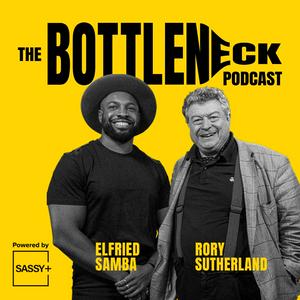
Rory Sutherland, Vice Chairman of Ogilvy UK, and Elfried Samba, CEO and Co-Founder of Butterfly Effect and former Global Head of Social at Gymshark, explore the hidden blocks that slow teams down, from flawed strategies to missed cultural signals and outdated thinking. Each episode breaks down a real challenge through the lens of behavioural science, digital strategy, and lived experience. Through conversations with industry pioneers and creative thinkers, they unpack why teams fail and reveal secrets for driving progress. Joined by guests who’ve built, rebuilt, or reimagined entire industries, Rory and Elfried challenge assumptions, unpack failure, and explore what moves the needle. Powered by Sassy+ www.sassyplus.com Hosted on Acast. See acast.com/privacy for more information.
Podcast websiteListen to The Bottleneck Podcast, The Diary Of A CEO with Steven Bartlett and many other podcasts from around the world with the radio.net app
Get the free radio.net app
- Stations and podcasts to bookmark
- Stream via Wi-Fi or Bluetooth
- Supports Carplay & Android Auto
- Many other app features
Get the free radio.net app
- Stations and podcasts to bookmark
- Stream via Wi-Fi or Bluetooth
- Supports Carplay & Android Auto
- Many other app features

The Bottleneck Podcast
Scan code,
download the app,
start listening.
download the app,
start listening.
 UK

