
Listen to this podcast in the app for free: Download for free in the App Store
radio.net
Sleep timer
Save favourites
418 episodes

Agents Make Ideas More Valuable Than Execution - Dr. Alex Mehr
27/10/2026 | 47 mins.🤖 AI agents for business could transform entrepreneurship by making execution faster, cheaper, and accessible to people without technical skills.
In this episode of Beginner’s Guide to AI, Dietmar Fischer speaks with Dr. Alex Mehr, founder and CEO of Famous Labs, former NASA research scientist, and co-founder of Zoosk. Alex has worked with artificial intelligence since building neural networks during graduate school. Today, he is developing agents designed to turn ideas into products, marketing campaigns, and functioning businesses.
What happens when you no longer need a development team, marketing department, or complex collection of software tools to test an idea?
Alex argues that the entrepreneurial bottleneck is shifting. Execution used to be scarce. AI agents can now build websites and applications, create content, launch advertising, monitor campaign results, and modify landing pages. As those capabilities improve, original ideas and good judgment become more important.
The discussion also challenges one of the best-known concepts in startup culture: the minimum viable product. In a crowded market where polished products can be built quickly, Alex believes a visibly incomplete product may no longer produce meaningful validation.
You will learn:
🤖 Why an AI agent is more than a chatbot
💡 Why ideas could become the new business bottleneck
🚀 How founders can test products faster
📊 How AI agents could manage advertising and landing pages
⚰️ Why the traditional MVP may be outdated
🧠 Why creativity needs regular practice
🦾 Why physical robots remain far behind digital agents
⚠️ Why Alex believes AI risks are often overstated
This episode is for entrepreneurs, marketers, consultants, coaches, product teams, and anyone who wants to understand how agentic AI could change the process of building a business.
Newsletter Anyone???
📧💌📧
Tune in to get my thoughts and all episodes. Don’t forget to subscribe to our newsletter:
beginnersguideto.ai
📧💌📧
About Dietmar Fischer
Dietmar Fischer is a podcaster and AI marketer from Berlin.
If you want help with AI strategy or digital marketing, visit:
argoberlin.com
Quotes from the Episode
“Execution is becoming easier and easier and easier by the day, so yes, the bottleneck is ideas.”“The world has changed, the advice has not.”“You gotta get in the habit of going to the idea gym.”
Chapters
00:00 Alex Mehr’s 25-year journey with AI
03:01 Turning an idea into a working business
08:49 AI agents versus chatbots
13:21 What autonomous execution means for entrepreneurs
19:19 Why ideas become the new bottleneck
24:31 Why the minimum viable product is dead
29:18 From digital agents to humanoids and robots
36:25 Are the risks of AI agents overstated?
40:14 Where to find Alex Mehr and SuperCool
Hosted on Acast. See acast.com/privacy for more information.Do Football Clubs Understand Talent Better Than Companies? DIETMARs OPINION
25/10/2026 | 17 mins.AI Is Breaking the Career Ladder
If companies stop hiring beginners because AI can do junior work, who will become tomorrow’s senior talent?
Artificial intelligence can now perform many of the routine tasks traditionally assigned to junior employees. For an individual company, replacing some of that work with AI can look like an obvious efficiency gain.
But there is a problem.
Junior work is not only cheap labor. It is how people learn. It is how beginners gain experience, make mistakes, develop judgment, and eventually become the senior employees companies depend on.
In this solo thought episode, Dietmar Fischer compares the workplace with professional football. Successful clubs do not only buy established stars. They build academies, train young players, and give them time on the pitch. Companies need their own version of that system.
Anthropic recently reported that the share of junior employees among its technical hires fell sharply as the use of AI agents increased. A wealthy AI company may still be able to recruit senior talent from around the world. But what happens to smaller companies when the wider talent pipeline begins to dry up?
⚽ In this episode:
What football academies can teach companies about talent
Why AI threatens the path from junior to senior
How short-term savings can create a long-term skills shortage
Why demographics make the problem more urgent
How junior hiring can build employee loyalty
Why the market may not solve the problem by itself
What managers can do now
This is not an argument against AI. It is an argument for using AI without removing the development path that creates human expertise.
📧💌📧
Tune in to get my thoughts and all episodes. Don’t forget to subscribe to our newsletter: beginnersguideto.ai
📧💌📧
Quotes from the Episode
“The market dries out. So how do you find seniors in the future that you are able to pay?”
“Keep hiring juniors. Find jobs for them. Invent something.”
“Individual rational decisions sum up to collective irrational ones, leading the market to fail.”
About Dietmar Fischer
Dietmar Fischer is the creator and host of Beginner’s Guide to AI and a digital marketer at Argo.berlin. If you want to get your AI project or digital marketing moving, contact him at argoberlin.com.
Chapters
00:00 Why Football Matters to an AI Podcast
01:23 Youth, Work, and a Growing Lack of Opportunity
02:46 What Football Academies Teach Companies
07:01 When AI Removes the Junior Rung
10:22 Demographics and the Coming Senior Shortage
13:36 Why Companies Must Keep Hiring Juniors
15:00 Market Failure and Collective Responsibility
16:18 The Premier League Warning
17:48 Investing in Tomorrow’s Experts
18:38 A Message to Early-Career Workers
Hosted on Acast. See acast.com/privacy for more information.The Invisible Label: How AI Watermarking Will Change Digital Trust
23/10/2026 | 24 mins.AI-generated images, voices, videos and text are becoming harder to distinguish from human-made content. AI watermarking promises to help by embedding an invisible signal that detection software can identify. But what does that signal really prove, and can it survive editing, compression or a determined attacker?
In this episode of A Beginner’s Guide to AI, Prof. GePhardT examines how AI watermarking works across images, audio, video and text. We separate genuine watermark detection from unreliable attempts to guess whether something “looks like AI.” We also examine why a missing watermark cannot prove that a human created the content.
The EU AI Act has made this question urgent. Providers of relevant generative AI systems must make synthetic outputs machine-readable and detectable as artificially generated or manipulated. Watermarks are one possible solution, alongside metadata, digital fingerprints and cryptographic content provenance.
Google SynthID provides our real-world case. The system places imperceptible signals inside supported AI-generated media and allows users to check for them. It demonstrates that watermarking can work at enormous scale, but also reveals the limits of compatibility, robustness and public understanding.
🔍 What You Will Learn
How invisible AI watermarks are embedded into pixels, audio, video frames and text
Why watermarking is different from metadata and general AI detection
What Article 50 of the EU AI Act means for synthetic content
How Google SynthID and the SynthID Detector work
Why C2PA and Content Credentials matter
Whether AI watermarks can be removed
Why origin and truth are not the same thing
📧💌📧
Tune in to get my thoughts and all episodes. Don’t forget to subscribe to our newsletter.
📧💌📧
💬 Quotes from the Episode
“A detected watermark does not prove that content is false, and the absence of one does not prove that it is human-made.”“AI watermarking should be treated as one layer of evidence, not a universal truth machine.”“Technology can provide the signature; judgement must still provide the truth.”
⏱️ Chapters
00:00 Why AI Content Needs an Invisible Label
02:10 How AI Watermarking Works
07:25 Watermarks, Detectors and Content Provenance
10:25 What the EU AI Act Requires
12:20 Google SynthID in the Real World
17:15 What Watermarks Can and Cannot Prove
👤 About Dietmar Fischer
Dietmar is a podcaster and digital marketer from Argo.berlin. If you want to know how to get your AI or digital marketing going, contact him at argoberlin.com
Hosted on Acast. See acast.com/privacy for more information.Cutewashing AI: The Hidden Cost of Cute AI
21/10/2026 | 20 mins.AI agents are becoming more capable, more personal and much harder to ignore. They can use connected apps, prepare work in the background and act on your behalf. So why are Big Tech companies making them look like cheerful little creatures with giant eyes?
In this episode of A Beginner’s Guide to AI, Professor GepHardT looks at cutewashing: the use of cute AI mascots to make powerful AI agents feel safe, familiar and harmless. From OpenAI dots to Meta Muse, these tools are moving beyond chatbots. They can access information, work across apps and take action.
That makes trust, permissions and privacy more important than ever.
🎯 In this episode:
Why cute AI agents are everywhere
What makes an AI agent different from a chatbot
How anthropomorphic AI design can shape trust
Why AI agent permissions and approvals matter
What OpenAI dots and Meta Muse reveal about the future of personal AI
How to test an AI agent before you let it access your digital life
📧💌📧
Tune in to get my thoughts and all episodes. Do not forget to subscribe to our newsletter: beginnersguideto.ai
📧💌📧
Quotes from the Episode
“Cute is not a security feature.”
“The mascot can open the door. Control must be behind it.”
“The most trustworthy AI is not the one that looks the most harmless. It is the one that makes its power visible.”
👤 About Dietmar Fischer
Dietmar Fischer is a podcaster and digital marketer from Argo.berlin. If you want to get your AI or digital marketing moving, contact him at argoberlin.com.
Hosted on Acast. See acast.com/privacy for more information.AI Isn’t Moving Too Fast. It’s Too Noisy - Nikolas Badminton
19/10/2026 | 55 mins.🤖 Why AI Transformation Needs Intentionality, Not More Technology
AI transformation is not about putting AI everywhere. Futurist Nikolas Badminton argues that successful organizations are becoming much more intentional about where AI creates value and where humans remain essential.
In this episode of Beginner’s Guide to AI, Dietmar Fischer speaks with Nikolas Badminton, Chief Futurist and Hope Engineer at Futurist.com, about moving beyond AI hype and building organizations that can actually handle technological change.
Nikolas argues that the world is not simply changing faster. It is getting noisier.
Behind the endless stream of AI models, agents and automation promises are the same difficult questions companies have faced for decades: people, processes, governance, data, culture and leadership.
So what changes when AI enters the picture?
We explore why going all in on AI can make employees work harder instead of less, why intentionality is becoming central to AI strategy, and why successful AI adoption is fundamentally a transformation project.
We also go beyond AI.
Nikolas introduces the idea behind his new book, The Hope Engineer’s Playbook: hope can become a practical energy for organizational change when leaders combine vision with pathways, agency and wisdom.
We discuss futures thinking, employee empowerment, sustainability, open-source AI, AI sovereignty and even science fiction as a serious strategic tool.
🎧 In this episode:
• Why AI feels faster and more chaotic than it really is
• Why leaders should stop trying to use AI everywhere
• The hidden organizational work behind AI transformation
• Why AI can increase employee workload
• Hope as an energy for change
• Why agency matters inside organizations
• Open-source AI and enterprise AI sovereignty
• Why sustainability and futures thinking belong in business strategy
• How science fiction helps executives experience possible futures
• Whether AI leads us toward Terminator, Matrix or something completely different
Get the Newsletter!
📧💌📧
Tune in to get my thoughts and all episodes. Don't forget to subscribe to our Newsletter:
https://beginnersguideto.ai
📧💌📧
🎙️ About Dietmar Fischer
Dietmar Fischer is a podcaster and AI marketer from Berlin.
If you want help with AI strategy or digital marketing, visit:
https://argoberlin.com
💬 Quotes from the Episode
“The world is changing faster than ever before. I actually think it's noisier than ever before.”“It's a transformation project. There's still people and processes and governance, there's data, and that's messy.”“I get hired for the things I used to get fired for.”
⏱️ Chapters
00:00 Meet Futurist and Hope Engineer Nikolas Badminton
01:26 Why AI Feels Faster Than It Really Is
04:33 From AI Hype to Intentional Transformation
09:16 Why Hope Is a Serious Leadership Tool
17:16 Futures Thinking and the Courage to Think Differently
25:10 How to Become a Hope Engineer
29:22 AI Sovereignty and the Case for Open Source
32:47 Sustainability, Science Fiction and Better Futures
42:11 Will AI Create Terminator or Matrix?
45:26 The Hope Engineer’s Playbook
🔗 Where to Find Nikolas Badminton
🌐 Website: futurist.com
💼 LinkedIn: linkedin.com/in/futuristnikolasbadminton
📕 The Hope Engineer’s Playbook: How Leaders Build Vision, Pathways, and Energy for Better Futures: https://futurist.com/hope-engineers-playbook/
Hosted on Acast. See acast.com/privacy for more information.
More Business podcasts






Trending Business podcasts
























About A Beginner's Guide to AI
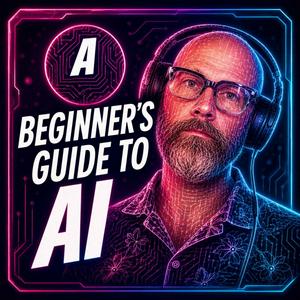
"A Beginner's Guide to AI" makes the complex world of Artificial Intelligence accessible to all. Each interview episode asks someone working with AI about what they do and how AI can help you. The explainer episodes take an important concept/idea and, yeah, explain it to you!Ideal for novices, tech enthusiasts, and the simply curious, this podcast transforms AI learning into an engaging, digestible journey. Join us and learn everything you need to know on how to use AI in the best way 🚀🎙️ About The Host, Dietmar FischerDietmar is a AI enthusiast and digital marketer from Berlin. If you want to know how to get your AI or your digital marketing going, just contact him at argoberlin.com Hosted on Acast. See acast.com/privacy for more information.
Podcast websiteListen to A Beginner's Guide to AI, This is Money Podcast and many other podcasts from around the world with the radio.net app
Get the free radio.net app
- Stations and podcasts to bookmark
- Stream via Wi-Fi or Bluetooth
- Supports Carplay & Android Auto
- Many other app features
Get the free radio.net app
- Stations and podcasts to bookmark
- Stream via Wi-Fi or Bluetooth
- Supports Carplay & Android Auto
- Many other app features

A Beginner's Guide to AI
Scan code,
download the app,
start listening.
download the app,
start listening.
A Beginner's Guide to AI: Podcasts in Family
 UK
UK