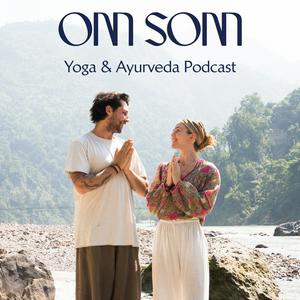
PodcastsEducationOm Som Yoga + Ayurveda Podcast

Om Som Yoga + Ayurveda Podcast

Aaron Petty + Paige Taylah
Om Som Yoga + Ayurveda Podcast
Latest episode

117 episodes

  • Om Som Yoga + Ayurveda Podcast

    The Practice that Reveals Your Real Self | SVĀDHYĀYA

    22/03/2026 | 50 mins.
    PRACTICE WITH US:
    365 Sadhana Sangha
    https://practice.omsom.yoga/365-sadhana-sandha/join
    100 Hr Asana Sadhana Dharma
    https://practice.omsom.yoga/asana-sadhana-dharma-oto
    200 Hr Yoga Teacher Training Sri Lanka 2026
    https://omsom.yoga/200-hour-yoga-teacher-training-sri-lanka
    50 Hr Online Yin Yoga Teacher Training
    https://practice.omsom.yoga/yin-yoga-and-prana-vayus-oto

    ON THIS WEEK’S EPISODE:
    We often think self-study means fixing ourselves. But in yoga, Svādhyāya isn’t about becoming better. It’s about becoming honest.

    In this episode, Aaron and Paige explore Svādhyāya as illumination. Not self-help. Not self-analysis. But observation for its own sake.

    Through the story of Indra and Virochana, we unpack the difference between identifying with the body and inquiring into the witness behind it. One student stops at the reflection. The other keeps going.

    Svādhyāya asks:
    Who is observing the body?
    Who is watching the mind?
    Who is aware of the story?

    And what happens when we stop trying to improve ourselves and simply see?

    DEFINITION & ETYMOLOGY:
    • Svā (स्व) - one’s own, the Self
    • Adhyāya (अध्याय) - study, recitation, inquiry

    Svādhyāya (स्वाध्याय) means study of the Self. Reflection upon the Self. A returning to what is deeper than identity.

    In this episode we clarify the distinction between:
    • Self-help - observation to create change
    • Self-analysis - asking why
    • Svādhyāya - observing without fixing

    KEY CONCEPTS & INSIGHTS:
    • Agni as illumination - fire does not only burn, it reveals
    • The difference between ahamkāra (the constructed self) and the witness
    • The “space between” experience and observer - where story and identity form
    • Kriyā Yoga - Tapas reveals, Svādhyāya observes, Īśvara Praṇidhāna surrenders
    • Communion with one’s iṣṭa-devatā through self-study
    • The paradox of the Self - it cannot be known as an object

    We also explore Yoga Sūtra 2.44:
    “Svādhyāyād iṣṭa-devatā-saṃprayogaḥ”
    Through self-study comes communion with the chosen form of the Divine.

    And the riddle from the Kena Upaniṣad:
    “It is not known by those who know it, and known by those who do not know it.”

    The Self cannot be captured. Only revealed.

    PRACTICAL INTEGRATION:
    • Journalling without editing - observe thoughts in real time
    • Five-layer reflection: physical, mental, emotional, energetic, spiritual
    • Silent mantra repetition to quiet the mind
    • Mirror work - observe without correcting
    • Trāṭaka (candle gazing) - object, observer, space between
    • Notice reactions in daily life without immediately creating a story

    Ask yourself:
    • What are you trying to change before you’ve truly seen it?
    • Where are you satisfied with an answer that’s almost true?
    • What becomes possible when understanding replaces the need to fix?

    Svādhyāya is not something to master.
    It is something to return to.

    When the layers fall away, nothing new is gained.
    Only remembered.

    SHARE & CONNECT
    Thank you for listening to the Om Som Yoga & Ayurveda Podcast. Please share this episode with someone it might support, and connect with us on social media or via our website.

    Instagram: @OmSom.yoga
    Website: OmSom.yoga

    We operate a yoga studio in Berwick, Victoria, Australia, offering classes, workshops, and Yoga Teacher Training programs. We’d love to connect with you wherever you are on your journey.

    HARI OM
  • Om Som Yoga + Ayurveda Podcast

    Resistance is the Doorway: Tapas in Real Life

    15/03/2026 | 33 mins.
    PRACTICE WITH US:365 Sadhana Sanghahttps://practice.omsom.yoga/365-sadhana-sandha/join100 Hr Asana Sadhana Dharmahttps://practice.omsom.yoga/asana-sadhana-dharma-oto200 Hr Yoga Teacher Training Sri Lanka 2026https://omsom.yoga/200-hour-yoga-teacher-training-sri-lanka50 Hr Online Yin Yoga Teacher Traininghttps://practice.omsom.yoga/yin-yoga-and-prana-vayus-otoON THIS WEEK’S EPISODEIn this conversation with Lina, we explore:• Tapas as “heat”: the friction that creates real change• Why resistance isn’t failur, it’s the doorway• How tapas applies to asana, pranayama, meditation, and daily life• The difference between “love and light” bypassing vs grounded transformation• Why the hard thing isn’t always the intense thing (sometimes it’s rest, gentleness, or silence)DEFINITION & ETYMOLOGYTAPAS (तपस्)• Root: TAP (तप्) - to heat, to burn, to glow• Tapas is the inner heat generated by sustained effort - especially when we meet discomfort consciously.• A simple felt-sense: rub your hands together - friction builds warmth. Tapas is that warming force that makes transformation possible.KEY CONCEPTS1) RESISTANCE IS PART OF THE PATHYou will meet resistance in practice and in life. The work is not to eliminate it - it’s to relate to it with presence.2) CONTAINED FIRE TRANSFORMSUncontained Agni burns everything. Contained Agni refines. Tapas is the art of containment: staying steady enough at the edge for the process to do its work.3) THE “HARD THING” CHANGES DEPENDING ON YOUSometimes the hard thing is intensity, strength, effort.Sometimes the hard thing is softness, silence, slowness, rest.Tapas is not performative struggle - it’s honest contact with what you avoid.4) IDENTITY IS WHAT GETS CHALLENGED FIRSTDiscipline doesn’t only test the body - it tests the story of who you think you are. Tapas is the willingness to live beyond the old pattern.TEXTUAL SOURCESPATAÑJALI - KRIYĀ YOGA (YS 2.1)tapaḥsvādhyāyeśvarapraṇidhānāni kriyāyogaḥTapas appears first - because without discipline, there’s no practice to sustain.PATAÑJALI - NIYAMA (YS 2.32)śauca santoṣa tapaḥsvādhyāyeśvarapraṇidhānāni niyamāḥTapas is placed among the core qualities we cultivate for a yogic life.BHAGAVAD GĪTĀ - “MENTAL TAPAS” (BG 17.16)manaḥ prasādaḥ saumyatvaṁ maunam ātma-vinigrahaḥ bhāva-saṁśuddhir ity etat tapo mānasamThis expands tapas beyond “hard effort” into the discipline of: serenity, gentleness, silence, and self-restraint.UPANIṢADIC TEACHING - KNOWING BRAHMAN THROUGH TAPASA widely-cited Upaniṣadic line: tapasā brahma vijijñāsasva (“By tapas, seek to know Brahman”).This frames discipline not as self-punishment, but as the means of deep knowing.PRACTICAL INTEGRATIONON THE MAT• Choose one posture you avoid and practise it with steadiness (not force).• Stay in ŚAVĀSANA longer than you usually would.• Sit for PRĀṆĀYĀMA for 20 minutes (steady, simple, sustainable).• Hold one āsana for 10 minutes, then rest.IN MEDITATION• Notice the urge to fidget, distract, or “escape.”• Practise staying present with the raw sensation of discomfort - without needing to like it.IN DAILY LIFE• Follow through on one commitment you’ve been postponing.• Tell someone your commitment so you’re held gently accountable.• Train presence: when the mind wanders mid-task, return (without self-judgement).REFLECTIVE TAKEAWAY• Where in your life are you avoiding discomfort?• What changes when you treat resistance as part of the practice not an obstacle?SHARE & CONNECTThank you for listening to the Om Som Yoga & Ayurveda Podcast. Please share this episode with someone it might support, and connect with us on social media or via our website.Instagram: ⁠⁠⁠⁠⁠⁠⁠⁠⁠⁠⁠@OmSom.yoga⁠⁠Website: ⁠⁠⁠⁠⁠⁠⁠⁠⁠OmSom.yoga⁠⁠We operate a yoga studio in Berwick, Victoria, Australia, offering classes, workshops, and Yoga Teacher Training programs. We’d love to connect with you wherever you are on your journey. HARI OM
  • Om Som Yoga + Ayurveda Podcast

    Brahmana: When Calming Down Is the Wrong Advice

    08/03/2026 | 26 mins.
    PRACTICE WITH US:
    365 Sadhana Sangha
    https://practice.omsom.yoga/365-sadhana-sandha/join
    100 Hr Asana Sadhana Dharma
    https://practice.omsom.yoga/asana-sadhana-dharma-oto
    200 Hr Yoga Teacher Training Sri Lanka 2026
    https://omsom.yoga/200-hour-yoga-teacher-training-sri-lanka
    50 Hr Online Yin Yoga Teacher Training
    https://practice.omsom.yoga/yin-yoga-and-prana-vayus-oto

    ON THIS WEEK'S EPISODE:

    We talk about slowing down, calming the nervous system, resting more. And it's necessary. Until it's not.

    Sometimes people aren't anxious. They're stagnant. Flat, foggy, heavy. Apply calming practices there and things sink further. This week, Aaron and Selenna explore Brahmana, the final piece in their series on energetic technique. Not stimulation for its own sake, but nourishment through expansion. The right fuel, in the right amount, at the right time.

    DEFINITION & ETYMOLOGY:

    Brahmana (Sanskrit: ब्राह्मण)
    Root: bruh, to grow, enlarge, or strengthen
    In yoga: any practice that builds heat, increases prana, and creates upward or expanding energetic movement
    The counterpart to Langhana (descending, calming) and complement to Samana (balancing)

    KEY CONCEPTS & INSIGHTS:

    • Brahmana is the coffee. Langhana is the whiskey. Samana is the water, good anytime. This three-part energetic framework makes practice intentional rather than random.
    • The Katha Upanishad story of Nachiketa and Yama: the sacred fire must be built, fed, and tended with care. Too little fuel and it dies. The wrong fuel and it explodes. The right fuel, offered with awareness, sustains the light.
    • Dosage is everything. Anything is a medicine. What makes it medicinal is the amount. Brahmana in excess becomes depleting.
    • Ayurvedic lens: Kapha types (earth and water) tend toward stagnation and benefit most from Brahmana. Vata types need Langhana. Pitta types need Samana. No extremes for Pitta.
    • The breath is the barometer. Stagnant mind: move the breath. Anxious mind: slow it. Hathayoga Pradipika, Chapter 2: when the breath moves, the mind moves.

    TEXTUAL & TRADITIONAL SOURCES:

    • Hathayoga Pradipika, Chapter 2: practice Bhastrika 10 times daily. Not 50. The text is precise. 10 inhales, hold, release. One round.
    • Hathayoga Pradipika, Chapter 2: when the breath moves, the mind moves. When the breath is still, the mind becomes still.
    • Gheranda Samhita: Kapalbhati destroys impurities and eliminates excess Kapha dosha. Brahmana practice and Ayurvedic dosha theory are inseparable.

    PRACTICAL INTEGRATION:

    • Bhastrika and Kapalbhati are the key Brahmana pranayamas. Fast, rhythmic, heating. Best in the morning or when energy is low. Not before sleep or when agitated.
    • In asana: move through Surya Namaskar with more pace and add strength elements. Monitor for over-stimulation and ease back if needed.
    • In daily life: Brahmana is reengagement. Rekindling enthusiasm after withdrawal. Finding what excites you and pursuing it.

    Reflection: Where in your life are you sinking when what you actually need is more fuel?

    SHARE & CONNECT

    Thank you for listening to the Om Som Yoga & Ayurveda Podcast.
    Please share this episode with someone it might support, and connect with us on social media or via our website.

    Instagram: @OmSom.yoga
    Website: OmSom.yoga

    We operate a yoga studio in Berwick, Victoria, Australia, offering classes, workshops, and Yoga Teacher Training programs. We'd love to connect with you wherever you are on your journey.

    HARI OM
  • Om Som Yoga + Ayurveda Podcast

    The Energetic Seals of Hatha Yoga & The Gateway to Sushumna | Bandha Explained

    01/03/2026 | 38 mins.
    PRACTICE WITH US:
    365 Sadhana Sangha https://practice.omsom.yoga/365-sadhana-sandha/join
    100 Hr Asana Sadhana Dharma https://practice.omsom.yoga/asana-sadhana-dharma-oto
    200 Hr Yoga Teacher Training Sri Lanka 2026 https://omsom.yoga/200-hour-yoga-teacher-training-sri-lanka
    50 Hr Online Yin Yoga Teacher Training https://practice.omsom.yoga/yin-yoga-and-prana-vayus-oto

    ON THIS WEEK'S EPISODE:

    Bandha gets taught like it's just about gripping the core. Tighten, hold, brace. And then people wonder why their breath disappears.

    This week, Aaron and Milli unpack one of the most misunderstood concepts in Hatha yoga. Bandha is not muscular force. It is intelligent containment. This episode covers both the physical and energetic dimensions of bandha, why the distinction matters, and how learning to hold without hardening changes your practice and your daily life.

    DEFINITION & ETYMOLOGY:

    Bandha (Sanskrit: बन्ध)
    • Literal meaning: to tie, bind, restrain, or hold together
    • The English word "bandage" shares the same root
    • Too loose and it does nothing. Too tight and it cuts off circulation. The same principle applies in yoga.

    KEY CONCEPTS & INSIGHTS:
    • Physical bandha: co-activation of opposing muscle groups around a joint complex (attributed to Krishnamacharya). Creates joint stability, prevents injury, and keeps energy moving efficiently without leaking.
    • Energetic bandha: the three subtle bandhas are Mula Bandha (pelvic floor), Udiana Bandha (navel center), and Jalandhara Bandha (throat center). Classified in the texts as mudras, not muscular contractions. Their purpose is to contain and direct prana.
    • Together they are called Treta Bandha or Maha Bandha. According to the Hathayoga Pradipika (Chapter 3), when all three are combined, prana enters the Sushumna, the central channel.
    • Mula Bandha works with apana vayu (downward force). Jalandhara Bandha with udana vayu (upward force). Udiana Bandha draws both to meet at the navel. This is the ha-ta union at the heart of Hatha yoga.
    • The mythic archetype is Shiva containing the halahala poison at the throat using Jalandhara Bandha. Hence Nilakanta, the blue-throated one.

    TEXTUAL & TRADITIONAL SOURCES:
    • Hathayoga Pradipika, Chapter 3: when Mula, Udiana, and Jalandhara Bandha are combined, prana enters the Sushumna nadi.
    • Gheranda Samhita: the three bandhas are great secrets within the discipline of yoga. No classical text describes bandha as muscular contraction.

    PRACTICAL INTEGRATION:
    • Instead of squeezing or clenching, try counter-activation cues. Can you bend and straighten the knee simultaneously? That meeting point of opposing forces is bandha.
    • For hypermobile practitioners: co-activating muscles around joints creates stability that passive flexibility alone cannot.
    • In daily life: awareness of where your energy is going makes boundaries less effortful. Containment is not force. It is awareness.
    • Stay in Tadasana after each pose and feel the energetic effect.

    Reflection: What changes when you allow strength to organise itself from within?

    SHARE & CONNECT

    Thank you for listening to the Om Som Yoga & Ayurveda Podcast.
    Please share this episode with someone it might support, and connect with us on social media or via our website.

    Instagram: @OmSom.yoga
    Website: OmSom.yoga

    We operate a yoga studio in Berwick, Victoria, Australia, offering classes, workshops, and Yoga Teacher Training programs. We'd love to connect with you wherever you are on your journey.

    HARI OM
  • Om Som Yoga + Ayurveda Podcast

    Indu Arora on Soma, Samadhi & the Promise of Yoga

    22/02/2026 | 1h 3 mins.
    PRACTICE WITH INDU IN MELBOURNE:
    https://indu-arora.mykajabi.com/yoga-nidra-australia

    PRACTICE WITH US:
    365 Sadhana Sangha
    https://practice.omsom.yoga/365-sadhana-sandha/join
    100 Hr Asana Sadhana Dharma
    https://practice.omsom.yoga/asana-sadhana-dharma-oto
    200 Hr Yoga Teacher Training Sri Lanka 2026
    https://omsom.yoga/200-hour-yoga-teacher-training-sri-lanka
    50 Hr Online Yin Yoga Teacher Training
    https://practice.omsom.yoga/yin-yoga-and-prana-vayus-oto

    ON THIS WEEK'S EPISODE:

    Aaron sits down with Indu Arora, yoga and Ayurveda teacher, mentor, and author, for a wide-ranging conversation on what yoga actually is. They explore soma, the nectar of the mind, why we have settled for flexibility and muscular strength when yoga promises something far greater, and how samadhi is not a peak experience reserved for cave-dwelling monks but a natural state we are all already moving toward.

    This is a conversation for anyone who has ever felt that yoga has more to offer than they have yet found.

    ABOUT INDU ARORA:
    Indu Arora is a yoga and Ayurveda teacher, mentor, and author based in the USA. She has been sharing yoga philosophy, yoga therapy, and Ayurveda for over two decades, teaching across Kriya Yoga, Himalayan Yoga, Kashmir Shaivism, and Sivananda lineages. She studied in the traditional Guru-shishya parampara setting and considers herself a student for a lifetime. Her core teaching is that yoga is a work-in, not a work-out.

    She is the author of Mudra: The Sacred Secret, Yoga: Ancient Heritage Tomorrow's Vision, and Soma: 100 Heritage Recipes for Self-Care.

    KEY CONCEPTS & INSIGHTS:

    • Yoga as a work-in, not a work-out. When we define yoga by asana, we reduce it to a tug of war with the body. You can do yoga without moving a muscle.
    • The purpose of yoga is yoga. Every health benefit, every physical improvement, is a side effect. As Indu's teacher says: buy one, get one free. Don't stop at the candy store.
    • Soma (Sanskrit: सोम): the nectar of the mind. A calm, cohesive, lunar quality of awareness. It is not found outside. It drips down when the mind settles and is consumed by our inner fire when we live in depletion and constant doing.
    • Samadhi is not a peak experience for the enlightened few. The word itself tells us: dhi means mind, sa means to gather. Samadhi is simply collecting the scattered pieces of the mind together. How simple is that?

    TEXTUAL & TRADITIONAL SOURCES:

    • The Rigveda references soma as the nectar of the sacred fire, offered to invoke immortality. In yoga, this external ritual is realised internally.
    • The soma chakra, also called bindu or indu chakra, sits within the Sahasrara (crown) chakra. This is considered the seat of soma in the subtle body.
    • Pratyahara, the fifth limb of Patanjali's eight-limbed path, describes this conscious introversion. It is not sleep. It is a U-turn of the senses toward the self.

    PRACTICAL INTEGRATION:

    • Three times a day, pause for 2 minutes. Breathe in for 4 counts, out for 4 counts. Make it an unbroken loop. This builds the nervous system's readiness for deeper practice and offers a daily taste of soma.
    • Keep your forehead relaxed. While cooking, commuting, talking. Notice where micro-tension lives in the jaw, the shoulders, the fingers. Easing the body is the first step to easing the mind.
    • Before entering an asana, feel first. Visualise. Hold the experience. Come down. Reflect. Let the body lead with its innate wisdom rather than the mind imposing a shape.

    Reflection: What would your practice look like if you stopped doing yoga and started listening for it?

    SHARE & CONNECT

    Thank you for listening to the Om Som Yoga & Ayurveda Podcast.

    Please share this episode with someone it might support, and connect with us on social media or via our website.

    Instagram: @OmSom.yoga
    Website: OmSom.yoga

    HARI OM
More Education podcasts

About Om Som Yoga + Ayurveda Podcast

Welcome to the Om Som Yoga and Ayurveda Podcast with Aaron Petty and Paige Taylah. Our goal with this podcast is to dive into how we as humans can live more intentional, ethical & sustainable lives. And also how we can come into harmony with, ourselves, others & the earth in the process.
Podcast website

Listen to Om Som Yoga + Ayurveda Podcast, Something For Everybody and many other podcasts from around the world with the radio.net app

Get the free radio.net app

  • Stations and podcasts to bookmark
  • Stream via Wi-Fi or Bluetooth
  • Supports Carplay & Android Auto
  • Many other app features
Social
v8.8.5| © 2007-2026 radio.de GmbH
Generated: 3/31/2026 - 8:15:28 AM