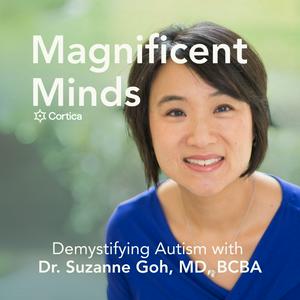
PodcastsHealth & WellnessMagnificent Minds: Demystifying Autism with Dr. Suzanne Goh, MD, BCBA

Magnificent Minds: Demystifying Autism with Dr. Suzanne Goh, MD, BCBA

Suzanne Goh
Magnificent Minds: Demystifying Autism with Dr. Suzanne Goh, MD, BCBA
Latest episode

16 episodes

  • Magnificent Minds: Demystifying Autism with Dr. Suzanne Goh, MD, BCBA

    Autism and Language: What Every Parent Needs to Know with Laura Bierck, SLP-BCBA

    25/05/2026 | 32 mins.
    In this episode, I'm taking you inside one of the most misunderstood topics in autism: how speech and language actually develop. If your child isn't talking the way you expected, or speaks in scripts and echoes, or can read words but struggles to have a conversation, this episode will give you the framework you've been searching for. I'm joined by Laura Bierck, speech language pathologist, board certified behavior analyst, and our Senior Manager of Clinical Excellence at Cortica, to walk through what the science actually says about autistic communication.
    I walk you through the brain science that explains why so many autistic children process language differently (many have stronger visual brain networks than auditory ones, which is why some children can read words before they ever speak them), and more importantly, what that means for how you support your child every single day. We break down Gestalt language processing and the 2025 research showing up to 90% of autistic individuals use echolalia at some point, hyperlexia and the surprising power of written words, the simple 9-to-1 language shift that changes everything, and why AAC is never a last resort.
    This episode is for you if: your child communicates in ways that don't match the typical milestones chart, you've been told to "wait and see" but something in you wants to do more, or you simply want to understand how your child's brain is approaching language so you can meet them there. Throughout, I want you to remember this: communication is something we build with our children. When you shift from trying to pull language out of your child to creating opportunities for connection, everything changes.
  • Magnificent Minds: Demystifying Autism with Dr. Suzanne Goh, MD, BCBA

    Mental Health in Autism: Supporting the Whole Family

    11/05/2026 | 26 mins.
    In this episode, I'm joined by Aqila Armstrong, licensed marriage and family therapist and Senior Manager of Counseling at Cortica, for a conversation we've been wanting to have for a long time: mental health in autism. For Mental Health Awareness Month, we go beyond the surface to talk about why mental health is so often overlooked in autism care, and why that needs to change. One 2021 study found that nearly 78% of autistic youth also have a mental health condition, most commonly depression, anxiety, ADHD, or behavioral challenges. And those conditions can affect a person's quality of life sometimes even more profoundly than the features of autism itself.
    I walk you through, alongside Aqila, why anxiety and depression are so common across the autistic lifespan: the biological factors like sleep and rumination, the mismatch with environment, social isolation, bullying, sensory overload, and the quiet exhaustion of masking. We break down how mental health distress can show up differently in autistic children, why irritability is so often misread as a "bad child," and how what gets labeled as noncompliance or PDA (now increasingly understood as a persistent drive for autonomy) often points to underlying anxiety. We also talk about which therapies work, what to look for in a neuro-affirming practitioner, and how to support the whole family, including siblings carrying a silent burden and the caregivers who are often holding more than anyone realizes. (Research shows parents of autistic youth have higher rates of PTSD than the general public.)
    This episode is for you if: you've ever wondered whether your child's behavior might be more than autism, you're a parent feeling stretched thin and unsure how to add one more thing to the schedule, you want to understand what neuro-affirming mental health support actually looks like, or you're a clinician, educator, or family member who wants to better support an autistic child or adult.
  • Magnificent Minds: Demystifying Autism with Dr. Suzanne Goh, MD, BCBA

    Medical Testing for Children with Autism

    27/04/2026 | 26 mins.
    In this episode, I'm walking you through the essential medical tests that every parent of an autistic child should know about, and more importantly, how to decide which ones actually matter for your child. I cover five key areas of testing in autism: genetics, metabolic and nutritional health, brain function, gut health, and the immune system. For each one, I break down what the research says, what's clinically recommended, and how to think about whether it applies to your child.
    We start with genetic testing, including chromosomal microarray and fragile X, the two tests that the American Academy of Pediatrics recommends as standard for every child diagnosed with autism, and I explain why genetic testing is not about blame or labeling but about understanding your child's biology.
    I walk through metabolic and nutritional screening, including why mitochondrial dysfunction, which some estimates suggest may affect a third or more of autistic individuals, deserves attention, and why common nutrient deficiencies like iron, vitamin D, and B12 can quietly affect learning, mood, and energy in ways that are easy to miss.
    I cover EEG and brain function, including how absence seizures can look like daydreaming and go undetected for years. I explain why gastrointestinal symptoms in autism are massively underdiagnosed, and how a child in chronic gut pain may not be able to tell you about it, showing it instead through irritability, aggression, or disrupted sleep.
    And I take you into the emerging science of immune involvement in autism, from maternal immune activation to neuroinflammation to folate receptor autoantibodies, a specific and testable mechanism where treatment with leucovorin has shown real promise.
    This episode is for you if: you've been told your child "has autism" but no one has walked you through the medical workup, you're unsure which tests are worth doing and which are noise, your child has symptoms like low energy, sleep problems, GI issues, or behavioral changes that no one has fully investigated, or you want a clear, science-backed framework for making informed decisions with your care team.
    Throughout, I want you to remember: medical testing on its own is not the goal. Understanding your child is the goal. Supporting their biology is the goal. Creating the conditions where they can feel well, learn, connect, and grow. That is the goal.
  • Magnificent Minds: Demystifying Autism with Dr. Suzanne Goh, MD, BCBA

    Autism Is Not One Thing: Subtypes and How to Determine Your Child's Subtype

    13/04/2026 | 19 mins.
    In this episode, I'm taking you inside one of the most important shifts happening in autism science right now: subtyping. I walk you through the latest research on why autism is best understood as many different conditions under one umbrella, not a single biology with a single path. We look at a landmark 2025 study from Princeton, published in Nature Genetics, that identified four distinct subtypes of autism across more than 5,000 children, each with shared behavioral profiles and shared genetics. I also cover biological subtypes including mitochondrial dysfunction (which my team at Columbia was the first to identify directly in the brain) and maternal autoantibody-related autism (MAR autism), an immune-driven subtype studied extensively by Dr. Judy Van de Water at UC Davis.
    This episode is for you if: you've been told your child "has autism" but no one has helped you understand what kind, your child's profile doesn't seem to match other autistic children you've met and you want to know why, you want to understand the genetics and biology behind your child's development, or you're looking for a science-backed framework that goes beyond one-size-fits-all treatment.
    Throughout, I want you to remember: understanding your child's biology is not about finding something wrong. Every child, with autism or without, is their own unique subtype, and the journey we are on is to understand them more deeply so we can support their unique path to thriving.
  • Magnificent Minds: Demystifying Autism with Dr. Suzanne Goh, MD, BCBA

    Preparing Your Autistic Child for Adulthood with Dr. Haley Masterson and Meaghan O'Dea Johnson

    30/03/2026 | 26 mins.
    In this episode, I'm exploring a question that weighs on so many parents: What will the future look like for my autistic child? Whether your child is a toddler, in elementary school, or already a teenager, the thought of adulthood can feel overwhelming. You may wonder when to start planning, what skills to focus on, and how to prepare without letting anxiety take the wheel.
    I'm joined by two wonderful colleagues from my team at Cortica: Meaghan O'Dea Johnson, pediatric nurse practitioner and dietitian, and Dr. Haley Masterson, pediatric neurologist, both of whom work closely with children, adolescents, and families navigating this very transition. Together, we'll cover why the skills that support independence in adulthood begin developing in childhood and why it's never too early to start building them, how to break big goals into small, attainable steps instead of approaching adulthood like a cliff, the powerful role of extracurriculars like Special Olympics and barrier-free theater in building community, friendships, and purpose, why development doesn't stop at 18 (or any age) and how motivation, interests, and new environments continue to unlock growth, how to approach topics like dating, consent, and relationships with directness and respect from an early age, and the systemic changes we need in employment, education, healthcare, and public perception to better support autistic adults.
    The bottom line: adulthood is not a cliff. It's a gradual, ongoing process that families can prepare for one small step at a time. With the right supports and intentional scaffolding, autistic individuals continue to learn, grow, and surprise us well into adulthood. As Dr. Masterson shares through her own brother's story, new skills and meaningful experiences can emerge at any stage of life.
    And perhaps the most important takeaway: keep your expectations high, and simply adjust your understanding of what supports may be needed to get there. A positive mindset isn't just comforting; it's evidence-based. If you're struggling to see the progress, talk to your child's provider and borrow a little of their optimism.
    This episode is for you if you're wondering when to start thinking about your child's transition to adulthood, feeling anxious about what independence will look like for your family, looking for practical strategies to build daily living skills at any age, wanting guidance on navigating legal transitions, higher education, or relationships, or simply ready to hear that with the right supports, autistic individuals can build extraordinary lives filled with purpose, connection, and joy.
More Health & Wellness podcasts
About Magnificent Minds: Demystifying Autism with Dr. Suzanne Goh, MD, BCBA
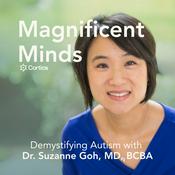
I'm Dr. Suzanne Goh—pediatric neurologist and Chief Medical Officer at Cortica. Magnificent Minds brings science, heart, and clarity to conversations about autism and child development. Each episode, I break down the research and answer the questions parents actually ask—from early signs and diagnosis to medical therapies and evidence-based treatments. If you're looking for honest, compassionate, science-backed guidance, you're in the right place.
Podcast website

Listen to Magnificent Minds: Demystifying Autism with Dr. Suzanne Goh, MD, BCBA, Huberman Lab and many other podcasts from around the world with the radio.net app

Get the free radio.net app

  • Stations and podcasts to bookmark
  • Stream via Wi-Fi or Bluetooth
  • Supports Carplay & Android Auto
  • Many other app features
Magnificent Minds: Demystifying Autism with Dr. Suzanne Goh, MD, BCBA: Podcasts in Family