
Listen to this podcast in the app for free: Download for free in the App Store
radio.net
Sleep timer
Save favourites
392 episodes
396 | When Decluttering Triggers Anxiety
11/11/2026 | 56 mins.Subscribe to my new YouTube Channel HERE and watch this episode on YouTube.
What if you're not avoiding the object, but you're avoiding how you expect to feel when you decide what to do with it?
A box of keepsakes, your child's old things, or a sweatshirt you never wear can bring up more than a simple question of what to keep. It can bring up guilt, uncertainty, fear of regret, and the urge to put off the decision.
In this conversation, Amber sits down with Jenna Overbaugh, a licensed professional counselor who specializes in OCD and anxiety. Jenna shares how anxiety can turn an ordinary decision into something that feels loaded—and why the goal isn't to wait until you feel completely calm or certain before you act.
Jenna has spent years helping people work with anxiety and OCD. In graduate school, she also helped develop FAM Training, a program designed to help family members support loved ones who hoard. She brings that experience to a thoughtful conversation about clutter, avoidance, and the meaning we attach to our things.
One of Jenna's most useful reminders: you can feel anxious and still take a step that matters to you. As you practice making decisions without waiting for perfect certainty, you can begin building trust in yourself.
Jenna also shares personal stories about anxiety, motherhood, and the decisions that helped her move toward the life she wanted. Her perspective is a reminder that you don't have to feel certain before you begin. Sometimes the next step is simply the smallest one you can take today.
For more from Jenna:
Website: https://jennaoverbaughlpc.com
Instagram: @jenna.overbaugh
Book: Making Peace with a Noisy Mind — coming February 2027
In this episode:
00:00 Meet Jenna
10:02 Why decisions about clutter can feel so loaded
14:35 Is OCD a spectrum?
19:18 Facing what feels difficult
21:35 Start with one small step
26:17 "Is this constructive thinking?"
31:06 Stepping back from a thought
38:18 Making choices based on your values
47:24 Why motivation can follow action
49:52 Building self-trust
52:12 Jenna's sweatshirt story
57:00 Three ways to work with avoidance
59:23 "Choose your hard"
1:01:43 Today may be the easiest day to begin
This conversation is for educational purposes and is not a substitute for individualized mental health care.
Watch this episode on YouTube.395 | Clear Trauma Clear Clutter - Could Unresolved Trauma Be Keeping You Stuck? With Dr. Judith Swack
04/11/2026 | 1h 9 mins.Have you ever looked around your home, felt completely overwhelmed by everything that needs to be done, and found yourself unable to take action? What if your response has more to do with unresolved trauma than with motivation?
In this episode of Declutter Your Chaos, I'm joined by Dr. Judith Swack, biochemist, immunologist, and creator of Healing from the Body Level Up (HBLU), a method designed to address trauma and deeply ingrained behavioral patterns.
We explore how past experiences can influence our nervous system, why we repeat habits we consciously want to change, and how our body's stress responses can contribute to overwhelm, procrastination, and avoidance.
Learn more about Dr. Judith Swack:
Website: https://hblu.org
Book: Clear Trauma Now: The Powerful Solution for Getting Unstuck: LINK for the book
If you've ever wondered why you keep repeating the same behaviors despite wanting something different, this conversation offers a new perspective on the connection between your body, your habits, and your home.
If you found this episode helpful, please share it with someone who is feeling overwhelmed by clutter, stuck in old habits, or interested in learning how to work with their nervous system to create lasting change.
Declutter Your Chaos — One breath, one step, one choice.394 | ONE RULE to Fix Procrastination and Motivation
27/10/2026 | 24 mins.Have you ever started decluttering, only to feel completely exhausted five minutes later?
Where do I start? Should I keep this? What if I need it someday? Where does this go?
Before you know it, you've made a hundred decisions and barely made a dent in the clutter.
Here's what you might not realize: You're not necessarily exhausted from decluttering. You're exhausted from deciding.
In today's episode of Declutter Your Chaos, we're exploring the neuroscience behind decision overload and how one simple rule can make decluttering feel so much easier.
Drawing on insights from neuroscientist Daniel Levitin's book The Organized Mind, I'll explain why too many decisions can leave you feeling overwhelmed, how to work with your brain instead of against it, and the one small shift that can help you finally get started.
You'll learn how to:
Reduce the mental exhaustion that comes with decluttering.
Stop getting distracted by everything else that needs your attention.
Establish one simple rule that makes starting easier.
Make meaningful progress without tackling your entire home.
Bring mindfulness and self-compassion into the decluttering process.
You don't need more motivation. You need fewer decisions.
And sometimes, one simple rule is all it takes to get started.
Mentioned in this episode:
The Organized Mind by Daniel J. Levitin
#DeclutterYourChaos #Decluttering #DeclutteringTips #MindfulDecluttering #Neuroscience393 | Neuroscience of Decluttering - Two Strategies to use today
20/10/2026 | 13 mins.Hey Guys,
Have you ever held on to something you don't need, want, or even particularly like, simply because it's yours?
Neuroscience may help explain why.
In this episode of Declutter Your Chaos, we're exploring the endowment effect,,,our brain's tendency to assign greater value to things simply because we own them.
Inspired by Dr. Emily Falk's New York Times article, The Neuroscience of Decluttering, and her book What We Value: The Neuroscience of Choice and Change, we'll look at fascinating research into how ownership influences our sense of self and why that matters when we're decluttering.
You'll learn two simple, neuroscience-informed strategies to help you make more intentional decisions about your possessions:
Think like a buyer, not an owner. Instead of asking, "Should I get rid of this?" ask, "Would I buy this today?"
Borrow someone else's perspective. Imagine the object belongs to a friend. Would you encourage them to keep it?Understanding how our brains work can help us let go of things we no longer need—without all the second-guessing.
The goal isn't just to get rid of stuff. It's to change our relationship with it.
Mentioned in this episode
Dr. Emily Falk — The Neuroscience of Decluttering, The New York Times, October 11, 2026
What We Value: The Neuroscience of Choice and Change by Dr. Emily Falk
Find me at @amber.cammidge on Instagram.
About Amber
Amber Cammidge is the creator of The Mindful Home Technique, a science-backed approach to decluttering and and has helped hundreds of women declutter their homes. She is host of Declutter Your Chaos, a top ranking podcast approaching 2 million downloads, and hundreds of raving reviews, where a she helps women stop fighting their clutter by understanding the psychology behind it. Blending behavioral science, neuroscience, practical decluttering strategies, and mindfulness - informed by her training in Mindfulness-Based Stress Reduction (MBSR) and immersion in the teachings of Joe Dispenza, Jon Kabat Zinn, and Tich Nhat Hanh - Amber teaches that your home isn't just where you live - it's where you practice becoming the person you want to be. Her work is about creating space for clarity, confidence, and a life that allows you to become the best version of you.392 | If You've Been Dealing With Clutter For a Long Time
13/10/2026 | 23 mins.Hey Guys,
What if the biggest thing standing between you and the home you want is the story you've been telling yourself?
In this episode of Declutter Your Chaos, we're talking about how our thoughts shape our behavior, why confidence comes from taking action, and how mindfulness helps us move forward even when we don't feel motivated.
You'll learn how to stop treating your thoughts as facts, take ownership of your choices, and build self-trust through small, consistent actions.
Your challenge: Choose one thing you've been avoiding. Spend 15 minutes working on it. Notice your thoughts, take a breath, and keep going.
You're more capable than you realize.
Hope this helps,
Amber
Find me at @amber.cammidge on Instagram.
About Amber
Amber Cammidge is the creator of The Mindful Home Technique, a science-backed approach to decluttering and and has helped hundreds of women declutter their homes. She is host of Declutter Your Chaos, a top ranking podcast approaching 2 million downloads, and hundreds of raving reviews, where a she helps women stop fighting their clutter by understanding the psychology behind it. Blending behavioral science, neuroscience, practical decluttering strategies, and mindfulness - informed by her training in Mindfulness-Based Stress Reduction (MBSR) and immersion in the teachings of Joe Dispenza, Jon Kabat Zinn, and Tich Nhat Hanh - Amber teaches that your home isn't just where you live - it's where you practice becoming the person you want to be. Her work is about creating space for clarity, confidence, and a life that allows you to become the best version of you.
More Education podcasts









Trending Education podcasts
























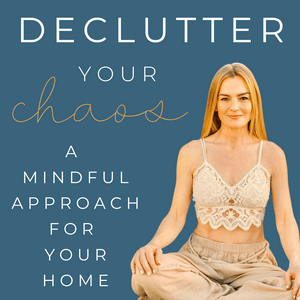
About Declutter Your Chaos - Mindful Minimalism
Welcome to Declutter Your Chaos, the podcast for women who are ready to take control of their homes and their lives.
Each episode blends practical, bite-sized decluttering strategies with a mindful, no-nonsense approach to the deeper emotional patterns that keep you stuck. We'll uncover the "why" behind the clutter, reset your habits, and help you create a home that actually supports the life you want to live.
Create systems that stick—because they're built around you, not what Instagram says your home should look like.
Whether your clutter is physical, mental, or emotional, you're not alone—and you're not broken.
You're just ready for a change.
Let's do this together.
Welcome to Declutter Your Chaos.
xo, Amber
Podcast websiteListen to Declutter Your Chaos - Mindful Minimalism, Begin Again with Davina McCall and many other podcasts from around the world with the radio.net app
Get the free radio.net app
- Stations and podcasts to bookmark
- Stream via Wi-Fi or Bluetooth
- Supports Carplay & Android Auto
- Many other app features
Declutter Your Chaos - Mindful Minimalism: Podcasts in Family
 UK