PodcastsHealth & WellnessMove Well, Live Well, Perform Well

Move Well, Live Well, Perform Well

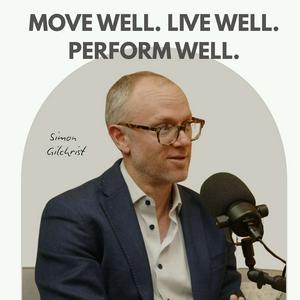
Simon Gilchrist
Move Well, Live Well, Perform Well
Latest episode

23 episodes

  • Move Well, Live Well, Perform Well

    Breathing Dysfunction, Red Light Therapy & Modern Health with Dr Steve James

    28/05/2026 | 1h 23 mins.
    Metabolic health is becoming one of the most important conversations in modern medicine, yet many people still underestimate how deeply it influences energy, performance, resilience, and long-term health.

    In this episode, we sit down with Dr Steve James, Consultant in Metabolic Health and Performance Medicine, to explore how physiology, behaviour, breathing, and environment shape health outcomes in the modern world.

    With a background spanning critical care, cardiac anaesthesia, and performance medicine, Dr James brings a unique perspective on human physiology under both extreme stress and high-performance conditions. His work now focuses on helping people optimise metabolic health through a more integrated and preventative approach to medicine.

    We break down what metabolic health actually means, why it matters far beyond weight or fitness, and how modern lifestyles may be driving widespread metabolic dysfunction. A key focus of the conversation is VO₂ max - what it tells us about cardiovascular fitness, resilience, and longevity, and why it may be one of the most important health markers we can track.

    We also explore the role of breathing and respiratory health, discussing how modern life may be changing the way we breathe, the physiological consequences of poor breathing patterns, and whether breathwork should become part of daily health routines.

    The discussion expands into environmental and recovery factors, including light exposure and red light therapy. Dr James explains the physiology behind these interventions, what the evidence currently shows, and how light may influence inflammation, recovery, and overall wellbeing.

    Beyond physiology alone, we explore the behavioural side of health. Dr James shares insights into why sustainable behaviour change is often the missing link in long-term health outcomes, and why understanding psychology, motivation, and habits is just as important as understanding biology.

    Finally, we discuss the foundations of long-term resilience, the highest-impact habits for improving metabolic health, and why many people may be overlooking the fundamentals while searching for quick fixes or interventions.

    🎙️ In This Episode, We Cover
    • What metabolic health actually means
    • Why metabolic dysfunction is becoming increasingly common
    • VO₂ max and its relationship with longevity and resilience
    • Blood sugar regulation and energy metabolism
    • How the body produces and uses energy
    • Why breathing is often overlooked in health and performance
    • The consequences of poor breathing patterns
    • Breathwork and respiratory health
    • Light exposure and red light therapy explained
    • The relationship between environment and recovery
    • Behaviour change and long-term health outcomes
    • Why psychology matters in health optimisation
    • Modern lifestyles and their impact on physiology
    • The highest-impact habits for long-term health
    • Practical ways to improve resilience and recovery

    🎯 Who This Episode Is For
    • Anyone interested in improving long-term health and resilience
    • People looking to optimise energy, recovery, and performance
    • Individuals interested in metabolic health and longevity
    • Those curious about breathwork, VO₂ max, and recovery tools
    • Clinicians, coaches, and practitioners interested in preventative health

    🎙️ Powered by Mayfair Health

    At Mayfair Health, we specialise in recovery, performance, and proactive wellness. Whether you’re looking to optimise your health, improve resilience, or better understand your physiology, our multidisciplinary team is here to help.

    🔗 Website: https://www.mayfairhealth.co.uk
    📩 Contact: [email protected]
    📞 Phone: 020 3985 1500
    📱 Instagram: @mayfairhealth
  • Move Well, Live Well, Perform Well

    Why Tendon Pain Keeps Coming Back with Dr Lorenzo Masci

    13/05/2026 | 1h 11 mins.
    Tendon pain is one of the most common issues seen in both sport and everyday life, yet tendinopathy remains widely misunderstood.

    In this episode, we sit down with Dr Lorenzo Masci, Consultant in Sport and Exercise Medicine, to explore how tendon injuries develop, why some cases become chronic, and what actually drives successful recovery.

    With extensive experience managing complex tendon conditions in both elite athletes and the general population, Dr Masci shares a practical and evidence-based perspective on conditions such as Achilles tendinopathy, patellar tendinopathy, and proximal hamstring injuries.

    We break down what tendinopathy really is, how tendon injuries differ from muscle injuries, and why recovery often requires a very different approach than most people expect.

    A key focus of the conversation is the role of imaging and investigations. Dr Masci explains why scans don’t always correlate with pain, the common mistakes clinicians and patients make when interpreting imaging findings, and why clinical presentation should often guide treatment more than structural changes alone.

    We also explore the foundations of tendon rehabilitation, including load management, building tendon capacity, and how to progress safely from pain back to performance. The discussion covers why many people either underload or overload tendons during rehab, and how finding the right balance is critical for long-term recovery.

    Beyond rehabilitation, we discuss where treatments such as shockwave therapy, PRP, and injection-based interventions fit into tendon management, what the evidence actually shows, and when these treatments may or may not be appropriate.

    Finally, Dr Masci explores the growing understanding that tendon health is influenced by far more than mechanics alone. We discuss the links between metabolism, hormones, inflammation, lifestyle, and tendon pathology, and why clinicians increasingly need to think beyond the tendon itself when managing recurrent or persistent injuries.

    🎙️ In This Episode, We Cover

    • What tendinopathy actually is
    • Why tendon injuries differ from muscle injuries
    • The role of scans and imaging in tendon pain
    • Why imaging findings don’t always match symptoms
    • Common mistakes when interpreting scans
    • How to “get someone out of trouble” with a painful tendon
    • Load management and tendon rehabilitation principles
    • Building tendon capacity safely
    • How to progress from pain back to performance
    • Shockwave therapy and what the evidence says
    • PRP and injection-based treatments
    • Why some tendon problems become chronic
    • The role of the nervous system in chronic tendon pain
    • Metabolic health and its relationship with tendinopathy
    • Hormones, menopause, and tendon health
    • Lifestyle, inflammation, and recovery
    • Tendon stiffness, elasticity, and injury prevention
    • The biggest mistakes people make during rehab

    🎯 Who This Episode Is For

    • Anyone dealing with ongoing tendon pain or injury
    • Runners and athletes managing Achilles, patellar, or hamstring issues
    • People struggling with recurrent or chronic tendinopathy
    • Clinicians and therapists interested in tendon rehabilitation
    • Anyone looking to better understand tendon health and recovery

    🎙️ Powered by Mayfair Health

    At Mayfair Health, we specialise in recovery, performance, and proactive wellness. If you’re managing ongoing pain, rehabilitating from injury, or looking to optimise your long-term health and movement, our multidisciplinary team is here to help.

    🔗 Website: https://www.mayfairhealth.co.uk
    📩 Contact: [email protected]
    📞 Phone: 020 3985 1500
    📱 Instagram: @mayfairhealth
  • Move Well, Live Well, Perform Well

    HRV Explained: The Metric You Are Reading Wrong

    30/04/2026 | 1h 4 mins.
    HRV has become one of the most talked-about metrics in health and performance, but it’s also one of the most misunderstood.
    In this episode, we sit down with Dr Marco Altini, data scientist, endurance coach, and founder of HRV4Training, to explore what heart rate variability actually reflects in the body, and how it should (and shouldn’t) be used.
    With a background spanning data science, physiology, and wearable technology, Marco brings a unique perspective on how physiological data can inform stress, recovery, and long-term adaptation. His work has influenced elite athletes, coaches, and increasingly, how HRV is applied in general health and longevity.
    We break down the foundations of HRV, how it relates to the autonomic nervous system, and whether it should be viewed as a marker of recovery, resilience, or overall system health.
    A key focus of the conversation is interpretation. Marco explains why “higher HRV is always better” is a flawed concept, the importance of understanding your individual baseline, and why daily fluctuations often matter far less than long-term trends.
    We also explore the role of wearable technology — from ECG to PPG devices — and whether consumer tools are now accurate enough to guide decision-making. As an advisor to Oura, Marco shares insight into how these technologies are evolving, and the risks of oversimplifying complex physiology into single scores.
    Finally, we discuss the practical side: what actually impacts HRV, how lifestyle factors like sleep, stress, and alcohol influence your data, and how to use HRV in a way that genuinely supports healthspan and performance.

    🎙️ In This Episode, We Cover
    What HRV actually measures in the body
    HRV and the autonomic nervous system
    HRV as a marker of health, resilience, and longevity
    Why “higher HRV is better” is misleading
    The importance of baseline, normal range, and trends
    Daily vs long-term HRV: what really matters
    Common mistakes when interpreting HRV data
    Which metrics are actually useful (and which aren’t)
    Wearables explained: ECG vs PPG vs camera-based
    Are consumer devices accurate enough?
    Morning vs overnight HRV tracking
    How sleep, stress, and alcohol impact HRV
    Can you meaningfully improve your HRV?
    The risks of over-relying on wearable data
    Practical ways to use HRV for health and performance

    🎯 Who This Episode Is For
    • Anyone using or considering wearable health technology
    • People interested in recovery, stress, and longevity
    • Athletes and coaches using HRV for performance
    • Individuals looking to better understand their physiology
    • Clinicians and practitioners interested in data-driven health

    🎙️ Powered by Mayfair Health
    At Mayfair Health, we specialise in recovery, performance, and proactive wellness. If you’re navigating ongoing symptoms, optimising your health, or looking to better understand your body, our multidisciplinary team is here to help.
    🔗 Website: https://www.mayfairhealth.co.uk
    📩 Contact: [email protected]
    📞 Phone: 020 3985 1500
    📱 Instagram: @mayfairhealth

  • Move Well, Live Well, Perform Well

    Why Everything Starts at the Foot with Expert Podiatrist, Justin Coulter

    15/04/2026 | 1h 19 mins.
    Foot health is often overlooked, yet it underpins how we move, perform, and stay pain-free.

    In this episode, we sit down with Justin Coulter, specialist podiatrist and founder of First Podiatry, to explore how the feet influence the entire body, from the ankles and knees through to the hips and spine.

    Drawing on his experience across private practice and complex orthopaedic cases, Justin shares a clear and practical perspective on how many common musculoskeletal issues can stem from poor foot mechanics and inefficient movement patterns.

    We break down the fundamentals of foot function, the role of gait and biomechanics in long-term health, and the early signs that something isn’t working as it should.

    A key focus of the conversation is the ongoing debate around orthotics versus natural foot function. Justin explains when orthotics are genuinely needed, what they are doing biomechanically, and whether there is a risk of over-reliance over time.

    We also explore foot development in children, when intervention is appropriate versus when natural development should be allowed, and how modern lifestyles and footwear may be contributing to weaker, less resilient feet.

    Finally, Justin shares practical, actionable strategies to improve foot strength, movement quality, and long-term lower limb health.

    🎙️ In This Episode, We Cover

    • Why foot health is critical for movement and performance
    • How foot mechanics influence the knees, hips, and spine
    • Early signs of poor foot function
    • The role of gait analysis and movement assessment
    • Orthotics vs barefoot: when support is needed
    • What orthotics actually do (and don’t do)
    • Custom vs off-the-shelf orthotics
    • Foot development in children: when to intervene
    • How modern footwear and lifestyle affect foot strength
    • Simple ways to improve foot strength and resilience
    • Common misconceptions around foot health

    🎯 Who This Episode Is For

    • Anyone dealing with foot, knee, hip, or back pain
    • Runners and athletes looking to improve movement and performance
    • Parents concerned about their child’s foot development
    • People unsure whether they need orthotics
    • Clinicians and coaches interested in biomechanics and gait

    🎙️ Powered by Mayfair Health

    At Mayfair Health, we specialise in recovery, performance, and proactive wellness. Whether you’re managing ongoing symptoms, rehabilitating from injury, or looking to optimise your long-term health, our multidisciplinary team is here to help.

    🔗 Website: https://www.mayfairhealth.co.uk
    📩 Contact: [email protected]
    📞 Phone: 020 3985 1500
    📱 Instagram: @mayfairhealth
  • Move Well, Live Well, Perform Well

    How To Train For Longevity with Celebrity Trainer Matt Roberts

    01/04/2026 | 1h 10 mins.
    Longevity isn’t just about living longer, it’s about staying strong, capable and resilient for as long as possible.
    In this episode, we sit down with Matt Roberts, one of the UK’s most recognised personal trainers and founder of Matt Roberts Personal Training, to explore what truly drives long-term health, performance and physical resilience.
    With over two decades of experience working with royalty, CEOs and high-performing individuals, Matt shares the principles that actually move the needle when it comes to training for healthspan, not just aesthetics.
    We discuss the foundations of effective training, why muscle mass becomes increasingly important as we age, and how to think about the balance between strength training and cardiovascular fitness for long-term health.
    A key focus of the conversation is bone health and ageing, an area often overlooked until it becomes a problem. Matt explains why building and maintaining bone density should be a priority much earlier in life, and what types of training are most effective.
    We also explore how Matt’s own approach to training has evolved over time, and what his personal routine looks like today after years in the industry.
    Looking ahead, we dive into the future of health and performance through Matt’s latest venture, Evolution Clubs, and discuss the growing influence of wearables, supplements and recovery tools such as saunas and cold exposure. Importantly, we unpack what’s truly evidence-based, and what may be more hype than substance.
    This episode is a practical, no-nonsense guide to building a body that performs well not just now, but for decades to come.
    🎙️ In This Episode, We Cover
    • What training for longevity actually means in practice
    • The difference between healthspan and lifespan
    • Strength vs cardio: what matters most long term
    • Why muscle mass is critical for metabolic health and ageing
    • The importance of bone health: and when to start prioritising it
    • What types of training improve bone density
    • How Matt Roberts personally trains today
    • The concept behind Evolution Clubs and the future of fitness
    • Wearables, supplements and modern health optimisation
    • Saunas, cold exposure and recovery: science vs hype
    • The role of emerging trends like peptides and biohacking
    • The minimum effective dose of training for busy professionals
    🎯 Who This Episode Is For
    • Anyone looking to improve long-term health, strength and resilience
    • Busy professionals trying to balance health with a demanding schedule
    • People in their 30s, 40s and beyond thinking about longevity
    • Those confused by conflicting advice around training, recovery and supplements
    • Anyone interested in building a sustainable, high-performing body for life
    🎙️ Powered by Mayfair Health

    At Mayfair Health, we specialise in recovery, performance and proactive wellness. If you’re navigating ongoing symptoms, rehabilitating from injury, or looking to optimise your long-term health, our multidisciplinary team is here to help.

    🔗 Website: https://www.mayfairhealth.co.uk
    📩 Contact: [email protected]
    📞 Phone: 020 3985 1500
    📱Instagram: @mayfairhealth

More Health & Wellness podcasts
About Move Well, Live Well, Perform Well
Welcome to Move Well, Live Well, Perform Well, the podcast that explores how to optimise your movement, train effectively, recover from injuries and live stronger.Hosted by Simon Gilchrist, sports physiotherapist and founder of Mayfair Health and WellQ.Simon sits down with experts each week to share insights on movement, performance and real health challenges. From knee pain to back injuries to burnouts and recovery, they share practical advice and tips for optimising your health along the way.The podcast is powered by Mayfair Health, helping you to move better, live longer and perform at your best.
Podcast website

Listen to Move Well, Live Well, Perform Well, On Purpose with Jay Shetty and many other podcasts from around the world with the radio.net app

Get the free radio.net app

  • Stations and podcasts to bookmark
  • Stream via Wi-Fi or Bluetooth
  • Supports Carplay & Android Auto
  • Many other app features