

Listen to this podcast in the app for free: Download for free in the App Store
radio.net
Sleep timer
Save favourites
61 episodes
When Nobody's in Control: AI, Cyber Risk, and the Economics of Digital Trust
11/09/2026 | 51 mins.AI has the potential to bring a host of benefits to society and the global economy. It has fueled optimism around productivity, disinflation, and debt sustainability. But like many innovations that came before it, AI also brings a new set of challenges. The same technology that might boost economic growth and lift people out of poverty could also serve as a tool for cyberwarfare and fraud. Using AI, digital crimes could become faster, cheaper, and more scalable. AI is also becoming a new chokepoint in geopolitical competition: The discussion explores whether control of digital verification layers may create strategic leverage.
Shuman Ghosemajumder, co-founder of the AI and cybersecurity company Reken and former Global Head of Product for Trust & Safety at Google, joins PGIM's Daleep Singh to discuss how AI has expanded the field for cybercrime and why technology itself could be part of the solution.
The conversation also covers:
How the public and private sectors can manage cyber risks and develop defenses against AI-powered fraud
Why AI could make infrastructure and organizations more secure using proprietary tools
How public sentiment toward AI has evolvedThe Visible Hand: Marketcrafting from AI to the Price of Money
26/08/2026 | 39 mins.Adam Smith introduced his concept of the "invisible hand" in the 18th century, offering a metaphor for how self-interest and competition guide a free-market economy. The case could be made that government policy is an increasingly crucial force in shaping markets today, particularly amid heightened geoeconomic competition and a resurgence in industrial policy. In this way, individuals and entities in both the private and public sectors can be "marketcrafters."
PGIM's Daleep Singh is joined by Chris Hughes (Facebook co-founder, Chair of the Economic Security Project, and author of "Marketcrafters: The 100-Year Struggle to Shape the American Economy") for a discussion about government policy's role in driving markets and investment outcomes. They cover topics including:
How the U.S. government has shaped markets through history
Marketcrafting agendas that could address inflation and cost of living challenges
An industrial policy framework targeting housing affordability and emerging solutions like modular homes
The AI investment cycle and potential policy levers
The Federal Reserve's influence on financial markets through its ample reserves regimeChip Craze: Framing Industrial Policy for the AI Era
11/08/2026 | 37 mins.The AI-driven capex cycle might be the biggest investment story of the past century. The five largest hyperscalers were on track to spend around $800 billion on AI infrastructure in 2025, and as a share of U.S. GDP, AI capex has already eclipsed the dot-com boom of the 1990s. Chips are at the center of the AI frenzy – the same chips that also guide precision munitions and power satellite communications. In pursuit of a strategic advantage, nations are racing to shore up critical supply chains and achieve dominance in the economic arena. How will industrial policy's reemergence influence investment opportunities and global capital flows?
For a closer examination of industrial policy's risks and rewards, PGIM's Daleep Singh talks to Mike Schmidt, Distinguished Visitor at Princeton University's Griswold Center for Economic Policy and former Director of the CHIPS Program Office (CPO) at the U.S. Department of Commerce. The discussion covers topics including:
A framework for employing industrial policy effectively
Economic resilience and strategic dominance
Opportunities and challenges in ramping up U.S. chip production
Recent industrial policy actions and their market impact
How to prepare supply chains to withstand geopolitical weaponization or unexpected shocksThe Power Play: Is Fusion Nearing a Kitty Hawk Moment?
20/07/2026 | 23 mins.In an era of AI, data centers and electrification, rising power demand presents a range of challenges and investment opportunities across the energy sector. Bottlenecks in the supply chain, such as the backlog in gas turbine production, have grabbed headlines while the power-hungry digital infrastructure buildout lifts energy consumption. With the grid increasingly strained, commercial-grade fusion power is one innovative solution emerging in a rapidly evolving energy landscape.
PGIM's Daleep Singh visits Commonwealth Fusion Systems CEO Bob Mumgaard for a conversation inside the facility that houses SPARC, the company's prototype for what could be the first commercially produced machine that generates net energy from fusion. This milestone – expected in 2027 – would be significant, paving the way for the first generation of fusion power plants. Like geothermal energy and small modular reactors, commercially viable fusion power could make the national grid better equipped to meet forecasts for intense electricity demand – using dispatchable, zero-carbon power that could be more resilient through periods of geopolitical strife. Institutional investors will continue to play a role in deploying the long-term capital needed to scale new technologies, expand the power grid, and fortify energy supply chains.
Listen for an inside look at the future of fusion power. This episode explores:
CFS's plans to establish the first ARC plant in the early 2030s – and its ambitions to build thousands more
The engineering and capital hurdles to create grid-scale fusion power plants
Industrial policy actions and public-private partnerships that could accelerate the fusion buildout
Why fusion energy's supply chain is less vulnerable to geopolitical chokepoints than traditional fuel sourcesWarsh's Opening Act: Inside the Fed's Regime Shift with James Bullard
07/07/2026 | 23 mins.The arrival of Kevin Warsh as Chair of the Federal Reserve marked a regime shift. At its June meeting, the Federal Open Market Committee (FOMC) dropped its easing bias, opening the door to interest rate hikes as supply shocks collide with hotter demand. The Fed also announced five new task forces to evaluate key priorities, from inflation frameworks to AI's impact on productivity and the labor market. Under Warsh, the central bank sent an unmistakable message: This is just the opening act for a very different Fed.
James Bullard, former President and CEO of the Federal Reserve Bank of St. Louis and current Dean of the Mitch Daniels School of Business at Purdue University, joins PGIM's Daleep Singh to analyze the start of the Warsh era at the Fed. They discuss policy challenges from inflation's resurgence, the case for lower rates over the long run, and potential market implications if the Fed changes how it conducts monetary policy.
The conversation also covers:
The Fed's reaction function amid policy shifts and economic transformation
Emerging similarities to the Fed's Greenspan era
How changes to Fed communications and forward guidance could influence markets
Economic outcomes from the AI boom – and why fears of job destruction might be overblown
More Business podcasts
 The Diary Of A CEO with Steven BartlettBusiness, Education, Society & Culture
 The Real Eisman PlaybookBusiness, Investing
 James Reed: all about businessBusiness, Entrepreneurship, Management
 Prof G MarketsBusiness, Investing
 The Martin Lewis PodcastBusiness
 Working Hard with Grace BeverleyBusiness, Education, Health & Wellness, Marketing, Self-Improvement
 UnhedgedBusiness, Business News, Investing, News
 A Bit of OptimismBusiness, Careers, Education, Self-Improvement
Trending Business podcasts
 The Business Leader Podcast with Sir Richard HarpinBusiness, Entrepreneurship, Management
 In Good Company with Nicolai TangenBusiness
 The Paul Morris PodcastBusiness, Education, Entrepreneurship, Tutorials
 Many Happy ReturnsBusiness, Business News, Education, Investing, News, Self-Improvement
 The Bottleneck PodcastBusiness, Entrepreneurship, Marketing
 The Startup Ideas PodcastBusiness, Entrepreneurship
 Recruitment Mentors PodcastBusiness, Careers, Entrepreneurship
 Professional Triathlon NewsBusiness, Health & Wellness, Running, Sports
 The Gstaad Guy PodcastArts, Business, Design, Education, Entrepreneurship, Self-Improvement
 The Compound and FriendsBusiness, Business News, Investing, News
 Hot Money: Agent of ChaosBusiness, Health & Wellness, Sexuality, Society & Culture, Technology
 知行小酒馆Business
 Extraordinary Life StoriesBusiness
 Capital Allocators – Inside the Institutional Investment IndustryBusiness, Investing
 Chill & Prosper with Denise Duffield-ThomasBusiness, Entrepreneurship
 Inside the Strategy RoomBusiness, Business News, Management, News
 Simon SaysBusiness, Entrepreneurship
 Dodge Woodall NetworkBusiness, Entrepreneurship, Society & Culture, True Crime
 CIPDBusiness
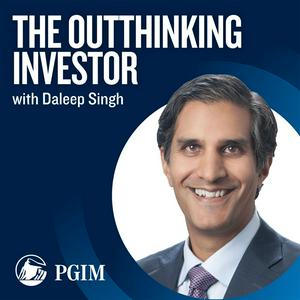
About The Outthinking Investor with Daleep Singh
In today's ever-changing world, investors should challenge old assumptions and think outside the box.
Markets trade on more than just economic data. They trade on geopolitics, technology, policy, and elections. In a world searching for a new equilibrium, old assumptions are expensive mistakes. Daleep Singh, Vice Chair and Chief Global Economist at PGIM, has spent his career at the intersection of markets and policy, from the U.S. Treasury and Federal Reserve to the White House. Now, Daleep is sharing his perspectives with you.
On PGIM's The Outthinking Investor, Daleep sits down with prominent economists, technologists, policymakers, and market veterans to map out the full distribution of what comes next—and why it matters.
Podcast websiteListen to The Outthinking Investor with Daleep Singh, The Diary Of A CEO with Steven Bartlett and many other podcasts from around the world with the radio.net app
Get the free radio.net app
- Stations and podcasts to bookmark
- Stream via Wi-Fi or Bluetooth
- Supports Carplay & Android Auto
- Many other app features
Get the free radio.net app
- Stations and podcasts to bookmark
- Stream via Wi-Fi or Bluetooth
- Supports Carplay & Android Auto
- Many other app features

The Outthinking Investor with Daleep Singh
Scan code,
download the app,
start listening.
download the app,
start listening.
The Outthinking Investor with Daleep Singh: Podcasts in Family
 UK
UK