
Listen to this podcast in the app for free: Download for free in the App Store
radio.net
Sleep timer
Save favourites
365 episodes
This Crazy Mistake Stops MSPs Capturing Leads In 2026
19/10/2026 | 55 mins.Is your lead magnet being ignored? It’s a common experience for MSPs and today I want to talk about why that happens and what actually works. Also this week, the power of a strong opinion in your marketing, and the fascinating insight of why this MSP sold… and why the buyer bought.
Welcome to Episode 362 of the MSP Marketing Podcast with me, Paul Green, powered by the MSP Marketing Edge.
Best lead magnet for MSPs in 2027
Let me start today by asking you a question… have you ever put something on your website that says “Sign up for our newsletter” or “Get our free guide” or something like that? And then over a number of years you’ve discovered that nobody ever does it. Maybe your mum fills in the form or something, but she’s the only one. No one else does it. If that’s happened to you, then you’re not alone, that’s a common experience for MSPs. And today I want to talk about why that happens and what actually works instead.
What we’re talking about there is something called a lead magnet. You’ve probably heard that phrase thrown around the internet. It’s a common phrase in marketing. And we’re going to talk about the kind of lead magnet that works best for MSPs, not just at the end of this year, but in 2027.
Put simply, a lead magnet is something that you give away in return for someone’s contact details or to start a conversation with them.
That’s the whole concept. It’s not new at all. In fact, the concept of a lead magnet actually predates the internet. It was something that was being done in the 19th century where people would give out samples to start a conversation with people. That’s how old it is. But in the internet age, we give away a thing, a PDF or a physical thing, and we do it in order to get their contact details and then we can do some automated marketing to them. That’s the theory.
However, it’s 2026 and nobody wants more emails, right? If you just say to someone, “Please sign up for our newsletter,” they’re not going to do that. That’s actually not a lead magnet and that hasn’t worked for 20 years because that’s just asking someone to add another task, to get more unwanted emails in their already overflowing inbox. And no one’s going to take you up on that. They haven’t done for the last 20 years. But they will still do it, they will join your mailing list if you offer them something that’s of such a high perceived value that they really, really want it and they will happily hand over their details. And I know this is the case because I’m doing this every single day of the week. And I’ll tell you more about that in a second because I’ve got a freebie for you, my lead magnet. I’m going to give it to you in just a few minutes.
But let’s talk first about the options for you. I’ve been doing lead magnets for around about 15 years or so. So I started doing it really well in my last business and this whole business started with a lead magnet. I built a list by putting a lead magnet out there just to MSPs in the UK about 10 years ago, and that’s how I got this whole business started. So we can talk about what works and what doesn’t work because I have learned this the hard way by doing it. And I’ve generated, I reckon it’s getting on for nearly 30,000 leads over the last 20 years, which is not the biggest number in the world. Someone like Alex Hormosi has generated millions and millions of leads in just five or six years. So I know it’s not the biggest number in the world, but I’ve done it consistently across a whole number of different sectors. So MSPs is just the last sector that I’m ever going to work with in my working career. I’ve previously worked with veterinarians, dentists, opticians/optometrists, and a whole bunch of other business owners, and they all came from lead magnets.
So when you are putting together a lead magnet for your MSP,...How Introvert MSPs Can Be Better At Networking Than Extroverts
12/10/2026 | 43 mins.The vast majority of MSPs are introverts but you can still go out and do networking or speak at a public event, if you know how. Also this week, why you should be thrilled when a Super MSP comes to your town, and what’s working best in MSP search lead generation right now.
Welcome to Episode 361 of the MSP Marketing Podcast with me, Paul Green, powered by the MSP Marketing Edge.
How to ace networking, even if you’re an introvert
I want to start today by sharing something personal. For most of my career, I thought that I was an extrovert. I mean, after all, I was a radio presenter, literally on the radio every day for 10 years. And now today I speak at conferences, I did ScaleCon this year, I did MSP Global again this year. And I host this podcast. These are all the activities of an extrovert, right? Well, it turns out no.
A few years ago I had a guest on this very podcast who said something that completely stopped me in my tracks. They explained that extroverts gain energy from being around people, while introverts lose energy from being around people. And it made me realise that every networking event that I’d ever been to and every conference that I’d ever spoken at, basically every room full of new people that I’d ever walked into, I’d come home and I needed a very long lie down. And my partner at the time used to find that hilarious. I would literally come back from a two-hour networking and I just needed to be on my own and recover. And neither of us really understood it at the time, but now I understand why this happened.
I am an introvert who has learned to be extroverted when the situation demands it, and that’s become normal for me. And because of that normalisation over 30 years, that’s why I thought I was an extrovert. Now, I know that a lot of MSPs are in exactly the same position. So today I want to show you how you can do the same thing, because the benefit for you is you can go out and do more networking, you might even get up on a stage and speak at a public event, which might be a nightmare idea for you right now, but very powerful if you have the power to do that. Because experts speak and experts go networking, right?
So let’s understand what’s actually happening. Let’s focus on networking. If you come away from networking events and you feel completely drained, you’re pretty much guaranteed to be an introvert. And the vast majority of MSPs that I’ve spoken to over the years, not all of them, but let’s say 70, 80% are definitely introverts. It seems to be the channel is an introverted channel. And of course, being an introvert is not a weakness or a flaw, it’s just how you and I are wired, right? We are wired to be introverts. And the difference between introverts and extroverts is fundamentally about energy. So as I said, extroverts get energised by social interactions, so they go and look for more of that social interaction. Whereas introverts are depleted by it.
Both introverts and extroverts can be brilliant and can perform well in a room full of people. It’s just the introverts need to go and do some recovery afterwards.
Recognising this about yourself is the most important step because once you understand this, you stop fighting it and you start working with it. So the goal is not to try and turn yourself into an extrovert, you can’t do that. The goal is to go and do the networking or the public speaking or whatever you do, and then protect yourself so you can recover and you can go and do it again. So here’s a couple of ways that you might do this.
Before the event, you need to protect your energy. And this is something that most advice about networking kind of ignores, it kind of bypasses or doesn’t acknowledge it. And this is where as an introvert, you can make the biggest practical difference. So you need to treat a networking...Step By Step: Attracting New Clients With Your MSP's Origin Story
05/10/2026 | 44 mins.The most powerful way for an MSP to let a prospect know who you are before they’ve ever spoken to you, is to tell them your origin story… find out how. Also this week, can you use your local community to generate leads?, and what if you could own your MSP but not have to run it?
Welcome to Episode 360 of the MSP Marketing Podcast with me, Paul Green, powered by the MSP Marketing Edge.
How to use your MSP’s origin story as a marketing asset
People buy from people, not from logos, not from service descriptions, and not from lists of accreditations. They buy from people. And the most powerful way to let a prospect know who you are before they’ve ever spoken to you is to tell them your MSP’s story. Today, I want to talk about your origin story, what it is, why it matters, and where to use it across all of your marketing. So let’s start by talking about why origin stories are so important for MSPs.
Every prospect who lands on your website or your LinkedIn or just looks at any of your marketing materials is subconsciously asking themselves the same question. Who is this person and can I trust them? A list of services that you do that doesn’t answer that question, a load of certifications or qualifications or memberships, or even talking about your tech stack which is weird and bizarre but some MSPs do it, none of those answer that at all. But a genuine human story does because you are talking to people who do not understand what you sell. They don’t know what they don’t know about technology, but they are wired the same as all other humans.
As humans we’re wired for stories. From childhood stories are how we learn, how we connect, and how we decide who to trust.
And this is built-in behaviour. It’s been the same behaviour for hundreds of thousands of years since humans first evolved into the kind of people we are today. In fact, we used to use stories to pass down knowledge from generation to generation before we had written languages. So we are hardwired to really respect and respond to stories. And so a prospect who reads your origin story and feels something, they can recognise parts of that story, they’re curious about it, they feel a warmth about you and what you’ve done with your life and your business. This is a prospect who has started to trust you before they’ve even met you. That is so powerful.
The commercial reality is that people buy from people that they know, like, and trust. Those three words are the most important things: know, like, and trust. And your origin story is the fastest route for you to achieve all three. So let’s explore what an origin story actually is. First of all, it’s not your resume, it’s not your CV. It’s not a timeline of what you’ve done within the business. It’s if you like the human narrative behind why you do what you do and how you came to do it in the first place. We all have an origin story. And there’s broadly two types of origin story that works really well for MSPs.
The first is the founder’s personal journey. So how did you come to be a business owner in the first place? What drove you to start your own MSP? What did that transition look and feel like to you? This works really well because business owners are universally interested in other business owners’ stories. So there’s an instant recognition and kind of like a feeling of solidarity there. If your prospect is a business owner who themselves took a leap of faith, then they will feel something when they read about your leap of faith.
The second type of origin story that works well is the businesses evolution story, how you came to work with the kind of clients that you work with, how a natural connection or some kind of happy accident led you to focus on a particular sector or type of business, and why that specialisation has made you genuinely better at what...SPECIAL: Fast Growing MSPs Do Just TWO Things Differently
28/09/2026 | 19 mins.What’s the difference between MSPs that are standing still right now and those that are rocketing ahead? It’s a special episode today because there’s only three months left of 2026, and I’ve actually got one of my colleagues as a special guest. He’s spent 10 years talking to MSPs about how to grow their business, and he’s going to share all of his brain with you right now.
Welcome to Episode 359 of the MSP Marketing Podcast with me, Paul Green, powered by the MSP Marketing Edge.
Fast Growing MSPs Do Just TWO Things Differently
Featured guest: Ben Smith has been part of the MSP Marketing Edge journey from Day 1, he helps MSPs build simple, repeatable marketing systems that compound over time, generating consistent leads instead of chasing the latest trend.
Having spent over 15 years consulting with business owners he brings practical, real-world experience rather than marketing theory.
Away from work, you’ll usually find him outdoors with his family or working on his latest renovation project.
Hello, my name’s Ben Smith. I work with Paul at the MSP Marketing Edge.
And how has it taken so long to get you on the podcast? We’ve been doing this podcast, what, seven years or something like that?
Good question.
I know, it is a good question. And you and I have actually worked together a very long time, way longer than actually the MSP Marketing Edge has been around. We’ll explore that in a second. But it’s good to have you here today, Ben, because you talk to MSPs all day, every day, and you hear the good, the bad, sometimes you hear the ugly because your job of course is to help people with their growth, with their marketing. And that means you’ve got quite a unique insight into what’s happening with MSPs around the world right now. So do you want to just start by telling us a little bit about you and your background and how we came to work together and what exactly you do for us here in the MSP Marketing Edge?
Absolutely. So we’ve worked together for is it 15 years now, Paul?
Yeah, scary, isn’t it? You had hair when we started. You didn’t really. For those watching on YouTube, Ben has no hair whatsoever.
This is a personal choice. People often say when they find out we’ve worked together that long that I’m either good at what I do or that I’ve got some secret information on you. So they don’t know that it’s both at this stage.
Thank you.
But yeah, we worked together in the previous business working with healthcare sector and opticians, veterinary practices and dentists. And then of course we’ve been working together with the MSP Marketing Edge where you do the podcast and all the fun, crazy stuff. And I speak with MSP owners all over the world and find out what they’re looking to do with their business and if we can help them.
Exactly that. In fact, if anything, I have the fun and you do the hard work.
I enjoy it just as much. So it’s all good.
I’m sure you do. Well, I know you do for a fact. And actually you are talking to our existing members as well as new members who are looking to join us because you do all the one-to-one consultations with our members, you do all of our onboarding. So essentially Ben is pretty much the only member of our team who loves being on a Zoom call all day long. I don’t like being on Zooms, I prefer doing stuff like this. And actually it was just you and me if we go back 10 years to when we first started this business. And so you and I have been here right from the beginning.
And that actually leads onto my first question, which is what have you seen change since 2016 to 2026 in terms of how MSPs grow their business? So I don’t mean from a tech point...Full Guide: Setting Up Emails That Create MSP Clients
21/09/2026 | 44 mins.A simple automated email sequence is one of the highest return marketing assets that your MSP can build… here’s how to get started. Also this week, how to get your whole team involved in marketing, and how to arrange a party for 3,000 MSPs.
Welcome to Episode 358 of the MSP Marketing Podcast with me, Paul Green, powered by the MSP Marketing Edge.
The one email sequence every MSP should have running
Most MSPs never use this, which even though it’s an oldie, is still completely valid in 2026. It’s an automated email sequence which warms up a prospect who has joined your CRM. And the beauty of it is that you set it up once and then you forget about it and it’s going to work for you for years and years to come. There are still far too many MSPs who connect with someone on LinkedIn or hand over a business card at a networking event or someone comes and downloads something from their website and that’s it. That person kind of disappears, maybe the MSP remembers them maybe they don’t, and actually they’re never contacted again.
Today, I want to fix that because a simple automated email sequence is one of the highest return marketing assets that your MSP can build. And as I say, once it’s set up, you don’t really have to do anything. Let’s talk about the one email sequence every MSP should have running. So we should start with looking at how people end up on your list in the first place and how if you don’t have a list, you should have a list.
Most MSPs underestimate the opportunity that having an email list presents.
So of course, LinkedIn connections are a massive source of leads because when you connect with a business owner or manager on LinkedIn, then not only do you have a connection on that platform, but you have the ability to then go and harvest other information about them. I’m a big fan of taking your connections on LinkedIn, finding their email address. There’s a number of different ways you can do that… you can either get it off LinkedIn or you can use a plugin like Lusher or something like that, or you can just go and Google it. There are only about seven or eight types of email address, paul@, paul.green@, pgreen@, p.green@, you get the idea, you go and brute force Google search those in speech marks and you will find that email address eventually.
So all those LinkedIn connections, you can go and find their email address and not enough MSPs are gathering email addresses and adding them into a CRM. Are you using a CRM? Do you have a basic one set up? Please go and do that quickly, it’s easy. Use MailerLite or MailChimp or if you’re in The Tech Tribe, you’ve already got one, it’s Growably, which is free as part of you’re the Tech Tribe membership. Go HighLevel is another popular one. Another one is ActiveCampaign. The ultimate one is HubSpot, but you will be paying them in kidneys every month. HubSpot’s really, really expensive. But the point is you can’t rely just on LinkedIn or gathering business cards. You’ve got to have a CRM where you are gathering people’s email addresses and you’ve got permission to email them.
By the way, if you do take all of those email addresses or just business cards or any emails you gather from anywhere, as long as you’re not doing this on mass and not just buying a bunch of data and shoving it in (that’s bad) but if you’re trickling in people you’ve met on LinkedIn or in real life, then what you do is you send them an email as soon as you put their email address in. You tell them what you’ve done, you say, “Hey, we just connected on LinkedIn, I hope you don’t mind but I found your email address and I’ve put it into my database. I’m going to send you one email a week about growing your business with technology. If you really don’t want that, there’s an unsubscribe button at the bottom.” And like 8 out of 10 people will not un...
More Business podcasts





Trending Business podcasts




















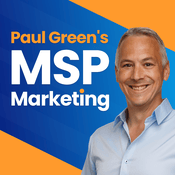
About Paul Green's MSP Marketing Podcast
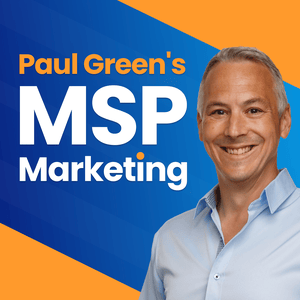
Welcome to Paul Green's MSP Marketing Podcast. If you're a Managed Service Provider (MSP) and want to improve your marketing & grow your business, this is the show for you. It's out every Tuesday on your favorite podcast platform.
Since launching in 2019, this has become the world's most listened to podcast about MSP marketing. Host Paul Green is the world's go to MSP marketing expert, and the founder of the MSP Marketing Edge.
Every week you'll get really smart ideas to improve your marketing. Plus you'll hear from the best guests, who will help you think differently about the way you attract new clients.
You can easily email and chat to the host Paul Green, who answers MSP's marketing questions every week. And there are versions of the podcast on YouTube if you want the full video experience.
Paul and his team at the MSP Marketing Edge say their mission for the podcast is to give you practical insights and expert advice to boost your business performance. They provide strategies to help you get more clients, increase your Monthly Recurring Revenue (MRR), and grow your net profit. They know that profitability is crucial, and we're here to help you succeed financially.
Running an MSP can feel lonely. If you ever feel lost or overwhelmed, this podcast is for you. Each week it covers key topics for MSPs, offering specific, practical advice tailored to the channel. You will learn effective marketing techniques to attract new clients and grow your business consistently and profitably.
Marketing an MSP involves many strategies, from digital marketing to traditional networking meetings. Paul's podcast explores all avenues to help you reach your target audience. The weekly episodes discuss creating compelling marketing materials, using social media effectively, and optimizing your website for search engines.
Every episode features special guests, including industry veterans and successful MSP owners, who share valuable insights and real-world experiences. These interviews provide inspiration and practical tips you can apply to your business.
Paul Green often talks with successful MSPs about how they are growing their businesses, sharing actionable tips and strategies. The discussions cover finding new clients, increasing revenue, and building service consistency to give you a competitive edge.
They also address day-to-day business aspects like recruitment, leadership, and financial management. The goal is to equip you with the knowledge and tools to run your business efficiently and profitably. Topics include attracting and retaining top talent, creating a positive workplace culture, and motivating your team.
Business growth is a central theme. In the podcast you'll hear strategies for scaling your business, expanding services, and entering new markets. Paul and his guests discuss the challenges and opportunities of growth, providing practical advice to overcome obstacles and seize opportunities.
Innovation is another key topic. Discuss the latest trends in the MSP industry and how to leverage them to your advantage. Topics include digital transformation, cybersecurity, and cloud computing, helping you stay competitive.
Though based in the UK, Paul's content is relevant globally. MSP challenges are similar worldwide, and his advice addresses these common issues, regardless of your location.
The MSP Marketing podcast offers in-depth discussions about the channel and MSP industry, providing actionable insights and practical advice. Listen each week for expert advice, practical strategies, and insights from industry leaders. Whether you're looking to boost your client base, optimize operations, or increase profitability, the MSP Marketing Podcast supports your journey to success.
About Paul Green
Paul encourages listener interaction and values your feedback and suggestions. Connect with him through the website, social media, and email to share your thoughts and ideas.
Paul Green is a le
Podcast websiteListen to Paul Green's MSP Marketing Podcast, James Reed: all about business and many other podcasts from around the world with the radio.net app
Get the free radio.net app
- Stations and podcasts to bookmark
- Stream via Wi-Fi or Bluetooth
- Supports Carplay & Android Auto
- Many other app features
Get the free radio.net app
- Stations and podcasts to bookmark
- Stream via Wi-Fi or Bluetooth
- Supports Carplay & Android Auto
- Many other app features

Paul Green's MSP Marketing Podcast
Scan code,
download the app,
start listening.
download the app,
start listening.
 UK
UK